Connect with us

Methanol

China: Zhejiang’s first inland methanol-powered boxship completes trial voyage

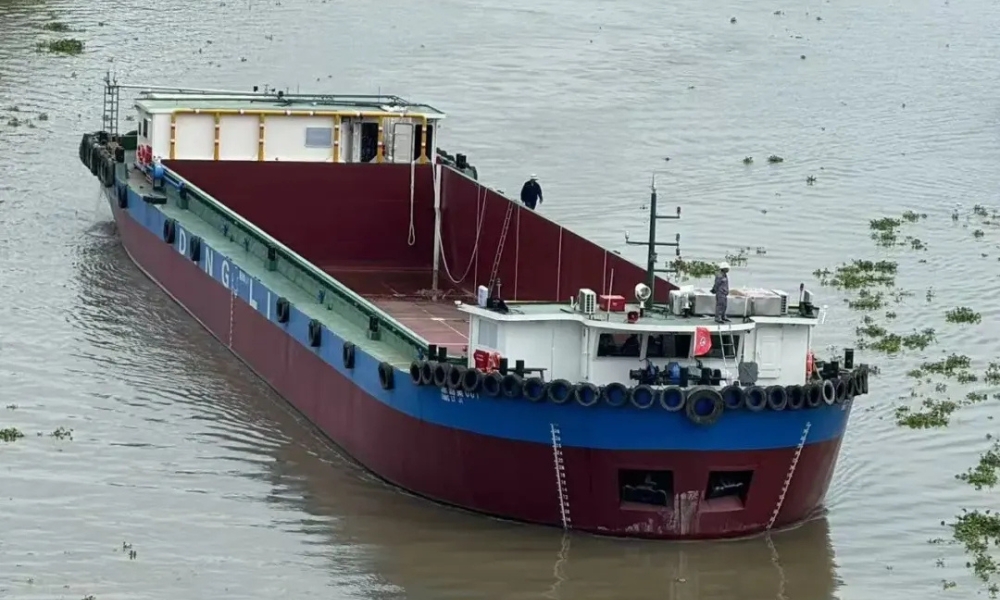
The 64-TEU new container vessel, “Ding Li Ji 001”, departed from the Zhebei Shipyard in Guangchen Town, Pinghu City on 22 July for trial operation.

Admin

Published

on

China: Zhejiang's first inland methanol-powered boxship completes trial voyage

Haining Communications, a government entity of Haining City, on Monday (27 July) said Zhejiang Province’s first inland methanol-powered container vessel has completed its trial operations, marking a milestone in the province’s adoption of methanol as a clean marine fuel for inland shipping.

The 64-TEU new container vessel, Ding Li Ji 001, departed from the Jiaxing Zhebei Shipbuilding’s shipyard in Guangchen Town, Pinghu City on 22 July for trial operations along the Hangzhou-Pinghu-Shenjia section of the Beijing-Hangzhou Grand Canal.

During the trials, engineers conducted comprehensive testing and verification of the vessel’s propulsion and manoeuvring performance, methanol fuel supply system, and onboard safety systems, validating both the safety of the vessel’s design and its operational suitability for inland waterways.

Jiaxing Zhebei Shipbuilding said the achievement marks a new stage in the application of methanol as a clean energy source for inland shipping and supports Zhejiang’s broader green and low-carbon shipping transition under its “Shipping Zhejiang” initiative.

The vessel measures 64.9 metres in length with a beam of 12.6 metres and a moulded depth of 3.5 metres. It has a designed service speed of 15.62 km/h and is certified to carry 64 TEU with a maximum cargo capacity of 1,883 tonnes, enabling it to serve bulk cargo transport on major inland waterways.

Powered by two dedicated 180-kW methanol engines, the vessel is equipped with a 10-cubic-metre methanol storage tank, providing a cruising range of up to 1,000 kilometres on a full tank. The design aims to address limitations associated with battery-electric vessels, particularly restricted range and charging infrastructure for long-distance inland transport.

Unlike conventional diesel-powered vessels, Ding Li Ji 001 employs direct methanol propulsion, using methanol as the primary fuel rather than traditional marine diesel.


Photo credit: Jiaxing Zhebei Shipbuilding
Published: 29 July, 2026

Continue Reading

Bunker Fuel

Port of Rotterdam publishes bunker fuel sales data for Q2 2026

Ethanol as a bunker fuel was reported in Rotterdam for the first time with 1,025 mt delivered in Q2 2026, following an ethanol-methanol blend bunkering operation of container vessel Eco Levant in May.

Admin

Published

on

By

RESIZED port of rotterdam

The Port of Rotterdam Authority recently published bunker fuel sales data for the second quarter (Q2) of 2026.

Deliveries of ultra low sulphur fuel oil, very low sulphur fuel oil, high sulphur fuel oil, marine gas oil and marine diesel oil in Q2 2026 (against on year) recorded respectively 123,190 metric tonnes (mt) (+33%  from 162,142 mt), 354,448 mt (-9.1% from 439,804 mt), 704,637 mt (+10.9% from 619,010 mt), 266,570(+18% from 273,696 mt), 64,777 mt (-8.2% from 86,821 mt). 

Bio-blended variants of ultra low sulphur fuel oil, very low sulphur fuel oil, high sulphur fuel oil, marine gas oil and marine diesel oil in Q2 2026 (against on year) recorded respectively 22,032 mt (-28.3% from  24,573 mt), 144,665 mt (-57% from 68,271 mt), 30,191 mt (+15.3% from 38,490 mt), 34,574 mt (+627.7% from 31,663 mt) and 8,413 mt (-30.2% from 2,223 mt).

Port data showed 273,021 m3 of liquefied natural gas (LNG) being delivered as a marine fuel in Q2 2026, down by 17.4% from 207,658 m3 in Q2 2025. Bio-methanol and bio-blended LNG recorded 2,845 mt and 7,506 m3 respectively in Q2 2026.

Ethanol as a bunker fuel was reported in Rotterdam for the first time with 1,025 mt delivered in Q2 2026,  following an ethanol-methanol blend bunkering operation of container vessel Eco Levant in May.

Manifold Times previously reported Evos Rotterdam holding a ground-breaking ceremony for its methanol and ethanol expansion project at the Port of Rotterdam, formally starting the construction phase of a major investment in additional terminal capacity.

Once operational in early 2028, the expansion will give Evos Rotterdam greater capacity to handle methanol and ethanol for industrial customers, as well as for the developing market in cleaner, low-carbon marine fuels and bunkering.

Shipping giant A.P. Moller – Maersk (Maersk) recently announced a new milestone in its marine fuel trials, with its dual-fuel feeder vessel Laura Maersk successfully operating on 100% ethanol for a second time.

The latest trial marked a significant step forward from earlier tests, as the vessel was supplied through a larger-scale bunkering operation conducted by barge in Rotterdam.

Related: X-Press Feeders, METHANAVE complete first ethanol-methanol bunkering op in Rotterdam
Related: Maersk advances ethanol fuel trials with larger-scale Rotterdam bunkering


Photo credit: Port of Rotterdam
Published: 29 July, 2026

Continue Reading

Methanol

Tsuneishi Solutions Tokyobay delivers first methanol fuel supply system for bulker

The LFSS is the first unit of T-SOL’s proprietary LFSS developed in-house and will be installed on a Kamsarmax bulk carrier, marking its first application on an actual vessel following a ClassNK AiP.

Admin

Published

on

By

Tsuneishi Solutions Tokyobay delivers first methanol fuel supply system for bulker

Tsuneishi Solutions Tokyobay (T-SOL) on Friday (24 July) said it delivered the first Low-flashpoint Fuel (MeOH) Supply System (LFSS) for medium- and low-speed diesel engines at the end of May 2026. 

The LFSS received Approval in Principle (AiP) from ClassNK in April 2024. It is the first unit of T-SOL’s proprietary LFSS developed in-house and will be installed on a Kamsarmax bulk carrier, marking its first application on an actual vessel following the AiP granted by ClassNK.

An LFSS is designed to safely and reliably supply alternative fuels with low flashpoints, such as methanol, to a vessel’s main engine.

The LFSS delivered by T-SOL has been developed specifically for medium- and low-speed diesel engines and features a simple and compact design in terms of its main components, dimensions and weight. The system is equipped with key components manufactured by Japanese suppliers, enabling the provision of instruction manuals in Japanese as well as prompt and flexible responses to customer enquiries.

As the LFSS is assembled in Japan, customers adopting T-SOL’s LFSS are not required to attend Factory Acceptance Tests (FAT) overseas or arrange for engineers from overseas equipment manufacturers to travel to Japan, thereby helping reduce both costs and operational burdens for customers. T-SOL also provides on-site technical support during commissioning and testing.

With the tightening and introduction of environmental regulations, marine fuels are entering a period of transition from heavy fuel oil to alternative fuels, including methanol. 

“The transition requires new expertise and considerable time for technical evaluation, increasing the burden on customers. Drawing on the expertise of its experienced engineers, T-SOL provides comprehensive support throughout each customer’s transition to alternative fuels,” the company said. 

Following the delivery of its first LFSS, T-SOL will continue to work to ensure a stable supply of LFSS units while advancing the research and development of technologies that contribute to greenhouse gas (GHG) emissions reduction, including engineering solutions for other alternative fuels. 


Photo credit: Tsuneishi Solutions Tokyobay
Published: 27 July, 2026

Continue Reading

Wind-assisted

Fairfield Maritime Japan, Neste ink charter deal for WAPS-equipped MR tanker duo

Vessels will utilise low-sulphur fuels and will be capable of being retrofitted to operate on methanol at some point in the future.

Admin

Published

on

By

RESIZED scott graham

Fairfield Maritime Japan (FMJ) on Wednesday (22 July) said it has signed a long-term charter contract with Neste for two vessels. 

The agreement enables FMJ to fund and manage the construction of two Ice Class 1A medium range (MR) oil and chemical tankers for Neste’s transports to and from its refinery in Porvoo, Finland. Neste is a producer of renewable diesel and sustainable aviation fuel (SAF), also refining a wide range of oil products in Porvoo. 

Fairfield Maritime Japan Ltd. is a portfolio company of Fairfield-Maxwell Ltd., a family office for the Sugahara family headquartered in New York City.

The two new ships will each have the capacity to ship 50,000 deadweight tons (DWT) and will be built by HD Hyundai Co., Ltd. of South Korea and delivered in the first and second quarters of 2029.

As Ice Class 1A certified ships, the two new vessels will be capable of navigating in ice conditions with the support of icebreakers, adhering to the Finnish Swedish Ice Class Rules.

These rules encompass the specific requirements for vessels navigating the Baltic Sea during the winter season. The highly ice-resistant ships will be able to approach and depart Porvoo in the winter months, contributing to operational continuity for Neste’s Porvoo facility.

The vessels will utilise low-sulphur fuels and will be capable of being retrofitted to operate on methanol at some point in the future. 

The vessels will be ready for the future with the possibility to connect to shore power when that is available. In addition, the ships will be equipped with wind-assisted propulsion systems (WAPS) to supplement the ships’ main engines. These technologies will reduce fuel consumption, emissions and operating costs.

“We’re pleased to partner with Fairfield Maritime Japan and Fairfield-Maxwell. With these new state-of-the-art vessels, we are continuing our efforts to deliver safe and efficient sea transport to and from our Porvoo refinery,” said Sander Wilgenhof, Head of Chartering, Neste.

“We are proud to be Neste’s long-term partner,” said Ryuichi Osonoe, President, Fairfield Maritime Japan. 

“We believe that our knowledge and expertise will significantly assist Neste in its sea transportation. We are looking forward to seeing these two new ships cross the sea to safely export out of Neste’s Porvoo refinery.”

“Fairfield has been a partner of choice for world-class shippers for nearly 70 years,” said Byron Sugahara, chairman of the board of Fairfield-Maxwell. 

“This agreement with Neste is  confirmation that our family’s legacy in the shipping industry remains strong and provides a solid foundation for continued growth and success.”


Photo credit: Scott Graham
Published: 24 July, 2026

Continue Reading

Trending