Connect with us

Business

Argus Media: Japan studies options to cut coastal shipping emissions

Japan is examining options on Thursday (July 1) to cut carbon dioxide (CO2) emissions from coastal shipping, as it considers raising an emissions target for the industry in line with the country’s more ambitious 46pc reduction target for 2030 on 2013 levels.

Admin

Published

on

5e16c2fc7aa8e 1578550012

Rieko Suda of global energy and commodity price reporting agency Argus Media on Thursday (1 July) published a report highlighting Japan’s plan to cut emissions of coastal vessels:

Japan is examining options  on Thursday (July 1) to cut carbon dioxide (CO2) emissions from coastal shipping, as it considers raising an emissions target for the industry in line with the country’s more ambitious 46pc reduction target for 2030 on 2013 levels.

The transport ministry is discussing presenting a decarbonisation roadmap later this year for the country’s coastal shipping industry, which handles 40pc of domestic freight transport, as it seeks to revise the industry’s 2030 emissions reduction target to 17pc compared with 15pc previously.

The ministry is working out a separate policy for coastal shipping because of its structural problems that could hinder capital investment in greener operations, as the industry is dominated by small enterprises with limited working capital.

Around 4,000 operators and shipowners operated 7,400 coastal vessels, 70pc of which were past their 14-year service life, during the April 2018-March 2019 fiscal year.

This contrasts with the international shipping industry where 200 firms operated 2,600 ocean-going vessels.

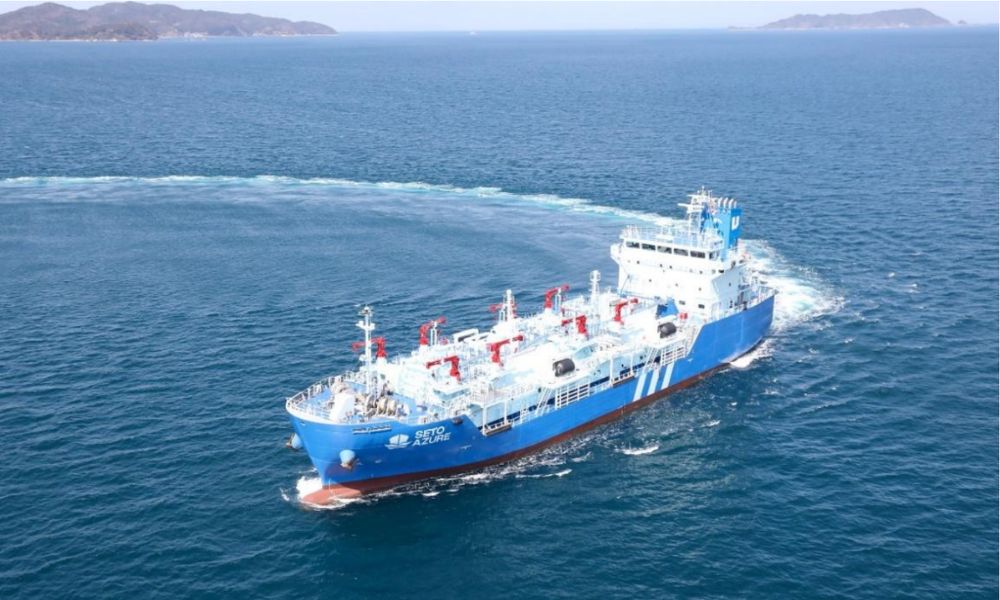
The transport ministry is considering exploring next-generation vessels for coastal shipping, such as battery-operated and hydrogen fuel cell ships, along with LNG-fuelled ships, to reduce emissions and work towards decarbonisation.

The introduction of such ships is expected to be mostly limited to domestic shipping routes where infrastructure is sufficient until 2030, according to the ministry.

Japan has developed LNG bunkering infrastructure at key domestic ports since the 2015 launch of the country’s first LNG-fuelled ship Sakigake by shipping firm NYK Line.

Rival shipping firm Mitsui OSK Lines last year launched the LNG-fuelled coastal bulk carrier Is Mirai in central Japan’s Ise bay where LNG bunkering infrastructure has been set up.

The existing hydrogen pipeline at Yokohama-Kawasaki port has attracted a proposed pilot operation of a hydrogen-powered fuel cell passenger ferry from 2024.

More projects are in the pipeline for hydrogen-powered ships in efforts to take advantage of proposed hydrogen infrastructure at Kobe in west Japan, Chita and Yokkaichi in central Japan and Hibikinada in south Japan.

The existing hydrogen pipeline at Yokohama-Kawasaki port has attracted a proposed pilot operation of a hydrogen-powered fuel cell passenger ferry from 2024.

More projects are in the pipeline for hydrogen-powered ships in efforts to take advantage of proposed hydrogen infrastructure at Kobe in west Japan, Chita and Yokkaichi in central Japan and Hibikinada in south Japan.

The coastal shipping industry has also made some progress in its shift to all-electric vessels particularly for small size, short-distance shipping.

Shipping firm NS United in 2019 launched a hybrid coastal bulk carrier that can run on a diesel engine or lithium-ion batteries. Shipbuilder Oshima Shipbuilding in 2019 commissioned a battery-powered electric passenger ship.

Coastal Expansion

The transport ministry expects use of greener ships will be expanded for coastal shipping after 2030 with further development of domestic supply infrastructure expected for carbon-neutral marine fuels, such as hydrogen, ammonia and synthetic fuels.

This is in line with Tokyo’s target to commercially deploy its first-generation zero-emissions vessels before 2028.

Tokyo is considering providing financial support for development of hydrogen- and ammonia-fuelled vessels, along with fuel supply infrastructure.

The transport ministry is also planning to continue pursuing energy efficiency in coastal shipping by launching next-generation vessels, including those with hybrid marine propulsion systems.

Such conventional fuel-efficient ships can be refitted with rechargeable batteries or hydrogen fuel cell batteries, or converted to be fueled with synthetic fuels after 2030 to achieve carbon neutrality.

It is also looking to improve efficient shipping operations, such as weather routing and use of onshore power to reduce emissions when moored at ports.

The ministry last year enforced a revised efficiency rating programme for coastal ships, targeting to help the industry enhance the fuel efficiency of their vessels.

A total of 43 coastal ships have so far been awarded the highest efficiency ranking, including three LNG-fuelled vessels.


Photo credit: Argus Media
Published: July 2,2021


Continue Reading

Legal

Singapore withdraws remaining 127 charges against Hin Leong founder OK Lim

Lim Oon Kuin, also known as OK Lim, was issued a stern warning and a district court granted him a discharge amounting to an acquittal for these charges on 17 July.

Admin

Published

on

By

RESIZED Sora Shimazaki on Pexels

Founder of collapsed oil trader Hin Leong Trading, Lim Oon Kuin, also known as OK Lim, has had the remaining 127 charges against him withdrawn, according to The Straits Times on Monday (20 July). 

OK Lim was issued a stern warning and a district court granted him a discharge amounting to an acquittal for these charges, including those for cheating, on 17 July. The discharge means Lim cannot be prosecuted again for the same offences.

Lim, 84, is currently serving a 13½-year prison sentence after the High Court reduced his original 17½-year jail term in March 2026. He was convicted in 2024 on two cheating charges and one count of abetting forgery in a case prosecutors described as one of Singapore’s most serious trade finance frauds.

Lim was convicted in May 2024 of two charges of cheating the Hongkong and Shanghai Banking Corporation (HSBC) and one count of abetting forgery that proceeded to trial out of a total of 130 criminal charges.

He was first charged in court on 14 August 2020, and was subsequently handed further charges in court on 25 September 2020, 30 April 2021 and 24 June 2021 for his role in perpetuating fraud on various financial institutions. 

A total of 130 charges were eventually brought against him for cheating and forgery-related offences.

Related: Singapore: Hin Leong Founder OK Lim gets jail term slashed to 13.5 years


Photo credit: Sora Shimazaki
Published: 21 July, 2026

Continue Reading

Winding up

Singapore: Coastal Logistics Pte Ltd to be wound up voluntarily

Coastal Logistics was reportedly affiliated with troubled Singapore bunker player Coastal Oil (Singapore) Pte Ltd.

Admin

Published

on

By

RESIZED Drew Beamer

Several resolutions for Coastal Logistics Pte Ltd were made during an extraordinary general meeting held on 14 July, according to a notice in the Government Gazette on Friday (4 July).

The following resolutions were duly passed during the meeting:

As Special Resolution

  • That it has been proved to the satisfaction of the meeting that the Company cannot by reason of its liabilities continue its business and accordingly the Company be wound up voluntarily pursuant to Section 160(1)(b) of the Insolvency, Restructuring and Dissolution Act 2018 (No. 40 of 2018);

As Ordinary Resolutions

  • that Mr. Wong Pheng Cheong Martin and Ms. Koay May Yee, both care of FTI Consulting (Singapore) Pte Ltd, One Raffles Quay, #27-10 South Tower, Singapore 048583 be appointed as the joint and several Liquidators of the Company for the purpose of such winding up; and
  • that the Liquidators be at liberty to open, maintain and operate any bank account(s) or account(s) for monies received by them as Liquidators with such bank(s) as they deem fit; and
  • that a Committee of Inspection will not be formed.

Manifold Times previously reported Nicholas James Gronow, director of Heng Tong Fuels & Shipping and Coastal Logistics, filed statutory declarations for both companies stating the firms cannot continue their businesses due to liabilities.

Both companies were reportedly affiliated with troubled Singapore bunker player Coastal Oil (Singapore) Pte Ltd. 

In 2019, several vessels owned by both firms entered the sale & purchase (S&P) market in Singapore.

Related: Singapore: Director declares Heng Tong Fuels & Shipping’s inability to continue business
Related: Heng Tong Fuels & Shipping in court over DBS Bank bunker tanker loan
Related: Singapore: Bunker tanker “Coastal Neptune” arrested
Related: Heng Tong Fuels & Shipping, Coastal Logistics tankers enter S&P market


Photo credit: Drew Beamer
Published: 21 July, 2026

Continue Reading

LNG Bunkering

PIL’s LNG dual-fuel boxship “Kota Elok” arrives in Singapore on maiden call

As the first of 13 new 13,000 TEU vessels joining its fleet, Kota Elok is equipped to operate on LNG and low-sulphur fuel oil that helps reduce our greenhouse gas emissions.

Admin

Published

on

By

PIL's LNG dual-fuel boxship “Kota Elok” arrives in Singapore on maiden call

Singapore-based Pacific International Lines Pte Ltd on Monday (20 July) said its first 13,000 TEU LNG dual-fuel container vessel, Kota Elok, recently made her maiden call to Singapore on 15 July.

As the first of 13 new 13,000 TEU vessels joining its fleet, Kota Elok is equipped to operate on liquefied natural gas (LNG) and low-sulphur fuel oil that helps reduce our greenhouse gas emissions. 

The vessel also incorporated energy-saving features and digital technologies to reduce fuel consumption and enhance operational performance, as well as a bow windshield to improve aerodynamics, contributing to improved fuel efficiency and lower emissions over the course of long-haul voyages.

“Following Singapore, Kota Elok will continue her voyage on our East Coast Service 1 (ES1) route to South America, calling at ports in Brazil, Uruguay, and Argentina before returning to Asia,” the company said in a social media post. 

Kota Elok also became PIL’s first vessel to receive Lloyd’s Register certification for compliance with the IACS UR E26 and UR E27 cyber security requirements.

Developed by the International Association of Classification Societies (IACS), UR E26 and UR E27 are mandatory cyber resilience requirements for newbuild vessels contracted from 1 July 2024. 


Photo credit: Pacific International Lines
Published: 21 July, 2026

Continue Reading

Trending