Connect with us
DNV Decarbonization Insight Series August 2026 - What maritime professionals should know about AI Training

Bunker Fuel Availability

ENGINE: East of Suez Fuel Availability Outlook (25 August 2026)

VLSFO availability tight in Singapore; typhoon- induced bad weather keeps bunkering halted in Zhoushan’s outer anchorages; bunker demand picks up across South Korean ports.

Admin

Published

on

RESIZED ENGINE East of Suez

The following article regarding regional bunker fuel availability outlook for the East of Suez region has been provided by online marine fuels procurement platform ENGINE for publication on Singapore bunkering publication Manifold Times:

  • VLSFO availability tight in Singapore
  • Typhoon- induced bad weather keeps bunkering halted in Zhoushan’s outer anchorages
  • Bunker demand picks up across South Korean ports

Singapore and Malaysia

Singapore’s VLSFO availability remains tight, with lead times varying significantly among suppliers. Some recommend around seven days, while others advise much longer lead times of up to 19 days. This compares with last week’s lead times of 7-13 days. A source attributed the tightening availability to reduced supply among suppliers and shortages of blending components.

HSFO lead times are currently at 6-12 days, broadly unchanged from 6-13 days last week. LSMGO availability, meanwhile, has tightened, with lead times increasing to 4-9 days from 2-8 days a week earlier.

Singapore’s residual fuel oil stocks have averaged 3% lower so far this month compared with July. Fuel oil inventories at the port have fallen below 19 million bbls so far in August, while middle distillate stocks have averaged 5% lower so far this month, Enterprise Singapore’s latest data shows.

In Malaysia’s Port Klang, bunker supply also remains constrained. Prompt VLSFO availability is tight, LSMGO supply remains limited and HSFO continues to face pressure.

East Asia

VLSFO availability in Zhoushan remains constrained despite subdued bunker demand, with suppliers now recommending lead times of around 10 days, compared with 7-10 days a week earlier. Lead times for LSMGO and HSFO have also extended to around 10 days, from 7-10 days previously.

The tightness is largely a lingering impact of the two-week suspension of bunkering operations in Zhoushan following Typhoon Dolphin, which created significant backlogs. The situation could persist, as bunkering at the port’s outer anchorages, Tiaozhoumen and Xiazhimen, has been suspended again since the weekend amid rough weather triggered by three successive cyclones, a source said.

China’s meteorological authorities on Tuesday raised the typhoon alert from yellow to orange, the second-highest level in the country’s four-tier warning system, as two typhoons are forecast to make landfall in the coming days. Typhoon Narra is expected to hit China between late Tuesday night and Wednesday, while Typhoon Saudel could make landfall between late Thursday night and Friday morning, according to the National Meteorological Center (NMC).

There is currently no clear timeline for the resumption of operations at the affected anchorages, the source added.

Bunker supply conditions remain mixed across northern China. Dalian and Qingdao have adequate VLSFO and LSMGO availability, although HSFO remains tight in Qingdao. Tianjin is facing constraints across all three major fuel grades, while Shanghai continues to have limited VLSFO and HSFO supply. LSMGO availability in Shanghai remains relatively stable.

Supply is also tight in southern China. Fuzhou continues to face shortages of VLSFO and LSMGO, while Xiamen has sufficient VLSFO but limited prompt LSMGO availability. Both VLSFO and LSMGO remain constrained in Yangpu and Guangzhou.

Hong Kong’s bunker market is largely unchanged, with suppliers continuing to advise lead times of around seven days for all major fuel grades.

In Taiwan, VLSFO and LSMGO can currently be supplied in around three days at Hualien and Keelung, slightly longer than the roughly two days required last week. Kaohsiung’s lead times have also increased to 3-4 days from around two days previously.

Local authorities in Kaohsiung and Hualien declared 24 August a day off because of adverse weather linked to the typhoons. Weather conditions have since improved, however, and bunkering operations have returned to normal, according to a Taiwan-based source.

Bunker demand has strengthened across South Korean ports as poor weather and operational disruptions in Chinese ports, particularly Zhoushan, have diverted buyers towards South Korea, a South Korean trader said.

Lead times at southern ports including Busan, Ulsan, Masan, Onsan, Yeosu and Kwangyang have widened to 4-11 days from 4-6 days a week ago.

The same trend is evident at western ports such as Incheon, Daesan, Dangjin, Pyeongtaek and Taean. Lead times for VLSFO, LSMGO and HSFO now stand at 4-11 days, compared with around five days previously.

Weather-related disruptions are expected to affect bunkering operations at Daesan, Ulsan and Yeosu on 26-28 August and again on 1-3 September. Daesan is also expected to face weather-related disruptions on 1-3 September.

Supply conditions in Japan remain severely constrained heading into September. All major refineries are currently restricting ex-wharf cargo releases after unusually competitive pricing last month triggered a sharp surge in demand and depleted nationwide availability, a Japan-based trader said.

Refineries and suppliers are now negotiating September wholesale prices and allocated volumes. The situation is particularly critical in western Japan, where both cargo and barge availability are severely limited.

Given the tight supply environment, responses to indications and availability enquiries are currently strictly indicative and remain subject to further confirmation, the source added.

Limited VLSFO, LSMGO and HSFO availability is being reported across major bunkering hubs including Tokyo, Chiba, Kawasaki, Nagoya, Yokkaichi, Osaka, Kobe, Mizushima, Tokuyama and Oita. Kashima is also experiencing constrained VLSFO and HSFO supply.

In Tokyo, Chiba and Kawasaki, the earliest delivery windows for VLSFO and HSFO are currently around eight days.

Oceania

VLSFO availability remains stable across Western Australia, with suppliers in Kwinana and Fremantle recommending lead times of around seven days. Both ports depend on a single supplier, while all bunker deliveries are carried out by barge.

Supply conditions are more mixed along Australia’s east coast. In Port Kembla, VLSFO can be delivered by either truck or pipeline, while Sydney has sufficient stocks of both VLSFO and LSMGO. HSFO availability in Sydney is comparatively tighter, with suppliers generally advising lead times of around seven days.

In Queensland, VLSFO and LSMGO remain readily available in Brisbane and Gladstone, with delivery windows holding at approximately one week.

Further south, VLSFO inventories in Melbourne and Geelong remain comfortable. However, both ports rely on a single bunker barge, keeping recommended lead times at around seven days. HSFO availability has tightened further in both Melbourne and Brisbane.

Separately, one supplier is offering all three major bunker grades in Brisbane, Sydney and Melbourne, with lead times of roughly five days.

In Western Australia, pipeline-based bunker deliveries at Dampier Cargo Wharf (DCW) remain suspended until around the end of September as repair work continues. Limited truck deliveries are still available, subject to vessel size. During the disruption, the supplier has designated the Toll Supply Base (TSB) in Dampier as the preferred location for bunker operations, according to a source.

Across the Tasman, bunker availability in New Zealand remains broadly unchanged. VLSFO is readily available in Tauranga and Auckland, where suppliers are recommending lead times of around four days. At Marsden Point, both VLSFO and LSMGO can be delivered directly to vessels through pipelines.

Weather remains the key operational risk in New Zealand, with bunker deliveries in Wellington and ports across the South Island particularly susceptible to delays during periods of adverse conditions.

South Asia

Adverse weather is expected to disrupt bunker operations at several Indian ports over the coming days. Sikka, Kandla and Visakhapatnam could experience operational interruptions between 27-29 August, while rough sea conditions are likely to hamper bunkering activities in Mumbai, Cochin and Visakhapatnam from 25-29 August.

In Sri Lanka, bunker availability remains good across all major fuel grades in Colombo and Trincomalee. However, intermittent weather-related disruptions are forecast at both ports between 25-29 August, increasing the risk of delays to bunker deliveries.

Middle East

Renewed tensions between the US and Iran around the Strait of Hormuz continue to constrain bunker fuel supply in Fujairah. Availability of VLSFO and LSMGO remains tight and broadly unchanged from last week, with only a limited number of suppliers able to offer LSMGO. HSFO supply is also restricted.

Supply conditions are more comfortable in nearby Khor Fakkan, where VLSFO and HSFO remain readily available. Despite the heightened regional tensions, bunker demand has picked up at both Fujairah and Khor Fakkan, according to a Middle East-based source.

In Saudi Arabia, VLSFO and LSMGO availability in Jeddah remains steady despite firmer demand. However, adverse weather could intermittently disrupt bunkering operations in Jeddah on 25 August and in Yanbu between 25-27 August.

Bunker supply remains constrained at Qatar’s Ras Laffan, where both VLSFO and LSMGO availability continues to be limited.

“Operations are currently ongoing across the Middle Eastern ports,” an Oman-based trader said.

Across Oman’s key bunkering hubs — Salalah, Muscat, Duqm and Sohar — LSMGO availability remains stable, with suppliers generally recommending lead times of 2-3 days, depending on the port and nomination. However, adverse weather forecast in Salalah between 25-29 August could temporarily disrupt bunker operations, according to a source.

Egyptian ports remain fully operational, although bunker inventories at Port Suez are critically low across all three conventional fuel grades.

Further south, availability of all major bunker fuel grades remains limited in Djibouti.

By Tuhin Roy


Photo credit and source: ENGINE
Published: 26 August, 2026

Continue Reading

Bunker Fuel

Baltic Exchange: Bunker Report (27 August 2026)

Bunker report panellists include Island Oil Limited, Cockett Marine Oil Pte, Monjasa A/S, KPI OceanConnect, NSI Marine and Transparensea Fuels.

Admin

Published

on

By

Baltic Exchange logo

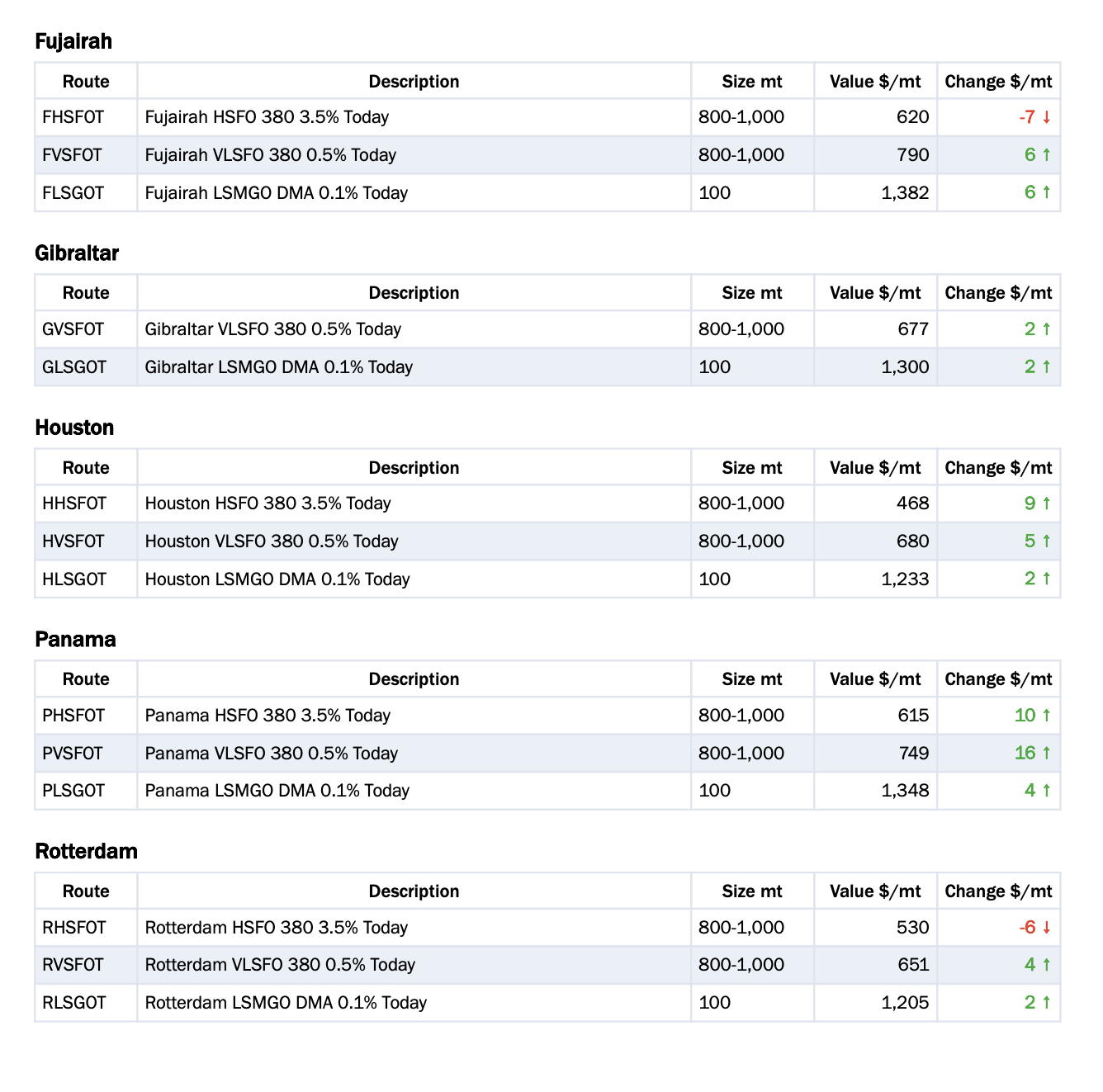
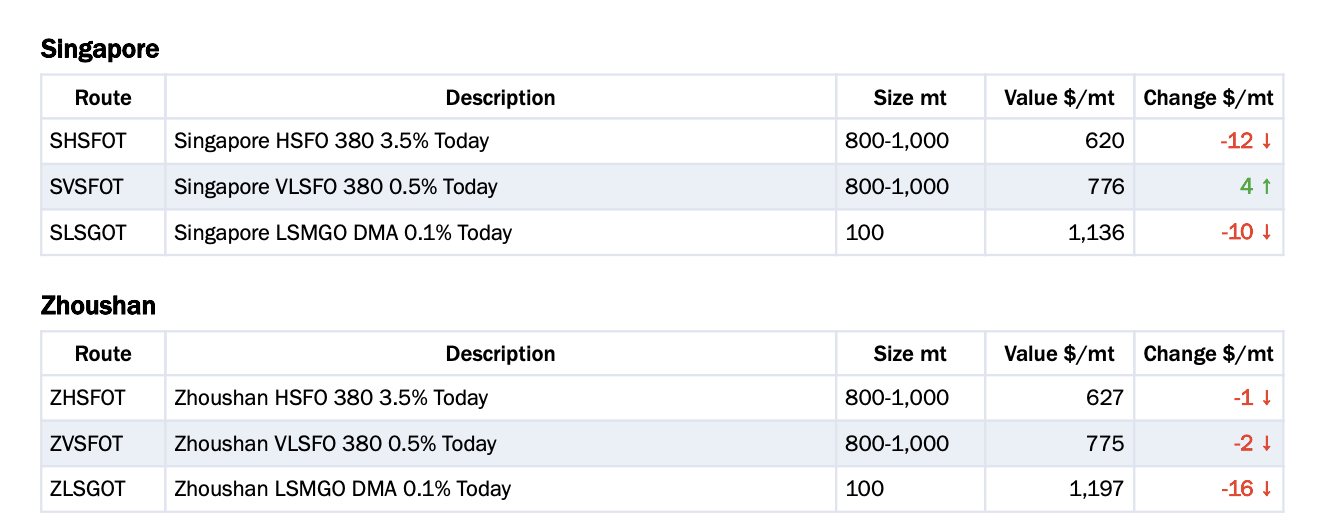
The following bunker report has been provided by freight market information provider Baltic Exchange for post on Singapore bunkering publication Manifold Times:

Screenshot 2026 08 28 at 1.25.59 PM

Screenshot 2026 08 28 at 1.26.15 PM

All values are in US$/metric ton, all-in (invoice price), delivered on board
Delivery in 7-10 days
ISO 8217:2010
IFO 380 3.5% Sulphur
IFO 380 0.5% Sulphur
DMA 0.1% Sulphur

Fujairah – Offshore Anchorage Area
Gibraltar – Anchorage area
Houston – Houston Harbor
Panama – (Pacific) dangerous cargo area, Balboa
Rotterdam – Waalhaven Maasvlakte range
Singapore – Anchorage, under SBA Scheme
Zhoushan – Southern anchorage area

Submitted weekly at Close of Business UK time Daily

Panellists:
Cockett Marine Oil Pte, Island Oil Limited, KPI OceanConnect, Monjasa A/S, NSI Marine and Transparensea Fuels


Photo credit and source: Baltic Exchange
Published: 28 August, 2026
Continue Reading

Bunker Fuel

ENGINE: Americas Fuel Availability Outlook (27 August 2026)

VLSFO and LSMGO tight at West Coast; Panama records healthy bunker demand; HSFO tight in Callao.

Admin

Published

on

By

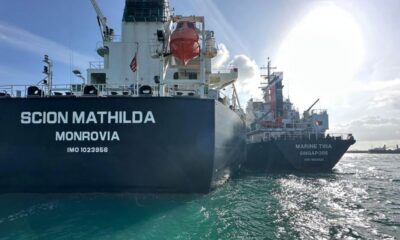
RESIZED ENGINE Americas

The following article regarding bunker fuel availability in the Americas region has been provided by online marine fuel procurement platform ENGINE for post on Singapore bunkering publication Manifold Times:

  • VLSFO and LSMGO tight at West Coast
  • Panama records healthy bunker demand
  • HSFO tight in Callao

North America

Bunker fuel demand is steady in Houston, and fuel availability at the port is normal. VLSFO and LSMGO can be delivered within lead times of 4–5 days.

“In Houston, around five days’ lead time is advisable for VLSFO and LSMGO. Shorter lead times are possible, but suppliers are then limited and prices tend to be less competitive,” a bunker trader told ENGINE.

HSFO is a bit tight at the port, and suppliers are recommending at least 7 days of lead time for deliveries.

Weather conditions are normal and port operations are running normally.

In New Orleans, Louisiana (NOLA), all three fuel grades are available, with a recommended lead time of 6–7 days amid steady demand. The shortest time in which HSFO and VLSFO can be delivered in NOLA is under 5 days.

In Bolivar Roads, VLSFO and LSMGO can be delivered within lead times of 7–8 days, a source said.

Availability is okay at the Galveston Offshore Lightering Area (GOLA), where suppliers can offer HSFO and LSMGO with lead times of 3–4 days. VLSFO is also available at the anchorage but requires a longer lead time of around 5–6 days.

With hurricane season ongoing, a rough patch of weather can be expected, a source said.

In New York, bunker fuel demand is normal, and availability is good for all three grades. Lead times for HSFO have come down this week, with suppliers now recommending anywhere between 3–7 days.

VLSFO and LSMGO can also be supplied within the same lead times at the port.

On the West Coast, bunker demand has been strong in Los Angeles and Long Beach this week, a source said.

VLSFO and LSMGO availability is tight at both ports, with lead times ranging from more than a week to 10 days. HSFO availability is relatively better, but suppliers would require at least a week’s notice, a trader said.

Vancouver’s bunker availability is steady, with HSFO available within 5–7 days, while VLSFO and LSMGO require around 6–8 days’ lead time.

Latin America and the Caribbean

In Panama, bunker fuel demand has seen a slight uptick compared to the previous week, and availability is good at both Balboa and Cristobal.

“Panama, in particular, has been busier than in prior weeks. HSFO supply is tighter, so I’d definitely recommend allowing for more lead time there,” a source said.

VLSFO and LSMGO can both be supplied within 3–6 days. HSFO requires longer lead times of 7–8 days. The shortest time within which two suppliers can deliver VLSFO at Balboa is 1–2 days.

VLSFO and LSMGO remain readily available across Colombia’s Cartagena, Santa Marta, and Barranquilla, with prompt delivery windows of 3–4 days.

In Freeport, Bahamas, HSFO and LSMGO can typically be supplied within 5–6 days, though some suppliers may deliver in as little as 2–3 days.

In Chile, HSFO is no longer available, while VLSFO and LSMGO availability is okay, with lead times of 4–7 days.

At Callao, HSFO availability is tight and under prior consultation, with lead times around 8–10 days. VLSFO and LSMGO remain okay, with lead times of 4–7 days, a trader said.

Fuel availability is okay in Brazil, with demand reported as steady, though several ports are dealing with congestion.

Santos and Rio de Janeiro currently have normal fuel availability, with lead times of 4–7 days. “Santos looks congested over the next 5–7 days, but it’s been okay,” a bunker trader said.

Availability is also okay in Paranaguá and Belem/Vila do Conde for both the grades, with lead times of 4–7 days. Rio Grande has okay availability for VLSFO, also within 4–7 days, though LSMGO is not promptly available there.

In Argentina’s Zona Común, both VLSFO and LSMGO are available via barges. A brief delay is anticipated due to strong winds at the anchorage location. Market conditions remain normal, with prices holding steady this week.

“Deliveries are normal, and most suppliers are asking for 5–7 days lead time,” a source said.

By Gautamee Hazarika


Photo credit and source: ENGINE
Published: 28 August, 2026
Continue Reading

Bunker Fuel Availability

ENGINE Europe & Africa Fuel Availability Outlook (26 August 2026)

Bunker demand down in the ARA; fuel availability tight for prompt supplies in Gibraltar; VLSFO availability tightens in Luanda.

Admin

Published

on

By

RESIZED ENGINE Europe and Africa

The following article regarding Europe and Africa bunker fuel availability has been provided by online marine fuel procurement platform ENGINE for post on Singapore bunkering publication Manifold Times:

  • Bunker demand down in the ARA
  • Fuel availability tight for prompt supplies in Gibraltar
  • VLSFO availability tightens in Luanda

Northwest Europe

The ARA has seen low demand of late. Fuel availability in the bunkering hub is tight for prompt supplies, with buyers advised lead times of around 5-7 days to get good coverage, a trader told ENGINE.

The ARA’s independently held fuel oil stocks have averaged 9% higher in August so far, compared to July’s monthly average, according to Insights Global data.

The ARA hub has imported 363,000 b/d of fuel oil in August so far, more than double July’s monthly average of 159,000 b/d, according to Vortexa cargo flows data. Most shipments came from Benin (26%), Venezuela (15%) and France (9%).

The region’s independent gasoil inventories – which include diesel and heating oil – have dropped by 3% in August so far, compared to July, according to the Insights Global data. Gasoil inventories have dropped to their lowest level in four years.

The region has imported 148,000 b/d of gasoil in August so far, up from an average of 119,000 b/d imported in July, according to Vortexa data. Most shipments arrived from the US (34%), Sweden (17%) and Nigeria (10%).

Fuel availability is normal in Germany’s Hamburg, and buyers are recommended a notice of five days to get delivery of any fuel grade, a trader told ENGINE.

In the bunker area off Denmark’s Skaw and in Sweden’s Gothenburg, fuel availability is tight and marine fuel supplies may require lead times of 10-14 days, a trader told ENGINE.

Mediterranean

Bunker fuel availability is tight for prompt dates at ports in the Strait of Gibraltar, with buyers advised lead times of around 7-10 days to get good coverage from the area’s suppliers, a trader told ENGINE.

Most suppliers in Gibraltar are delayed by 4-12 hours on deliveries, while suppliers are delayed by 6-24 hours on deliveries in neighbouring Algeciras, port agent MH Bland said.

In Spain’s Barcelona, fuel availability is tight for prompt suppliers, and buyers are advised lead times of around a week on deliveries, a trader told ENGINE.

Fuel availability is tight in Las Palmas, with buyers recommended lead times of around 10-12 days, a trader told ENGINE.

Fuel availability is normal off Malta, with VLSFO, ULSFO and LSMGO deliveries requiring 3-4 days of notice, a trader told ENGINE.

Fuel availability is tight in Greece’s Piraeus for prompt supplies, with buyers recommended lead times of 5-7 days, a trader said.

Fuel availability is stable in Turkey’s Istanbul, with deliveries of VLSFO, ULSFO and LSMGO readily available, a trader said.

Africa

In Togo’s Lome, availability is tight for prompt supplies of VLSFO and LSMGO, with buyers recommended 7 days of notice for both fuel grades.

Off Namibia’s Walvis Bay, VLSFO and LSMGO deliveries are possible within 5-7 days, a trader said.

VLSFO availability has tightened in Angola’s Luanda over the past week, and a supplier recommended lead times of 10 days for deliveries of the fuel grade. LSMGO availability is stable, and a notice of 3-4 days is sufficient for deliveries of the fuel grade.

Fuel availability is tight in South Africa’s Durban with buyers advised lead times of 5-7 days, a trader said. At least five vessels are expected to call at Durban for bunkers between 26 August–7 September, according to South Africa’s Transnet National Port Authority.

Rough north-easterly winds of more than 25 knots and high swells of more than 2.5 metres are forecast in the Durban area between 27-30 August.

VLSFO availability is tight off South Africa’s Algoa Bay for prompt supplies, with buyers advised notice of at least a week, a trader said. Weather in the Algoa Bay area is expected to be comparatively better than at Durban.

Bunker availability is tight in Port Louis, with suppliers quoting delivery dates around 10-14 days out, a trader said.

By Nachiket Tekawade


Photo credit and source: ENGINE
Published: 27 August, 2026
Continue Reading

Trending