Connect with us
DNV Decarbonization Insight Series August 2026 - What maritime professionals should know about AI Training

Alternative Fuels

South Korea’s Polaris Shipping orders tri-fuel bulk carriers for Vale charter deal

Bulk carriers, which will be delivered sequentially from 2031, will be equipped with WinGD-developed engines capable of using methanol, ethanol and heavy fuel oil as marine fuels.

Admin

Published

on

South Korea’s Polaris Shipping orders tri-fuel bulk carriers for Vale charter deal

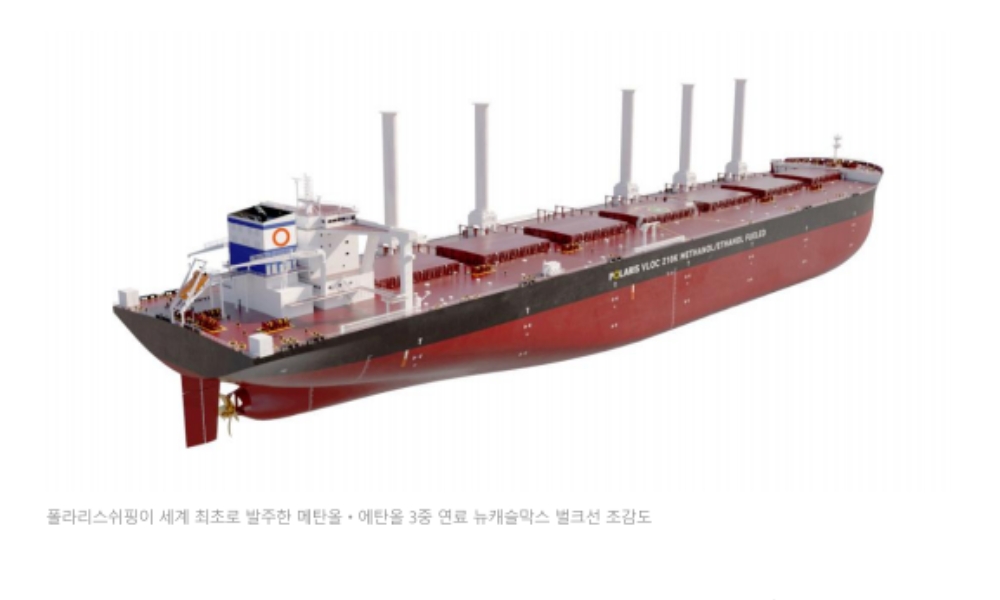
South Korean shipowner Polaris Shipping recently said it has signed a newbuilding contract for four tri-fuel vessels with Chinese shipbuilder Qingdao Beihai Shipbuilding Heavy Industry on 4 August.

The 210,000-dwt Newcastlemax bulk carriers, which will be delivered sequentially from 2031, will be equipped with WinGD-developed engines capable of using methanol, ethanol and heavy fuel oil as marine fuels.

The vessels are also designed as LNG- and ammonia-ready ships, allowing them to be converted to LNG or ammonia propulsion in the future.

Polaris Shipping also plans to significantly improve energy efficiency and reduce greenhouse gas emissions by applying various energy-saving technologies, including wind-assist propulsion systems, rotor sails, departure optimisation and land-based systems, to the vessels.

Polaris Shipping has completed a 25-year long-term charter contract for the bulk carriers with Brazilian iron ore producer Vale.

Polaris Shipping plans to sign construction contracts for up to four additional 210,000-dwt eco-friendly Newcastlemax bulk carriers with Chinese shipbuilder Hengli Heavy Industries in the near future. The Newcastlemax bulk carriers ordered from Hengli will be built as high-efficiency, environmentally friendly vessels to replace the company’s existing older bulk carriers.


Photo credit: Polaris Shipping
Published: 13 August, 2026
Continue Reading

Methanol

China: Xiamen issues safety guidelines for methanol bunkering operations

New guidelines establish safety requirements across the full methanol bunkering process, supporting the expansion of green marine fuel supplies at Xiamen Port.

Admin

Published

on

By

Xiamen, China

Xiamen Free Trade Zone on Monday (10 August) said its Administrative Committee recently jointly issued the Safety Guidelines for Marine Methanol Fuel Bunkering in Xiamen Waters with Xiamen Port Authority and Xiamen Maritime Safety Administration, establishing a framework for methanol bunkering operations in the port.

The guidelines are the first safety operating standard in Fujian province specifically covering marine methanol fuel bunkering. They apply to methanol bunkering operations conducted by bunker vessels in Xiamen waters and set out safety requirements covering the entire operation, from preparation through completion.

The guidelines specify requirements for bunkering companies, equipment and materials used on bunker vessels, hose inspection intervals, personnel certification and personal protective equipment.

They also require operators to conduct dedicated risk assessments and prepare emergency response plans before operations begin. During bunkering, operators must maintain continuous monitoring and comply with specified weather restrictions. After completion, pipelines must undergo procedures including purging and inerting.

Xiamen Port has previously carried out ship-to-ship bunkering of biofuels and LNG. The new guidelines provide a regulatory framework and operational basis for methanol bunkering and are intended to support the safe and orderly conduct of such operations.

The move is also expected to help Xiamen Port expand its market and bunkering capacity for green marine fuels. 


Photo credit: Woo Winter on Unsplash
Published: 13 August, 2026

Continue Reading

LNG Bunkering

Axpo and Vitol debut LNG bunkering operation at Italy’s largest cruise port

“Green Pearl”, a 7,500 m³ Italian bunkering vessel operated by Axpo, safely conducted the ship-to-ship refuelling operation on Sunday morning at Civitavecchia’s berth 18.

Admin

Published

on

By

Axpo and Vitol debut LNG bunkering operation at Italy’s largest cruise port

Switzerland’s energy producer Axpo on Wednesday (12 August) said it has completed the first liquefied natural gas (LNG) bunkering operation with Vitol at the Port of Civitavecchia in Italy, refuelling a flagship vessel of a leading international cruise line.

The company said Italy’s premier cruise port and Europe’s second largest now joins Genoa and Naples in offering LNG bunkering services.  

“This represents an important milestone in the development of infrastructure and services for alternative maritime fuels in Italian ports,” Axpo said. 

Green Pearl, a 7,500 m³ Italian bunkering vessel operated by Axpo, safely conducted the ship-to-ship refuelling operation on Sunday morning at Civitavecchia’s berth 18. Operated by Axpo, Green Pearl was brought into service in 2026 and is dedicated to ship-to-ship and ship-to-truck bunkering operations in Italian ports.

Axpo Italia CEO Simone Demarchi, said: “This latest operation shows the ability of our supply chain to grow rapidly and meet the needs of leading international cruise lines. Over the coming years, the shipping and cruise sectors will be called upon to accelerate their decarbonisation journey. Today, LNG is one of the most substantial and readily available solutions to help support this transition.”

Vitol Head of Small Scale LNG & LNG Bunkering Stefan Dubbeldam, added: “LNG and bio-LNG have a key role to play in reducing emissions from bunkering. Vitol is globally invested throughout the value chain, from upstream bio-LNG and LNG production and offtake, through to solutions for customers through our LNG Bunker Vessel fleet.”

The extension of Axpo’s coverage to Civitavecchia, the primary seaport for Rome, follows the launch of LNG ship-to-ship bunkering at Genoa in late 2025 and Naples in May this year. 

In addition to Green Pearl, the company has also chartered Alisios LNG, a new 12,500 m³ capacity bunkering vessel for low-emission fuels, which became operational in Spain last March.


Photo credit: Axpo
Published: 13 August, 2026

Continue Reading

Events

London forum to address critical bottlenecks holding back maritime decarbonisation

Marine Energy Transition Forum 2026 will be held on 11 November to address bunker fuel, technology and infrastructure barriers that continue to slow the industry’s transition to net-zero emissions.

Admin

Published

on

By

London forum to address critical bottlenecks holding back maritime decarbonisation

The Marine Energy Transition Forum (METF) 2026 will bring together leading voices from across the global maritime sector on 11 November 2026 at Norton Rose Fulbright, London.

The forum will tackle one of shipping’s most pressing challenges: how to overcome the fuel, technology and infrastructure barriers that continue to slow the industry’s transition to net-zero emissions.

Under the theme “Reframing the maritime decarbonisation roadmap: addressing fuel, technology and infrastructure bottlenecks,” the one-day forum will provide a platform for shipowners, fuel suppliers, technology developers, ports, policymakers and financiers to examine the practical steps needed to accelerate progress while maintaining commercial competitiveness.

As the maritime industry navigates an increasingly complex regulatory and commercial landscape, METF 2026 will focus on delivering practical insight into the challenges—and opportunities—shaping the next phase of the energy transition.

The conference programme will explore five key themes:

  • The effectiveness of current regulatory frameworks and policy measures, including regional and international initiatives driving maritime decarbonisation.
  • Progress in developing a resilient multi-fuel future, examining investment, fuel availability, supply chains and infrastructure.
  • The commercial readiness of emerging technologies, including alternative propulsion systems, vessel optimisation, batteries, carbon capture, wind propulsion and digital solutions.
  • Building a supportive business environment for energy transition companies, with discussions covering finance, innovation, scaling businesses and market development.
  • The evolving role of ports as critical enablers of shipping’s energy transition through new fuel infrastructure, shore power and energy cluster development.

METF 2026 is designed to encourage open discussion between every part of the maritime value chain, recognising that collaboration across fuel producers, shipowners, ports, technology providers, investors and policymakers will be essential if global decarbonisation ambitions are to be achieved.

The event will feature expert speakers, panel discussions and extensive networking opportunities, enabling delegates to exchange ideas, develop partnerships and gain practical insight into the strategies shaping the future of maritime energy.

Registration for METF 2026 is now open. Further information and registration can be found here


Photo credit: ship.energy
Published: 13 August, 2026

Continue Reading

Trending