
Alternative Fuels
ENGINE on Fuel Switch Snapshot: B100 and LBM mostly stable across key ports
Rotterdam’s B100 at $143-362/mt discounts to conventional fuels; LBM cheapest for low-methane-slip engines; LNG at $165-169/mt premiums over LBM in Rotterdam.

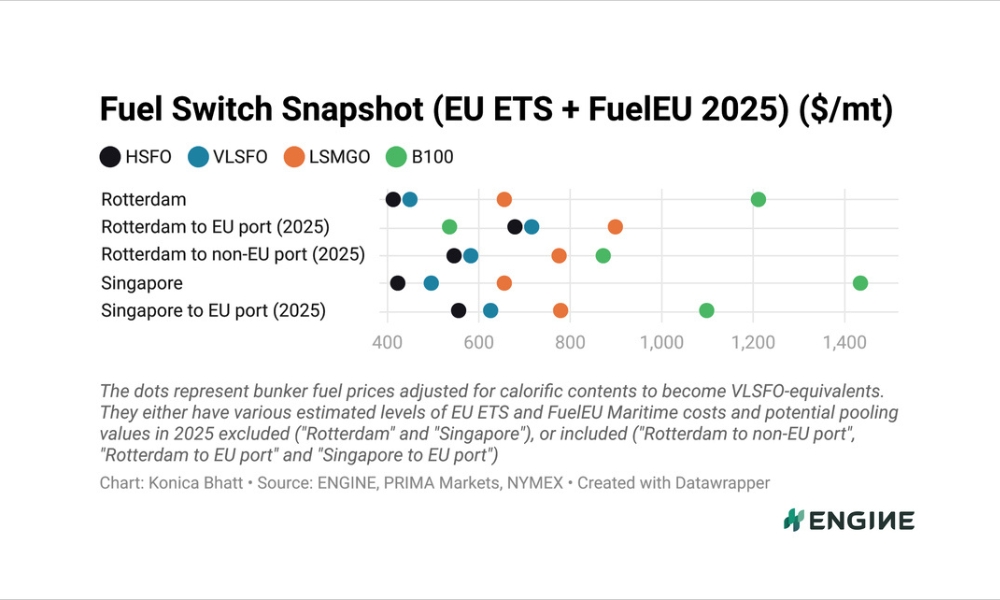
Once a week, bunker intelligence platform ENGINE will publish a snapshot of alternative and conventional bunker fuel prices in the world’s two biggest bunkering hubs. The following is the latest snapshot:
29 September 2025
- Rotterdam’s B100 at $143-362/mt discounts to conventional fuels
- LBM cheapest for low-methane-slip engines
- LNG at $165-169/mt premiums over LBM in Rotterdam
EU regulations mean that B100 can make sense on EU-EU voyages, but not so much on Singapore-EU voyages.
Rotterdam’s HBE-rebated B100 stands at discounts of $143/mt to HSFO, $179/mt to VLSFO and a sharp $362/mt to LSMGO.
Singapore’s B100, meanwhile, is priced $469/mt over its VLSFO even after factoring in biofuel benefits for a voyage between Singapore an an EU port.
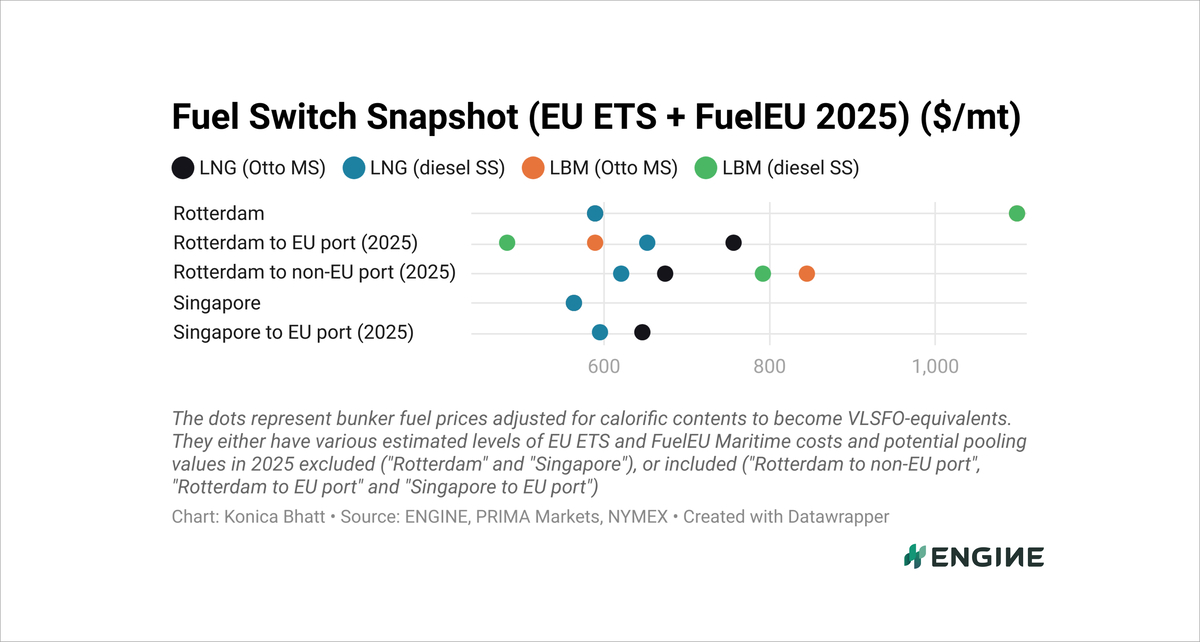
For dual-fuel ships with Otto medium-speed (Otto MS) engines, LNG sits at a $39/mt premium over VLSFO in Rotterdam, and a $20/mt premium in Singapore.
But for vessels with diesel slow-speed (diesel SS) engines, LNG shifts to discounts of $64/mt in Rotterdam and $32/mt in Singapore.
Liquefied biomethane (LBM) is the cheapest option for vessels with diesel slow-speed engines. It is even priced $54/mt below B100 in Rotterdam, though it flips to a $53/mt premium over B100 for vessels with Otto MS engines.
Rotterdam’s LBM is priced $126–230/mt below its VLSFO, depending on engine type.
Liquid fuels
Rotterdam’s VLSFO price has edged $4/mt lower in the past week. Availability of all conventional bunker grades in the wider ARA region remains stable, a trader said.
Rotterdam’s B100 benchmark has inched up by $3/mt over the same period, mainly driven by a $6/mt decline in Dutch HBE rebates for marine B100. The Prima Markets-assessed B100 rebate has paused its recent rise and eased over the past week.
Singapore’s VLSFO has also remained almost steady, rising $6/mt in the past week. Availability of the grade remains steady in the port, with traders recommending lead times of 7–10 days. The port’s B100 price has gained $8/mt in the past week.
Liquid gases
Rotterdam’s LNG bunker price has lost $6/mt in the past week, while its LBM benchmark has inched slightly lower by $2/mt.
LNG prices have been under some downward pressure in Rotterdam. The LNG bunker delivery premium has come off slightly to $136/mt, while front-month TTF has held steady at $579/mt. Lower temperatures have stimulated more gas demand in Europe, while steady Norwegian gas supply has contributed to keep prices in check.
Singapore’s LNG price has remained almost unchanged, with only a $1/mt decline in the past week. A near $5/mt rise in Singapore’s LNG bunker delivery premium has been countered by a $4/mt decline in the front-month JKM contract.
Northeast Asian LNG demand remains weak, and inventories are well-stocked, says JOGMEC. Steady fundamentals have kept prices in check, it argues.
By Konica Bhatt
Photo credit: ENGINE
Published: 30 September, 2025
LNG Bunkering
Singapore-based EPS takes delivery of three LNG dual-fuel bulk carriers
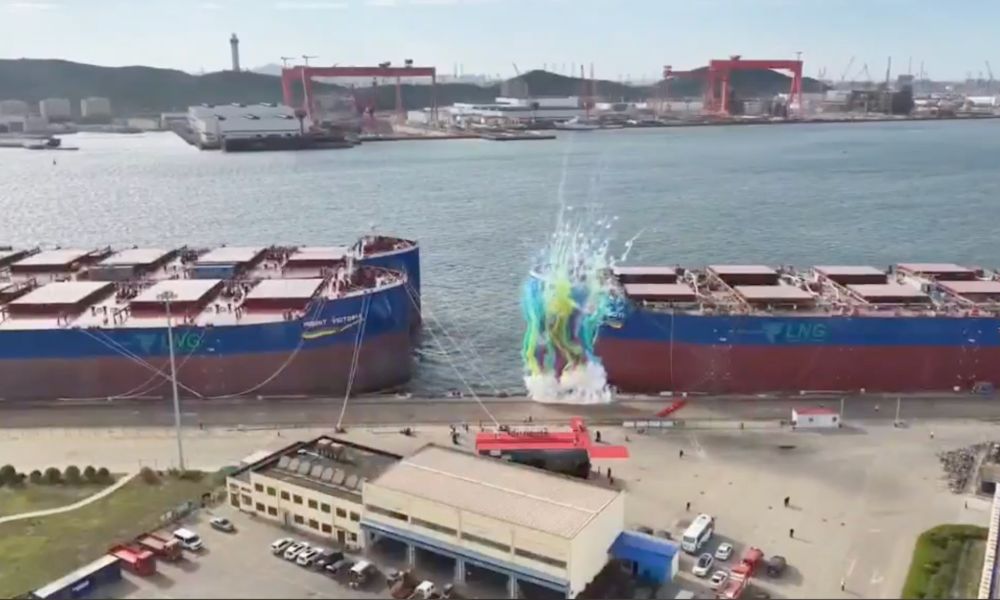
Three vessels are the third, fourth and fifth in the company’s series of 14 Newcastlemaxes being built at the yard, and were delivered five months ahead of their contracted delivery dates.
LNG Bunkering
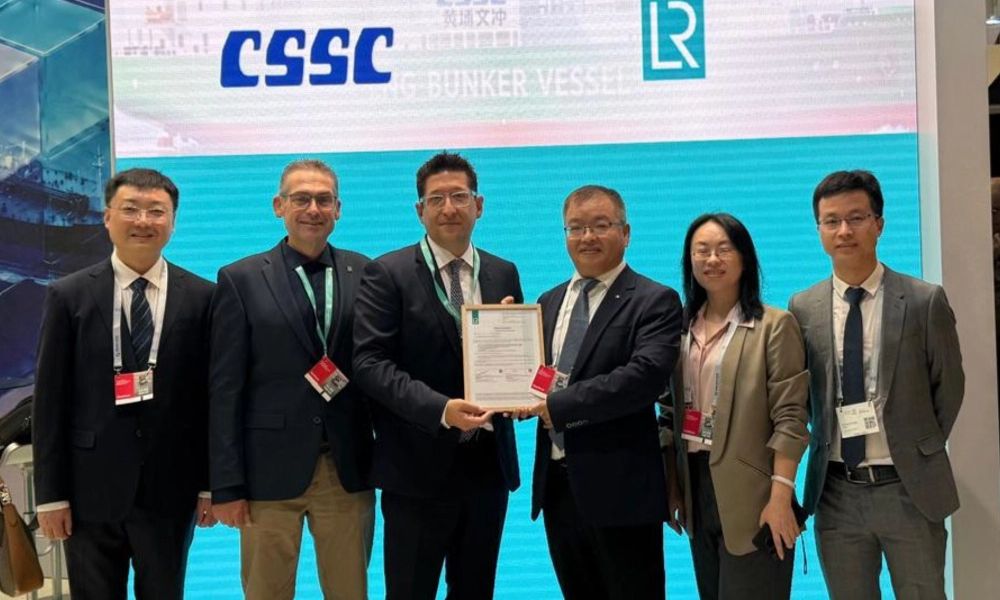
LR awards AiP to CSSC Huangpu Wenchong for 12,500 m³ LNG bunker vessel design
Vessel design incorporates Type C LNG cargo tanks and has been evaluated against a range of class notations covering gas operations, automation, environmental performance and cyber resilience.
Alternative Fuels
DNV at SMM: Chinese shipbuilders, European owners seek closer ties on alternative bunker fuels
Chinese shipbuilders and European shipowners called for closer collaboration on vessel development, alternative fuels and digitalization during the inaugural China-Europe Maritime Summit at SMM 2026.


OUR INDUSTRY PARTNERS

Singapore: Liquidators of Nan Ho Maritime, Nan Xin Maritime issue notices of dividend

Singapore-based EPS takes delivery of three LNG dual-fuel bulk carriers

ISWG-GHG 22: IMO working group aims to present NZF text at MEPC 85

UCL on ISWG-GHG 22: Majority back GHG pricing, centralised fund in IMO NZF talks

LR awards AiP to CSSC Huangpu Wenchong for 12,500 m³ LNG bunker vessel design

DNV at SMM: Chinese shipbuilders, European owners seek closer ties on alternative bunker fuels

Auramarine: Marine fuel flexibility will be key to shipping’s energy transition

Singapore-flagged tugboat “Kim Heng 3203” placed under Sheriff’s arrest

US targets five bunker companies in latest sanctions campaign against Iran

China’s bunker market reshaped by tax rebates, trade flows and refining changes, says economist

Rajah & Tann: Bunker disputes are won in the first 48 hours

Hengli Petrochemical’s ex-Singapore trading arm faces winding up application

Report: GCMD outlines practical approach to quantity assurance in marine biofuel supply chains

Singapore: Notices of annual meeting issued for Vroon Shipping Asia and related firms
-
 Vessel Arrest2 weeks ago
Singapore-flagged tugboat “Kim Heng 3203” placed under Sheriff’s arrest
-
 Sanctions2 weeks ago
US targets five bunker companies in latest sanctions campaign against Iran
-
 Interview2 weeks ago
China’s bunker market reshaped by tax rebates, trade flows and refining changes, says economist
-
 Bunker Claim6 days ago
Rajah & Tann: Bunker disputes are won in the first 48 hours
-
 Winding up2 weeks ago
Hengli Petrochemical’s ex-Singapore trading arm faces winding up application
-
 Biofuel2 weeks ago
Report: GCMD outlines practical approach to quantity assurance in marine biofuel supply chains
-
 Winding up2 weeks ago
Singapore: Notices of annual meeting issued for Vroon Shipping Asia and related firms
-
 Alternative Fuels2 weeks ago
GEA to provide global ethanol fuel data for DNV’s AFI platform