Connect with us

Newbuilding

Imabari Shipbuilding delivers ammonia, methanol-ready containership “ONE Sincerity”

Imabari Shipbuilding developed a concept design for future fuel conversion to methanol and ammonia and the installation of a carbon capture system of the vessel.

Admin

Published

on

Imabari Shipbuilding delivers ammonia, methanol-ready containership “ONE Sincerity”

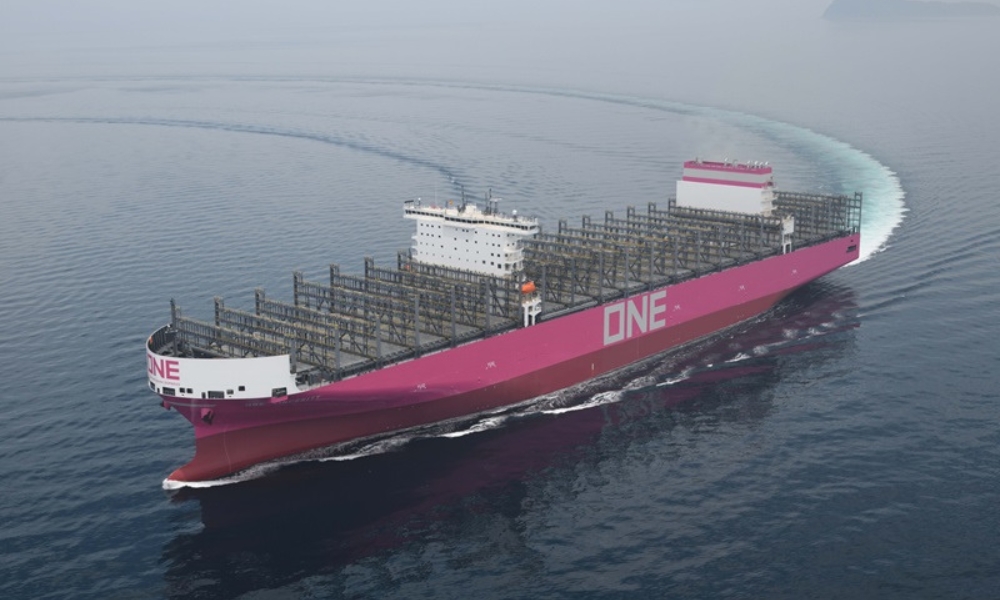
Japanese shipbuilder Imabari Shipbuilding Group recently said it delivered a new 13,900 TEU container ship to Singapore-based Ocean Network Express (ONE), which was built by its Hiroshima shipyard, on 12 August. 

The Singapore-flagged vessel is part of a series of 20 ammonia/methanol ready container vessels.

According to Imabari Shipbuilding, the vessel has a total length of 335.9 metres, a beam of 51 metres and a service speed of about 22 knots. 

The ship’s Energy Efficiency Design Index (EEDI) is reduced by approximately 60% over baseline requirements. To comply with sulphur oxide (SOx) and nitrogen oxide (NOx) emission regulations, the ship is equipped with a hybrid exhaust gas cleaning system (EGCS) and an exhaust gas recirculation system (EGR).


“We have also developed a concept design for future fuel conversion to methanol and ammonia and the installation of a carbon capture system, and have received Approval in Principle (AiP) from the vessel’s classification society,” the shipbuilder said.

The delivery of the ship comes following the naming of ONE Singapore, the sixth vessel in a series of 20 ammonia/methanol ready container vessels. 

Related: Singapore-based ONE names sixth ammonia/methanol-ready vessel in Japan


Photo credit: Imabari Shipbuilding
Published: 25 August, 2025

Continue Reading

Alternative Fuels

Shipfinex: The green fleet transition has a financing problem

Capt. Vikas Pandey, Founder & CEO, Shipfinex argues green shipping progress is uneven: major carriers can finance alternative-fuel vessels, while smaller owners face capital constraints.

Admin

Published

on

By

Shipfinex: The green fleet transition has a financing problem

By Capt. Vikas Pandey, Founder & CEO, Shipfinex

The numbers on alternative-fuel orders look encouraging. Seventy-two percent of newbuild capacity ordered in the first ten months of 2025 was for alternative-fuel vessels, with LNG dual-fuel accounting for 60% of that figure. More than 1,369 LNG dual-fuel vessels are now in operation or on order globally. By most measures, the transition appears to be happening.

Look at who is actually placing those orders. MSC. Hapag-Lloyd. CMA CGM. Carriers with balance sheets large enough to absorb the cost premium of alternative-fuel newbuilds and relationships with Chinese leasing companies that extend leverage ratios unavailable to most of the industry. The Strait of Hormuz disruption this March accelerated that activity further: LNG tanker charter rates spiked above $200,000 per day and carriers with deep pockets moved to lock in fuel flexibility. Meanwhile, for vessels under 6,000 TEU, orders for conventionally fuelled tonnage rose to 28% of capacity ordered in 2025, up from 19% the year before. That is not a story of broad commitment to green fuels. It is a story about who has access to capital.

An alternative-fuel newbuild costs materially more than a conventional equivalent. Methanol-ready designs, ammonia-ready structures, LNG dual-fuel systems, each carries a cost premium above the base vessel price. For an independent shipowner financing through a traditional bank, that gap is increasingly difficult to bridge. Top-40 bank lending to shipping fell from $454.9 billion in 2011 to $284.3 billion by end-2023. The Chinese leasing companies that absorbed part of that contraction are structurally oriented toward Chinese-built vessels under long-term contracts with tier-one counterparties. Independent bulk owners, mid-tier tanker operators, feeder container companies: they are working with a materially shrunken pool of willing lenders at precisely the moment they are being asked to upgrade their fleets.

This bifurcation deserves more attention from the marine fuels industry than it currently receives. Bunkering infrastructure investment follows demand signals. Alternative-fuel bunkering at secondary ports, methanol at regional hubs, LNG outside the major transhipment centres, requires a broader fleet base of alternative-fuel vessels to justify the investment. If green fuel adoption stays concentrated among a handful of majors rather than spreading across the independent owner fleet, the economics of scaling bunkering supply infrastructure outside the primary corridors remain thin.

Capital market structure and marine fuel adoption are connected, and pretending otherwise slows both. Digital instruments representing economic exposure to vessel-owning Special Purpose Vehicles, structured within regulated frameworks like VARA in Dubai, can extend the base of capital available to shipowners below the tier-one threshold. That capital base does not replace bank lending. It reaches operators that bank lending currently does not.

The Hormuz disruption reminded the industry that fuel supply chains carry geopolitical risk. The financing gap raises a quieter but equally structural point: the demand side of the green fuel equation depends on shipowners being able to afford the vessels that create that demand. Alternative-fuel bunkering infrastructure will scale when the fleet ordering those vessels does. Right now, that fleet is smaller than the order book numbers suggest.

About the Author

Vikas Pandey is a Master Mariner with decades at sea across various vessel categories. He is Founder and CEO of Shipfinex FZCO, a maritime asset tokenization platform operating under VARA In-Principle Approval (IPA/26/01/002) in Dubai and registered as a Virtual Asset Service Provider in Poland.

Disclaimer: This article is for informational purposes only and does not constitute financial advice or a solicitation to buy or sell any financial instrument or virtual asset. Maritime Asset Tokens are virtual assets; values may decline materially below purchase price. VARA In-Principle Approval does not constitute a final licence.

Linkedin: https://ae.linkedin.com/in/capt-vikaspandey
Website: https://www.shipfinex.com/


Photo credit: Shipfinex
Published: 4 June, 2026

Continue Reading

Newbuilding

LR launches Newbuild Advisory service, guide on major North Asian shipyards

Advisory service is designed to support shipowners, operators, yards, and investors throughout the design and build process while updated guide gives detailed insight into shipyards across China, Korea and Japan.

Admin

Published

on

By

RESIZED Chris Pagan

Classification society Lloyd’s Register (LR) on Tuesday (2 June) said it is growing its role in the newbuilding market with the launch of its Newbuild Advisory Service and updated New Construction Guide.

With global demand continuing to reshape shipyard orderbooks, owners are balancing a growing number of considerations during the planning phase of newbuilding projects, including fuel readiness, delivery timelines, technical capability and long-term operational requirements.

Launching at Posidonia 2026, the Newbuild Advisory service is designed to support shipowners, operators, yards, and investors throughout the design and build process, helping them to manage risk, optimise performance, and make informed decisions from concept through to delivery.

Drawing on experience from more than 500 new building projects, the Newbuild Advisory Service helps clients make better design and technology choices upfront, giving greater control over cost and schedule as projects progress, and reducing the risk of misalignment between owner expectations and yard execution.

It also adds a layer of independent oversight, with a focus on build quality, efficiency and long-term asset performance.

Sujith Tooneri, Global Head – Newbuild Advisory Services, LR, said: “Ship newbuilding for the future starts with making the right decisions today, and these decisions will shape the next generation of maritime operations.

“LR’s Newbuild Advisory Services provide expert guidance from concept to delivery, helping you design, specify and implement solutions that meet tomorrow’s standards. From concept, regulatory impact and risk to GHG reduction strategies and integrating innovative technologies, we ensure your fleet is smarter, safer and future ready.”

Alongside the Newbuild Advisory Service launch, LR is introducing an updated New Construction Guide, providing detailed insight into major North Asian shipyards, on yard capabilities, experience and regional strengths in a single, easy-to-use tool.

The guide brings together independent shipyard intelligence across China, Korea and Japan to help owners, operators and project teams compare options more confidently before entering newbuild discussions.

The guide reflects LR’s extensive knowledge of key shipyards, regional shipbuilding activity and newbuilding considerations, combined with its technical expertise across classification, plan approval, technical advisory and digital support services.

Sherry Li, Global Head of New Construction, LR, said: “Selecting the right shipyard has become more complex as owners balance delivery schedules, fuel transition strategies and changing market requirements. Clients need reliable insight early in the process to help them make confident decisions and reduce uncertainty around newbuilding projects.

“Our updated New Construction Guide reflects LR’s depth of knowledge across key shipbuilding regions, particularly North Asia. It is designed to give clients practical support as they evaluate shipyard capability, plan future fleet investment and navigate increasingly complex construction requirements.”

The Newbuild Advisory Service and updated New Construction Guide will be featured at the LR stand during Posidonia, as part of broader engagement with owners, yards and charterers on the next phase of newbuild activity.


Photo credit: Chris Pagan on Unsplash
Published: 3 June, 2026

Continue Reading

Methanol

Maritime Blue calls for proposals on methanol bunker barge design

Maritime Blue, in collaboration with the Port of Seattle, Port of Tacoma, Northwest Seaport Alliance, and ABS, is seeking a naval architecture firm to develop design schematics for a methanol bunker barge.

Admin

Published

on

By

RESIZED Venti Views on Unsplash

Maritime Blue, in collaboration with the Port of Seattle, Port of Tacoma, Northwest Seaport Alliance, and American Bureau of Shipping (ABS), is seeking a qualified naval architecture firm to develop design schematics for a methanol bunker barge.

A Request for Proposals (RFP), issued on 11 May, invited companies to submit a proposal for the barge, which will be used as the supply ship in a ship-to-ship methanol bunkering exercise during a high level risk assessment workshop planned for September 2026. 

The design is intended for a desktop exercise to identify operational requirements and safety gaps for green methanol bunkering in the Seattle-Tacoma Gateway.

The bunker barge is expected to have a methanol capacity of approximately 30,000 bbls but contractors may propose alternative capacities with justification. 

The receiving ship for the workshop has not been selected yet, but is anticipated to be a cargo, container, cruise, or ro-ro ship.

Maritime Blue said the submission deadline for the proposals is 1 June at 3pm PDT.


Photo credit: Venti Views on Unsplash
Published: 29 May, 2026

Continue Reading

Trending