Connect with us

Milestone

Yang Ming and KPI OceanConnect complete B30 HSFO biofuel bunkering in Busan

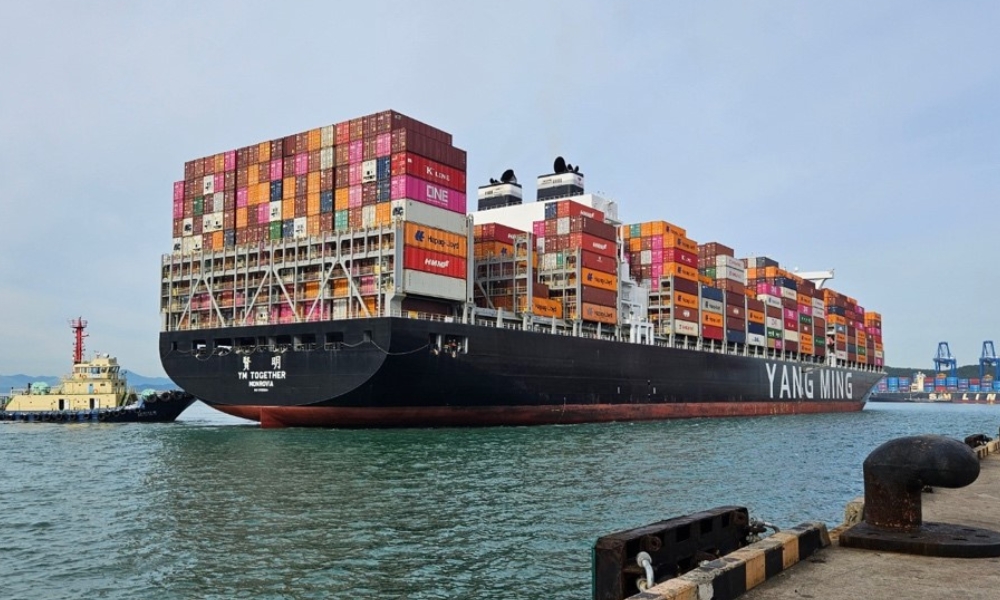
“YM Together”, a 11,000-TEU container ship currently serving the Trans-Pacific route PN3, recently became the first foreign-flagged vessel in South Korea to bunker biofuel, says Yang Ming.

Admin

Published

on

Yang Ming and KPI OceanConnect complete B30 HSFO biofuel bunkering in Pusan

Yang Ming Marine Transport Corporation (Yang Ming) on Friday (5 July) said it is beginning to fuel its fleet with sustainable biofuel bunkers.

YM Together, the 11,000-TEU container ship, recently became the first foreign-flagged vessel in South Korea to bunker biofuel, marking the company’s steady progress in sustainable development and energy transition.

In collaboration with KPI OceanConnect, a marine energy supplier, YM Together, currently serving the Trans-Pacific route PN3, bunkered the B30 HSFO biofuel at Busan Port in South Korea on 26 June. 

This type of biofuel is a blend comprising used cooking oil (UCO) made of native plants, which complies with ISO 8217 and meets International Sustainability & Carbon Certification (ISCC) standards. This biofuel also meets the green fuel standards of the FuelEU Maritime Initiative, reducing up to 25% of GHG emissions than do conventional marine fuels. 

YM Together bunkered the B30 HSFO biofuel

Apart from the biofuel, onboard facilities such as scrubbers and shore power systems (AMP) enable YM Together to effectively cut GHG emissions and offer customers with transport services that are sustainable and environmentally-friendly. 

The addition of Busan port as a biofuel bunkering port in Asia increases flexibility in bunkering options for different routes, which in turn helps Yang Ming to expand the use of biofuel. 

In the meantime, the company is providing biofuel usage data requested by a publicly-owned local research institute in South Korea, hoping to accelerate the sustainable goal of energy transition in the industry by sharing practical experiences and contributing to academic research. 

In response to the impact of global climate change, Yang Ming is carrying out various energy-saving measures in its operations to improve the fleet’s energy efficiency. 

These measures include retrofitting existing ships for energy efficiency, adopting smart technology to enhance onboard energy monitoring, using weather routing system to optimize routes and reduce fuel consumption, and fitting vessels with AMP systems for shore power. 

In 2023, Yang Ming’s fleet reduced carbon intensity by 61.86% compared to the baseline year of 2008, achieving the IMO’s goal of a 40% reduction by 2030 ahead of time. 

Looking forward, Yang Ming said it will continue using ISCC-certified biofuel to cap its total yearly GHG emissions and reduce the pressure of carbon emissions on customers and the entire supply chains.


Photo credit: Yang Ming
Published: 8 July, 2024

Continue Reading

LNG Bunkering

Singapore: FueLNG achieves 800th LNG bunkering operation milestone

Bunker tanker “FUELNG Venosa” delivered LNG marine fuel to bulk carrier “MV Ubuntu Humanity” at Eastern Bunkering A Anchorage (AEBA) on 11 July.

Admin

Published

on

By

Singapore: FueLNG completes 800th LNG bunkering operation

Singapore’s licensed LNG bunker supplier FueLNG on Friday (17 July) announced the successful completion of its 800th LNG bunkering operation in the republic.

The company said bunker tanker FUELNG Venosa delivered LNG marine fuel to bulk carrier MV Ubuntu Humanity at Eastern Bunkering A Anchorage (AEBA) on 11 July. 

“This achievement is more than just a number,” FueLNG said.

“It reflects the trust our customers place in us, the dedication of our operations team, the professionalism of our marine partners, and our unwavering commitment to safe, efficient, and reliable bunker deliveries.” 

Manifold Times previously reported FueLNG completing its 500th LNG ship-to-ship (STS) bunkering operation.

Related: Singapore: FueLNG achieves milestone of 500th STS LNG bunkering operation


Photo credit: FueLNG
Published: 20 July, 2026

Continue Reading

Alternative Fuels

Repsol and Maersk wrap up first bioethanol bunkering operation in Port of Barcelona

Repsol supplied 2,800 mt of bioethanol to a Maersk container vessel, “Antonia Maersk”, in the first bunkering operation of its kind in the Port of Barcelona and one of the first in the Mediterranean.

Admin

Published

on

By

Repsol and Maersk wrap up first bioethanol bunkering operation in Port of Barcelona

Spanish energy company Repsol and shipping giant A.P. Moller – Maersk (Maersk) completed the first bioethanol bunkering operation in the Port of Barcelona, according to the port authority on Wednesday (15 July). 

Repsol successfully supplied 2,800 metric tonnes (mt) of bioethanol to a Maersk container vessel, Antonia Maersk, in the first bunkering operation of its kind in the Port of Barcelona and one of the first in the Mediterranean. 

The operation demonstrates growing demand for alcohol-based marine fuels, as well as the readiness of the infrastructure, logistics, and operational capabilities required to support their deployment at commercial scale. 

Juan Abascal, Repsol’s Executive Managing Director of Industrial Transformation and Circular Economy, said: “With this supply, we reaffirm our commitment to the decarbonization of maritime transport through solutions that are available today and ready to scale in the future. 

“At Repsol, we provide shipping companies with a reliable supply chain and a multi-energy strategy that combines different renewable fuels to support the sector in a safe, competitive, and sustainable transition.”

The supply took place in the Port of Barcelona under fully commercial conditions, bringing together key players across the maritime value chain and demonstrating how collaboration can accelerate the adoption of lower-emission solutions in shipping. 

The delivery was carried out by Bahía Candela, Repsol’s newest bunker vessel, operated by Mureloil and designed to supply both conventional marine fuels and next-generation energy products. 

During the bunkering operation, Bahía Candela operated using its battery system, enabling the fuel transfer to be completed with zero local emissions, and further reducing the environmental footprint of the operation. 

Prior to the bunkering, Maersk tested ethanol on one of its smaller vessels, the 1,800 TEU feeder vessel Laura Maersk, which in 2023 became the world’s first dual-fuel container vessel able to operate on methanol. Today, Maersk has 23 dual-fuel container vessels designed to operate on methanol; however, the company continues to explore ethanol as an alternative fuel for its methanol-enabled vessels. Laura Maersk has performed sailings on 100% ethanol as well as blends of ethanol and methanol. 

Emma Mazhari, Vice President Energy Markets at Maersk, said: “Following the successful ethanol trials conducted on Laura Maersk, this latest bunkering of Antonia Maersk marks another important step in our efforts to explore scalable low-emission fuel solutions. 

“As the first ethanol trial on one of our large dual-fuel vessels, with a capacity of 16,000 TEU, it allows us to deepen our understanding of ethanol’s operational potential at scale. 

“Building on the experience we have gained with methanol, we are working closely with port authorities and industry partners to develop the infrastructure and procedures needed to support ethanol bunkering. Ethanol is one of several pathways we are pursuing to diversify our future fuel portfolio and help accelerate the development of new, viable liquid marine fuel markets.”


Photo credit: Port of Barcelona
Published: 20 July, 2026

Continue Reading

Alternative Fuels

Port of Santos hosts Brazil’s first bioethanol bunkering of deep-sea containership

Copersucar, CMA CGM Group, AGEO Terminais, Santos Brasil and Bunker One completed a bioethanol bunkering operation for “CMA CGM IRON”, the first 13,000 TEU tri-fuel certified engine containership.

Admin

Published

on

By

Port of Santos hosts Brazil's first bioethanol bunkering of deep-sea containership

Sugar and bioethanol trading company Copersucar on Monday (13 July) said the company and its partners successfully completed a bioethanol bunkering operation for the CMA CGM IRON, the first 13,000 TEU tri-fuel certified engine containership, at the Port of Santos on 12 July.

The partners are CMA CGM Group, AGEO Terminais, the largest liquid bulk storage operator at the Port of Santos; Santos Brasil, the biggest container terminal in Brazil; and Bunker Holding subsidiary Bunker One. 

Copersucar said the operation represents a major milestone for the decarbonisation of maritime transport, positions Brazil among the countries capable of carrying out this type of bunkering operation, and reinforces bioethanol as a readily available solution to reduce greenhouse gas emissions from the shipping sector.

The bioethanol supplied by Copersucar benefits from a certified supply chain. Sugarcane expansion takes place mainly on degraded pastureland, while Brazil’s RenovaBio program establishes stringent sustainability and zero-deforestation requirements.

The bunkering required logistical and operational coordination among multiple stakeholders across the value chain, involving the transport of bioethanol to the Port of Santos, its storage in dedicated infrastructure, and its transfer to the vessel via a specialized barge.

“The operation provides practical evidence that bioethanol offers the attributes needed to accelerate the decarbonisation of maritime transport,” the company said. 

Beyond this first demonstration, the Port of Santos and Santos Brasil container terminal are positioning themselves and Brazil as a future low-carbon marine fuels hub for South America. As the continent’s largest port and a major gateway for global trade, Santos has the potential to connect Brazil’s renewable energy resources with international shipping demand. 

The CMA CGM IRON, delivered in 2025, is the Group’s first vessel in a series of twelve 13,000 TEU containerships, equipped with the world’s first tri-fuel engine certified to operate on bioethanol: Everllence-B&W G95ME-C10.5-LGIM.

“Together with our partners, we have shown that innovation can move from the laboratory to real maritime operations. The certification of our first tri-fuel vessel is a major technological milestone for CMA CGM. It opens the way for the broader use of lower-carbon fuels and gives us new options to accelerate the decarbonisation of our shipping activities” said Christine Cabau Woehrel, Executive Vice President Assets & Operations, CMA CGM.

“This operation demonstrates Copersucar’s ability to connect production, logistics and markets to enable bioenergy solutions at scale. More than a pioneering bunkering operation, we are creating the conditions for bioethanol to become a competitive component of the maritime energy mix, further strengthening Brazil’s leadership in the transition to a low-carbon economy,” said Tomás Manzano, CEO of Copersucar.

“This operation can be considered a milestone in the global maritime industry’s energy transition, as the sector begins to adapt to this new model. Today, Around 70 vessels of the global fleet are capable of operating on methanol and, consequently, with bioethanol. Over the next few years, however, an additional 400 vessels are expected to be delivered from shipyards ready to sail using a non-fossil fuel,” said Flavio Ribeiro, CEO of Bunker One.


Photo credit: Copersucar
Published: 14 July, 2026

Continue Reading

Trending