Connect with us

LNG Bunkering

Titan LNG develops novel tank concept for future European Inland Waterway bunker barges

Works with HB Hunte Engineering to introduce multiple 1000 m3 internal tank partitions into a single tank structure, meeting European safety criterion.

Admin

Published

on

Titan LNG develops novel tank concept for future European Inland Waterway bunker barges

Titan LNG on Wednesday (22 December) shared a social media post stating it has developed the ‘Hyperion’ series of tank concepts for future Inland Waterway (IWW) bunker barges operating in both seagoing and inland conditions:

As part of its current fleet of bunkering assets, Titan LNG operates the LNG bunker barges FlexFueler 001 and 002. The one-of-a-kind “FlexFueler” concept was developed in-house by Titan LNG and represents the first generation of LNG bunker assets tailor-made for the Antwerp-Rotterdam-Amsterdam area. Through concept development and operation of these barges, Titan LNG has gained a lot of experience with the European Inland Waterway (IWW) regulations, specifically their impact on LNG storage and handling systems.

Continued market growth and the higher tank capacity of the global fleet of LNG-fueled vessels is leading to more and larger IWW-dedicated bunker barges. However, scaling up to meet the market requirements efficiently is made difficult by a particular rule in the European code for carriage of dangerous goods. Namely, a tank capacity limit of 1,000 m3 per tank onboard bunkering barges. Which – when conventionally interpreted – leads to a multiple of 1,000 m3 cylindrical tanks. Though certainly valid from a safety perspective, the rule is a challenge when scaling up liquefied gas carriers as it tends to lead to designs with many small – and relatively expensive – tanks.

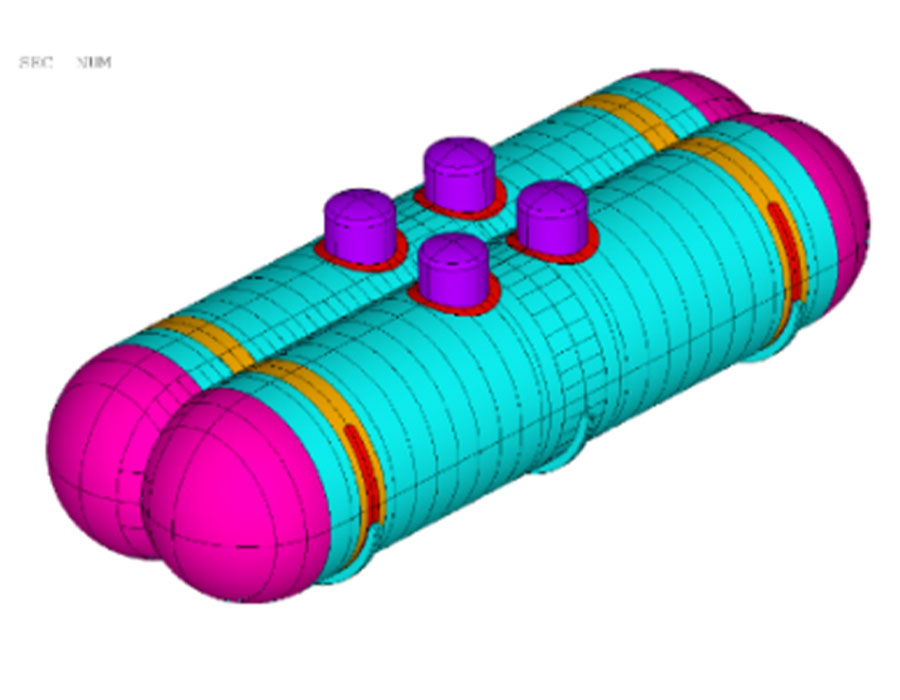
Titan LNG has devised a way to meet this safety criterion by introducing the principle of multiple 1000 m3 internal tank partitions into a single tank structure. The main benefit is that more fuel can be put into a single tank structure. As a result, the tanks take up less space, thus reducing the total footprint of the vessel while maintaining the cargo capacity. The internal partitions maintain their individual structural integrity in case of tank damage to a single partition. This solution has been patented as well as technically validated for one of the more challenging types of pressure vessel; a bilobe tank.

Fleet development director Douwe de Jong commented: “As more LNG and LBM fuelled vessels are built, innovations like this will become increasingly important to efficiently meet demand and effectively scale up supply infrastructure. By investing in the in-house development of its fleet, Titan LNG has managed to introduce the economies of scale associated with large LNG tanks found in seagoing vessels into IWW gas carrier vessel design. “

The design impact was investigated within Titan LNG’s “Hyperion” IWW bunker vessel design series. At a total capacity of 8,000 m3, the vessel’s length and breadth were reduced by 10-20%, compared to the individual tank approach. Fuel consumption, steel weight, outfitting costs and overall environmental impact of constructing and operating the vessel were reduced by similar percentages. The larger tank size also opened the possibility of using lighter and cheaper foam-insulated tanks instead of the vacuum-insulated pressure tanks that are more common in the <1,000cbm tank size range. It was also found that the resulting vessel lay-out and dimensions could work as both a seagoing and inland vessel. As a result, the “Hyperion” series currently features both seagoing and inland design versions, making it ready for the next decade and beyond.

Titan LNG cooperated with HB Hunte Engineering, who proved the structural feasibility of the tank concept. HB Hunte Engineering is also working with Titan LNG’s on the 4,500cbm bunker vessel design “Krios”.


Photo credit: HB Hunte
Published: 23 December, 2021

Continue Reading

LNG Bunkering

PIL’s LNG dual-fuel boxship “Kota Elok” arrives in Singapore on maiden call

As the first of 13 new 13,000 TEU vessels joining its fleet, Kota Elok is equipped to operate on LNG and low-sulphur fuel oil that helps reduce our greenhouse gas emissions.

Admin

Published

on

By

PIL's LNG dual-fuel boxship “Kota Elok” arrives in Singapore on maiden call

Singapore-based Pacific International Lines Pte Ltd on Monday (20 July) said its first 13,000 TEU LNG dual-fuel container vessel, Kota Elok, recently made her maiden call to Singapore on 15 July.

As the first of 13 new 13,000 TEU vessels joining its fleet, Kota Elok is equipped to operate on liquefied natural gas (LNG) and low-sulphur fuel oil that helps reduce our greenhouse gas emissions. 

The vessel also incorporated energy-saving features and digital technologies to reduce fuel consumption and enhance operational performance, as well as a bow windshield to improve aerodynamics, contributing to improved fuel efficiency and lower emissions over the course of long-haul voyages.

“Following Singapore, Kota Elok will continue her voyage on our East Coast Service 1 (ES1) route to South America, calling at ports in Brazil, Uruguay, and Argentina before returning to Asia,” the company said in a social media post. 

Kota Elok also became PIL’s first vessel to receive Lloyd’s Register certification for compliance with the IACS UR E26 and UR E27 cyber security requirements.

Developed by the International Association of Classification Societies (IACS), UR E26 and UR E27 are mandatory cyber resilience requirements for newbuild vessels contracted from 1 July 2024. 


Photo credit: Pacific International Lines
Published: 21 July, 2026

Continue Reading

LNG Bunkering

CIMC SOE secures order for 12,000-cbm LNG bunkering vessel from Sinopec Clean Energy

Once operational, the vessel is expected to strengthen Sinopec’s domestic coastal LNG bunkering network and help address gaps in China’s alternative fuel bunkering infrastructure.

Admin

Published

on

By

CIMC SOE secures order for 12,000-cbm LNG bunkering vessel from Sinopec Clean Energy

China’s Nantong CIMC Sinopacific Offshore & Engineering Co., Ltd. (CIMC SOE) recently signed a contract with Sinopec (Beijing) Clean Energy Co., Ltd. to build a 12,000-cubic metre (m3) LNG bunkering vessel, according to Chinese maritime media.

The vessel is scheduled for delivery in 2028 and will support Sinopec’s efforts to expand its presence in the marine clean energy sector.

Once operational, the vessel is expected to strengthen Sinopec’s domestic coastal LNG bunkering network and help address gaps in China’s LNG bunkering infrastructure.

With this signing , CIMC Pacific Offshore Engineering’s LNG bunkering vessel orderbook is further strengthened, maintaining its leading position in the global market for small and medium-sized LNG bunkering vessels.

The contract also marked another milestone for CIMC SOE, which has seen a sharp increase in orders and business performance this year amid a surge in domestic LNG vessel demand.


Photo credit: Nantong CIMC Sinopacific Offshore & Engineering
Published: 21 July, 2026

Continue Reading

Alternative Fuels

ENGINE on Fuel Switch Snapshot: LSMGO surges to greater premium over biofuel

B100 discount to LSMGO widens to $541/mt in Rotterdam; Singapore’s B100 drops to $106/mt below LSMGO; Rotterdam LBM at $639-833/mt discounts to LSMGO.

Admin

Published

on

By

ENGINE on Fuel Switch Snapshot: LSMGO surges to greater premium over biofuel

Once a week, bunker intelligence platform ENGINE will publish a snapshot of alternative and conventional bunker fuel prices in the world’s two biggest bunkering hubs. The following is the latest snapshot:

20 July 2026

  • B100 discount to LSMGO widens to $541/mt in Rotterdam
  • Singapore’s B100 drops to $106/mt below LSMGO
  • Rotterdam LBM at $639-833/mt discounts to LSMGO

B100’s premium over HSFO in Rotterdam has narrowed by $50/mt over the past week to $64/mt, while its discount to VLSFO has widened by $83/mt to $105/mt.

B100 has become far more competitive against LSMGO in Rotterdam, with its discount widening by $180/mt over the past week to $541/mt, as a surge in conventional fuel prices left B100 broadly unchanged by comparison.

B100’s price has risen by $109/mt in Singapore, but its discount to LSMGO has still widened by $102/mt to $106/mt, as LSMGO surged by an even greater $211/mt.

Rotterdam’s LNG premium over VLSFO has widened by $35/mt to $201/mt for vessels with Otto medium speed (Otto MS) engines. For vessels with diesel slow speed (diesel SS) engines, LNG has flipped to a $15/mt premium over VLSFO, from a $22/mt discount the prior week.

Liquefied biomethane (LBM) discounts to VLSFO in Rotterdam have narrowed by $50-52/mt to $203-396/mt over the past week. Against LSMGO, LBM discounts have widened by $45-47/mt to $639-833/mt, depending on engine type.

In Singapore, LNG is now $42/mt cheaper than LSMGO for vessels with Otto MS engines, and $134/mt cheaper for vessels with diesel SS engines.

ENGINE on Fuel Switch Snapshot: LSMGO surges to greater premium over biofuel

Liquid fuels

HSFO and VLSFO prices in Rotterdam have jumped by $66/mt and $99/mt respectively over the past week, while LSMGO has surged by an even steeper $196/mt. A $9.69/bbl ($71/mt) rise in front-month ICE Brent futures, to $87.94/bbl ($645/mt), drove bunker prices sharply higher across the board.

Bunker fuel availability is tight for prompt delivery dates in the ARA ports, with buyers advised to enquire about stems between 5-7 days ahead to get good coverage, a trader said.

Rotterdam’s B100 price has risen by $16/mt over the past week. Dutch ZRE A ticket prices were unchanged at €107.50/mtCO2e.

Singapore’s HSFO and VLSFO prices have risen by $130/mt and $132/mt respectively, while its LSMGO price has gained an even steeper $211/mt over the past week.

VLSFO availability in Singapore has been tight, with several suppliers reporting low stock levels. Recommended lead times have widened from 13–17 days last week to 14–19 days now.

Liquid gases

Rotterdam’s LNG prices have surged by $134-136/mt over the past week, while its LBM prices have climbed by $149-151/mt.

LBM discounts to LNG in Rotterdam have narrowed by $15/mt to $404-411/mt.

Singapore’s LNG bunker benchmarks have surged by $196-197/mt over the past week.

By Erik Hoffmann


Photo credit and source: ENGINE
Published: 21 July, 2026

Continue Reading

Trending