Connect with us

Business

TECO 2030 to cooperate with Keppel O&M subsidiary on maritime cleantech

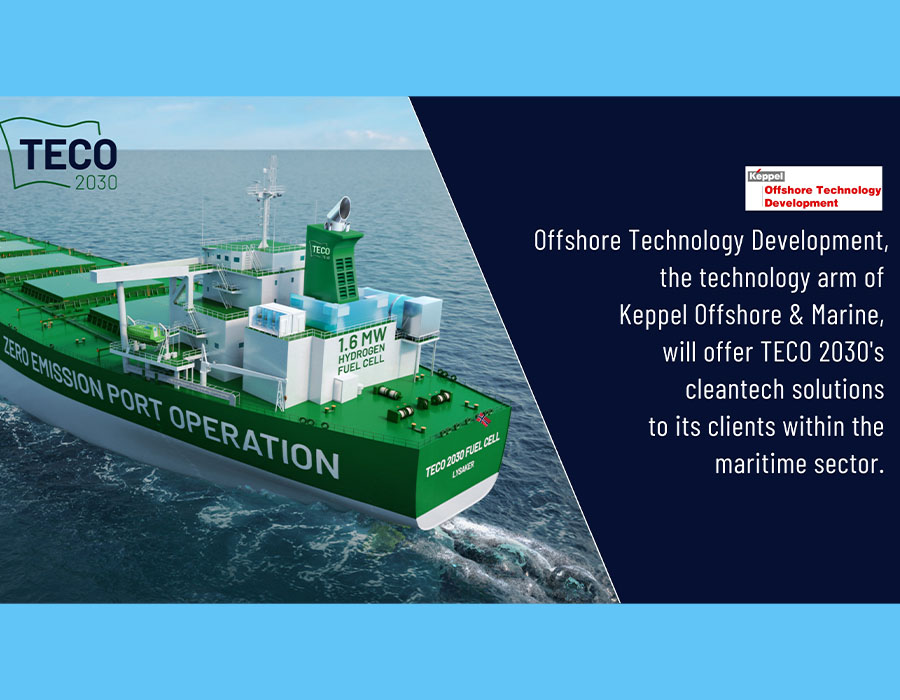
Offshore Technology Development will offer TECO 2030’s cleantech products, such as hydrogen fuel cells, CCS solutions and exhaust gas cleaning systems.

Admin

Published

on

Teco 301

Maritime cleantech company TECO 2030 on Thursday (7 October) said it has signed a Memorandum of Understanding (MOU) with Singapore’s Offshore Technology Development (OTD), a subsidiary of Keppel O&M, to offer TECO’s 2030 cleantech solutions to its clients within maritime sector.

As part of the agreement, OTD will be able to offer TECO 2030’s cleantech products, such as hydrogen fuel cells, carbon capture and storage (CCS) solutions and exhaust gas cleaning systems to its clients within the maritime sector.

TECO 2030 will provide technical support and services, and training to OTD personnel, and will cooperate with and support OTD in handling all of its solutions.

OTD is Keppel Offshore & Marine’s technology arm specialising in modern offshore platforms and critical equipment which support the oil and gas, marine, and offshore wind industries.

“We are delighted that OTD has chosen to work with our cleantech products in their efforts to help their clients within the maritime industry to reduce their environmental and climate impacts,” says Tore Enger, CEO of TECO 2030 ASA.

Green transition in the maritime industry

The International Maritime Organization (IMO) aims to reduce carbon intensity in international shipping by 40% by 2030, and to cut the total annual greenhouse gas emissions from international shipping by at least 50% by 2050 compared to 2008.

Ship-owners across the world will therefore have to do something to make their vessels more climate-friendly, and TECO 2030 will help them with that.

TECO 2030 is delivering technology that helps ships to reduce their environmental and climate impacts, and that even enables them to sail emissions-free.

TECO 2030 Marine Fuel Cell

Hydrogen fuel cells are the engines of tomorrow and convert hydrogen into electricity while emitting nothing but water vapour and warm air.

The TECO 2030 Marine Fuel Cell is the first fuel cell system in the world that is specifically designed for use onboard ships and on other heavy-duty applications. It is being developed by TECO 2030 in cooperation with the Austrian powertrain technology company AVL.

By exchanging one or more of their engines with a TECO 2030 Marine Fuel Cell, ships can switch from fossil fuels to hydrogen and reduce their emissions to zero. They can then sail emissions-free either on the whole journey or on shorter distances, such as when sailing into and out of ports.

Hydrogen fuel cells can also be used during port-stay, loading and discharging, enabling zero-emission operation at berth, without having to connect the ship to an onshore power supply.

TECO 2030 has received an Approval in Principle (AiP) by DNV, one of the world’s leading classification and certification bodies, for its Marine Fuel Cell System and its Fuel Cell Module FCM400, confirming that these are safe to use onboard ships.

TECO 2030 Carbon Capture

An immediate phase-out of fossil fuels in the maritime industry is highly unlikely. Despite the efforts to decarbonise the sector, the market share of oil-based fuels could be up to 40% by 2050, according to a report published by the American Bureau of Shipping (ABS) in April 2020.

Carbon capture and storage (CCS) solutions are therefore also likely to play a role in reducing CO2 emissions from ships. TECO 2030 is currently developing CCS solutions for the maritime industry together with the American technology company Chart Industries, Inc., and plans to make these available to the market in 2023.

TECO 2030’s CCS solutions for ships will capture CO₂ in the ship exhaust and store it until the ship reaches port. When offloaded, the CO2 can either be permanently stored in geological formations underground or be put to beneficial use in CO2-consuming industries.

According to DNV’s Maritime Forecast to 2050, published last month, carbon capture technology has the potential to reduce greenhouse gas emissions from the shipping industry by more than 30% by 2050.

Better exhaust gas cleaning systems can also help to reduce pollution from ships. The TECO 2030 Future Funnel is a next-generation exhaust gas cleaning system for ships that has been developed to enable ships to comply with upcoming and stricter environmental regulations.

The system reduces the amount of sulphur and nitrogen oxides (SOX and NOX), black carbon and particles (PM) that is emitted with ships’ exhaust gases.

Related: TECO 2030 receives AiP from DNV for marine hydrogen fuel cell system and modules
Related: TECO 2030: Carbon Capture Storage technology able to reduce CO2 emissions by 30-40%


Photo credit: TECO 2030
Published: 8 October, 2021

Continue Reading

Winding up

Singapore: Liquidators of Nan Ho Maritime, Nan Xin Maritime issue notices of dividend

Nan Ho Maritime’s second interim dividend and Nan Xin Maritime’s second and final dividend are payable from 4 September, according to Government Gazette notices.

Admin

Published

on

By

Resized benjamin child

Notices of dividend for Nan Ho Maritime Pte Ltd and Nan Xin Maritime Pte Ltd, which are currently in creditors’ voluntary liquidation, were published on the Government Gazette on Friday (4 September). 

The following are the details of the notice for Nan Ho Maritime:

Name of Company : Nan Ho Maritime (Pte.) Ltd. (In Creditors’ Voluntary Liquidation)
Unique Entity No. / Registration No. : 200814315C
Address of Former Registered Office : 21 Bukit Batok Crescent, #22-70 WCEGA Tower, Singapore 658065
Amount per centum : 2.305 per centum of all admitted ordinary claims
First and Final or otherwise : Second interim dividend
When Payable : 4 September 2026 onwards
Where Payable : c/o AAG Corporate Advisory Pte. Ltd., 11 Collyer Quay, #07-02 The Arcade, Singapore 049317

The following are the details of the notice for Nan Xin Maritime:

Name of Company : Nan Xin Maritime (Pte.) Ltd. (In Creditors’ Voluntary Liquidation)
Unique Entity No. / Registration No. : 201701966W
Address of Former Registered Office : 21 Bukit Batok Crescent, #22-70 WCEGA Tower, Singapore 658065
Amount per centum : 3.980 per centum of all admitted ordinary claims
First and Final or otherwise : Second and final dividend
When Payable : 4th day of September 2026 onwards
Where Payable : c/o AAG Corporate Advisory Pte. Ltd., 11 Collyer Quay, #07-02 The Arcade, Singapore 049317


Photo credit: Benjamin Child
Published: 7 September, 2026

Continue Reading

LNG Bunkering

Singapore-based EPS takes delivery of three LNG dual-fuel bulk carriers

Three vessels are the third, fourth and fifth in the company’s series of 14 Newcastlemaxes being built at the yard, and were delivered five months ahead of their contracted delivery dates.
Admin

Published

on

By

35

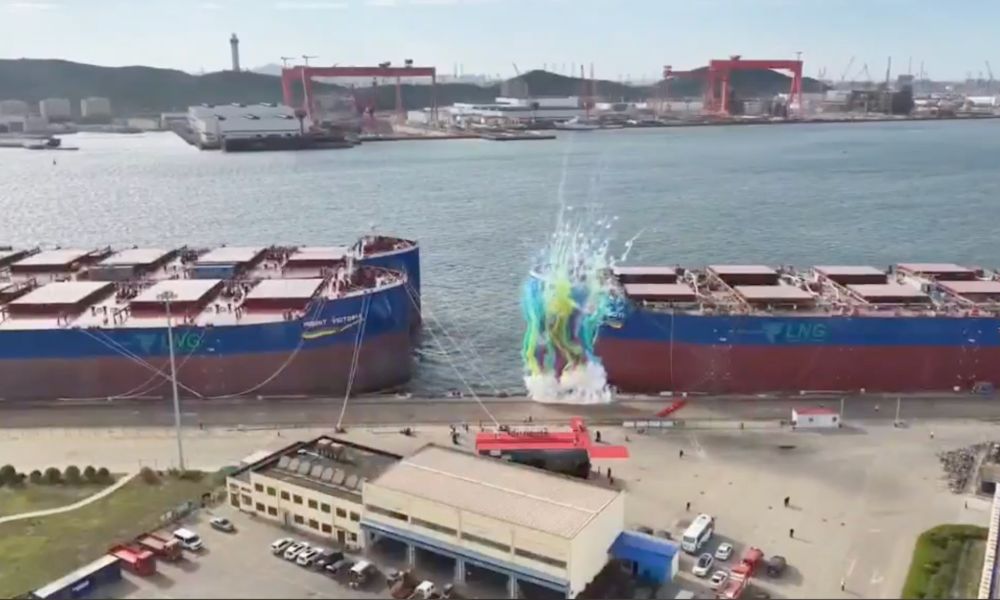
Singapore-based Eastern Pacific Shipping (EPS) on Friday (4 September) announced the naming and delivery of three new LNG dual-fuel Newcastlemax bulk carriers from China’s Qingdao Beihai Shipbuilding. 

Cyril Ducau, CEO of EPS, said the vessels were named Mount Victoria, Mount Yulong and Mount Wuyi

The three vessels are the third, fourth and fifth in the company’s series of 14 Newcastlemaxes being built at the yard, and were delivered five months ahead of their contracted delivery dates.

“A big thank you to CSSC Group and Qingdao Beihai Shipbuilding, working alongside our EPS team, for the tremendous collaboration and commitment behind this achievement,” Ducau said in a social media post.  


Photo credit: Eastern Pacific Shipping
Published: 7 September, 2026

Continue Reading

Port & Regulatory

ISWG-GHG 22: IMO working group aims to present NZF text at MEPC 85

The Chair expressed his observation of a genuine willingness within the Group to make concrete further progress at the next ISWG-GHG meeting and work towards presenting text to MEPC 85.
Admin

Published

on

By

IMO

The Intersessional Working Group on Reduction of Greenhouse Gas (GHG) Emissions from Ships (ISWG-GHG 22) met for its 22nd meeting from 1 to 4 September 2026, chaired by Mr. Sveinung Oftedal (Norway), according to the International Maritime Organization on Friday (4 September). 

According to a meeting summary by IMO, the meeting had a high level of participation, with nearly 1200 registered participants, in person and online.

During the meeting participants considered the following agenda items:

Consideration of proposals, including documents submitted to MEPC 84 and 85, previous sessions of ISWG-GHG, as well as documents submitted to ISWG-GHG 22, on how to address concerns with the draft amendments to MARPOL Annex VI on the Net-Zero Framework, in line with the 2023 IMO GHG Strategy

Following constructive discussions, the Chair expressed his observation of a genuine willingness within the Group to make concrete further progress at the next ISWG-GHG meeting and work towards presenting text to MEPC 85 that adequately addresses the noted progress made in the consideration of proposals on how to address concerns raised regarding the draft amendments to MARPOL Annex VI on the mid-term measure.

The Group invited interested delegations to continue to consult intersessionally to address remaining concerns with the draft amendments to MARPOL Annex VI, in line with the 2023 IMO GHG Strategy, taking into account views expressed at the Group’s session, with a view to submitting concrete proposals reflecting enhanced convergence allowing timely adoption and effective implementation.

Further consideration of the draft guidelines supporting the uniform and effective implementation of IMO’s mid-term measures.

The Group held a preliminary exchange of views on this agenda item, although time became a limiting factor and the Group and agreed to defer the consideration of all documents submitted to this session under this agenda item to ISWG-GHG 23 (23-27 November 2026).

Further consideration of the development of the IMO Life Cycle GHG Assessment (LCA) framework.

Due to time constraints, the Group was not able to consider the agenda item related to the IMO Life Cycle GHG Assessment (LCA) framework. The Group deferred the consideration of those documents to ISWG-GHG 23, in conjunction with the report of the fourth meeting of the GESAMP-LCA Working Group expected to be submitted to MEPC 85.

Next steps

The next meeting of the Intersessional Working Group on Reduction of Greenhouse Gas (GHG) Emissions from Ships (ISWG-GHG 23) is scheduled for 23 to 27 November 2026, ahead of MEPC 85 (30 November to 3 December).

The second extraordinary session of MEPC (adjourned last October) is scheduled to resume on 4 December, subject to discussions at MEPC 85.


Photo credit: International Maritime Organization
Published: 7 September, 2026

Continue Reading
Advertisement

OUR INDUSTRY PARTNERS


Trending