Connect with us

Technology

SMW 2021: MPA unveils programs to step up Maritime Innovation in Singapore

MPA will push for wider industry adoption of digitalisation initiatives such as eBL and electronic bunker delivery notes to drive productivity for the sector.

Admin

Published

on

MPA Maritime Boost 1

A new Maritime Innovation and Technology (MINT) Fund grant scheme was announced by the Maritime and Port Authority of Singapore (MPA) on Tuesday (20 April) at the 5th Singapore Maritime Technology Conference (SMTC). The grant will provide maritime technology start-ups in Singapore a leg-up to develop scalable solutions.

In addition, the MPA will push for wider industry adoption of digitalisation initiatives such as electronic bills of lading (eBL) and electronic bunker delivery notes (eBDN) to drive productivity for the sector.

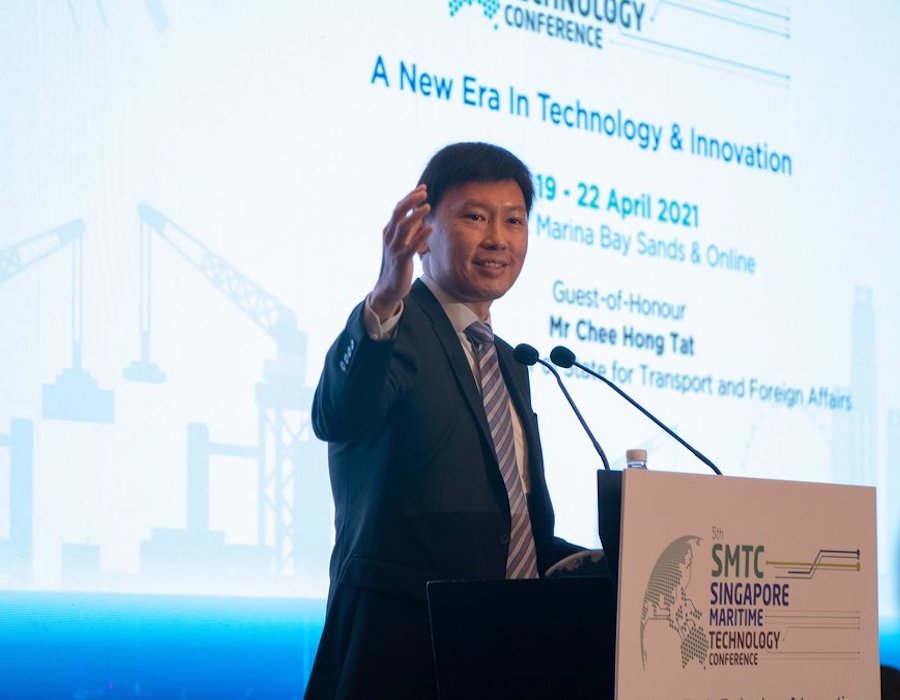
These developments were announced on Tuesday itself by Chee Hong Tat, Senior Minister of State for Foreign Affairs and Transport, at the SMTC. The SMTC is one of the key events organised in the Singapore Maritime Week 2021.

It was also announced that the MPA has allocated SGD 10 million (USD 7.5 million) from the MINT Fund to support the growth and development of maritime technology start-ups in Singapore. Under this expanded effort, MPA will also develop a digital technology marketplace and a start-up playbook.

The marketplace will connect maritime and venture capital companies with start-ups and facilitate discovery of solutions. The start-up playbook serves as a comprehensive guide for start-ups to springboard into Singapore tapping on schemes and support programmes relating to talent, capital and R&D resources.

As part of this endeavor, MPA will introduce a new grant scheme called MINT-STARTUP. Start-ups that have completed the PIER71 or relevant maritime acceleration programmes in Singapore can apply for a grant of up to SGD 50,000 to pilot their projects. Promising start-ups looking to scale up their offerings or projects can also apply for a project grant of up to SGD100,000.

PIER71 is a joint maritime innovation ecosystem between the Maritime and Port Authority of Singapore and the National University of Singapore through its entrepreneurial arm, NUS Enterprise.

Additionally, MPA also announced the successful completion of an eBL trial which demonstrated the interoperability between different digital trade platforms.

In January 2021, Singapore and the Netherlands completed a shipment where an eBL “shadowed” a live shipment from Qui Nhon, Vietnam to Rotterdam, the Netherlands via transhipment in Singapore.

The trial showed that there were significant time savings in the BL documentation process from an average of six to ten days when using a hardcopy to less than 24 hours when using an eBL.

This successful trial also marks one of the first title transfers, across different digital platforms, which was facilitated by TradeTrust, an open-standard digital utility to enable interoperability.

To catalyse adoption of eBLs, MPA is issuing a call-for-proposal (CFP) to develop and pilot eBL solutions that are based on open standards and meeting the United Nations Commission on International Trade Law (UNCITRAL) Model Law on Electronic Transferable Records (MLETR) framework.

Bringing together industry partners and solution providers, MPA noted the projects must be able to demonstrate benefits such as manpower savings and lowered fraud risk in commercial use cases. The Infocomm Media Development Authority and the Digital Container Shipping Association (DCSA) will be supporting this call.

MPA has also announced additions to the digitalOCEANS™ initiative focused on shaping and harmonising global data standards for maritime digitalisation. Senior Minister Chee welcomed the participation of DCSA, which will be joining MPA and other existing international partners in this key project.

As an industry body representing nine of the top container liners in the world and accounting for about 70% of the global container trade, DCSA will contribute cargo and vessel operational data standards, offering a boost towards interoperability of digital maritime platforms.

All partners will work on data harmonisation and target to jointly publish a set of API specifications for sharing across the international maritime community by end 2021.

This year’s SMTC also saw the signing of the 4th Memorandum of Understanding between MPA and PSA International on the Port Technology R&D programme. The programme aims to accelerate technology research, development and facilitate live trials in the areas of automated container port systems, advanced port optimisation techniques and green port technologies for application in existing container terminals and the new Tuas Port.

The programme will also uplift capabilities of the local port ecosystem including small and medium enterprises and research institutes. The MOU was signed at the SMTC by MPA Chief Executive, Quah Ley Hoon and PSA International Regional Chief Executive Officer (South East Asia), Ong Kim Pong, and witnessed by Senior Minister Chee and Niam Chiang Meng, Chairman, MPA and Tan Chong Meng, Group Chief Executive Officer, PSA International.

MPA also announced the extension of its Memorandum of Understanding with the Research Council of Norway (RCN) for an 8th term. Under the terms of the MOU, RCN and MPA will jointly support research in Maritime Digitalisation and Sustainable Shipping and organise the International Maritime-Port Technology and Development Conference.

This MOU will encourage maritime research institutes in Singapore and Norway to grow partnerships with maritime technology companies in both countries and to develop new capabilities.

This year’s SMTC takes place from Tuesday, 20 April to Thursday, 22 April and will be a hybrid conference featuring physical events at the Marina Bay Sands Convention Centre as well as virtual events taking place online.

The key focus of the conference is on critical issues facing the maritime industry, including industry transformation, digitalisation and decarbonisation, cyber resilience and the impact on ships and ports, as well as the growth of the start-ups in the sector and access to financing by industry players.

Close to 1,000 C-suite and senior executives from the maritime industry, R&D and tech community, start-up ecosystem and venture capitalists are expected to participate in the three-day conference both in-person and online.

More information on the CFP to develop eBL solutions is available here.  

MPA Maritime Boost 5

MPA Maritime Boost 4

As part of SMTC’s opening, a panel discussed Singapore’s vision for digital transformation, moderated by Quah Ley Hoon, Chief Executive, MPA.

MPA Maritime Boost 3

HE Anita Nergaard, Ambassador of Norway to Singapore and Mr Per Christer Lund, Science and Technology Counsellor, Innovation Norway, representing RCN.

MPA Maritime Boost 2

MOU was signed by MPA Chief Executive, Ms Quah Ley Hoon and PSA International Regional Chief Executive Officer (South East Asia), Mr Ong Kim Pong, and witnessed by Mr Chee and Mr Niam Chiang Meng, Chairman, MPA and Mr Tan Chong Meng, Group Chief Executive Officer, PSA International.


Photo credit: Maritime and Port Authority of Singapore
Published: 21 April, 2021
 

Continue Reading

Milestone

GCMD: Project CAPTURED achieves two regulatory milestones for onboard captured CO2

CO2 captured onboard during the project has been formally recognised for compliance under the EU ETS while a proposal submitted to MEPC 84, based on the project, has received IMO’s in-principle support.

Admin

Published

on

By

RESIZED venti views

Global Centre for Maritime Decarbonisation (GCMD) on Wednesday (21 July) said Project CAPTURED has achieved two regulatory milestones that strengthen the commercial case for onboard carbon capture and storage (OCCS).

This comes following its world’s first demonstration of an end-to-end value chain for onboard captured and liquefied CO2 (LCO2).

Completed in June 2025, the pilot showed that CO2 captured onboard a vessel can be offloaded ship-to-ship, transported overland and permanently bound through carbon mineralisation—a process that converts captured CO₂ into stable materials for industrial use.

The CO2 captured onboard during Project CAPTURED has been formally recognised for compliance under the European Union Emissions Trading System (EU ETS). This means the verified tonnage of captured CO2 can be deducted from emissions requiring the surrender of EU Allowances (EUAs).

To qualify for this recognition, the CO2 must be chemically bound permanently in eligible products. Project CAPTURED demonstrated that CO2 captured onboard vessels can meet this requirement through carbon mineralisation.

The data and learnings from the same demonstration formed the basis of a proposal submitted to MEPC 84. This proposal received in-principle support from the International Maritime Organization (IMO) for recognising carbon mineralisation as a form of permanent CO₂ storage.

Complementing geological sequestration, which is already accepted by the IMO, this recognition broadens the downstream options for CO2 captured onboard vessels, and supports the development of maritime carbon value chains. Beyond providing a permanent storage pathway, carbon mineralisation also creates the potential for captured CO2 to serve not only as a waste stream requiring permanent storage, but also as a feedstock for industrial applications through carbon mineralisation, extending emissions reductions beyond the shipping value chain.

Professor Lynn Loo, CEO, GCMD, said, “Project CAPTURED has moved OCCS beyond technical demonstration. The acceptance of the EU ETS deduction gives captured CO₂ a compliance value. At the same time, IMO’s in-principle support for carbon mineralisation will help clarify how captured CO2 can be treated after it leaves the vessel. Together, these milestones turn a pilot into a verified reference case for maritime carbon logistics, one that links regulatory recognition, commercial value and emissions impact.”


Photo credit: Venti Views on Unsplash
Published: 22 July, 2026

Continue Reading

Technology

Singapore: Ofiniti, ONE trial direct platform integration to streamline bunker workflows

Ofiniti started a trial in Singapore, integrating FuelBoss directly with a bunker buyer’s own platform, with Ocean Network Express as its first buyer-side integration partner.

Admin

Published

on

By

Singapore: Ofiniti, ONE trial direct platform integration to streamline bunker workflows

Ofiniti, the digital platform for maritime fuel operations, on Tuesday (21 July) said it has started a trial in Singapore, integrating FuelBoss directly with a bunker buyer’s own platform.

The company announced Singapore-headquartered container shipping firm Ocean Network Express (ONE) as its first buyer-side integration partner. 

“It is no coincidence we start in Singapore, as the Maritime and Port Authority of Singapore (MPA) remains at the forefront of digitalisation of all things bunkering,” the company said in a social media post.

In November 2023, MPA launched its digital bunkering platform, becoming the world’s first port to implement e-BDN. 

Ofiniti said every bunker delivery still runs on retyped data. 

“The buyer’s system says one thing, the supplier says another, and someone reconciles the gap by email, phone, or PDF. On every stem,” the company said. 

“We built FuelBoss to change this reality.”

With the integration, operational data now flows without manual re-entry, fewer reconciliation errors and faster processing and data, instead of documents, are readily available for procurement and claims workflows. 

“One connection will not transform the industry on its own, but digitalisation gets built one integration at a time. We are grateful to ONE for being willing to go first,” Ofiniti added.

Manifold Times previously reported ONE completing its successful trial of the electronic Bunker Delivery Note (e-BDN) with Shell. 

The e-BDN trial, using the digital bunkering solution developed by Angsana Technology, was conducted on 9 September 2023 at the Port of Singapore, with support from the MPA.

In March 2025, Ofiniti acquired Singapore-based Angsana Technology, with the entire Angsana team joining Ofiniti as part of the acquisition.

Related: MPA Chief Executive: Port of Singapore begins digital bunkering initiative today
Related: Singapore set to become first port in the world to debut electronic bunker delivery notes
Related: ONE completes e-BDN adoption trial with Shell in Port of Singapore
Related: Ofiniti acquires Singapore-based Angsana Technology to advance digital bunkering solutions


Photo credit: Ofiniti
Published: 22 July, 2026

Continue Reading

Technology

Genevos and Koedood Marine Group team up on maritime hydrogen fuel cell deployment

Collaboration will explore how ready-to-use marine fuel cell systems can support shipowners and shipyards in the transition towards zero-emission operations.

Admin

Published

on

By

Genevos and Koedood Marine Group team up on maritime hydrogen fuel cell deployment

Marine fuel cell systems provider Genevos recently said the company signed a Letter of Intent (LOI) with engine supplier Koedood Marine Group to explore the deployment of hydrogen fuel cell systems for inland and coastal maritime transport. 

The LOI was signed by Phil Sharp, co-founder and CTO of Genevos, and Mühlheim, Business Development Director of Koedood Marine Group during the 2026 Advanced Maritime Technology Show in Amsterdam.

Building on Koedood’s proven experience in hydrogen maritime projects – including its ongoing work with Mitsubishi Heavy Industries and TNO on hydrogen engine development – the collaboration will explore how ready-to-use marine fuel cell systems can support shipowners and shipyards in the transition towards zero-emission operations. 

“Koedood has a strong reputation in the maritime sector and a deep understanding of vessel operators’ needs. This LOI is an important step in exploring how Genevos’ hydrogen fuel cell systems can be deployed more widely across inland and maritime applications, helping shipowners reduce onboard emissions with robust, practical and scalable clean power solutions,” said Sharp.

The collaboration aligns with growing market demand for rapidly deployable hydrogen solutions and the wider need to accelerate the adoption of zero-emission technologies across the maritime sector. 

“With this collaboration, we are further strengthening our portfolio of maritime energy solutions. Together with Genevos, we are exploring how we can support our customers in the adoption of hydrogen technology,” said Mühlheim.


Photo credit: Genevos
Published: 20 July, 2026

Continue Reading

Trending