Connect with us

Alternative Fuels

Evos Rotterdam starts construction on methanol and ethanol expansion project

Once operational in early 2028, the expansion will give Evos Rotterdam greater capacity to handle methanol and ethanol for industrial customers, as well as for low-carbon marine fuels and bunkering.

Admin

Published

on

Evos Rotterdam starts construction on methanol and ethanol expansion project

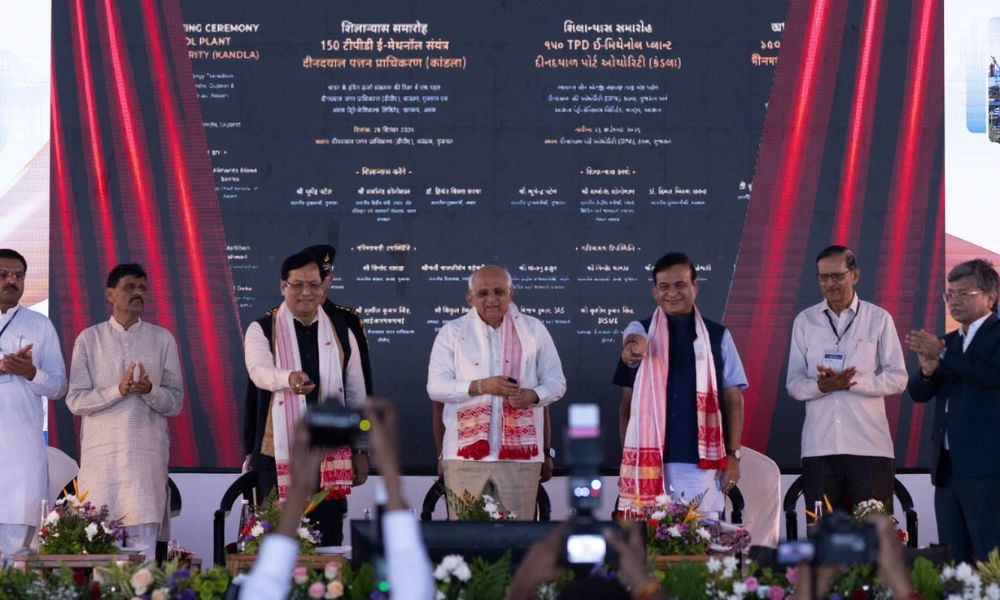
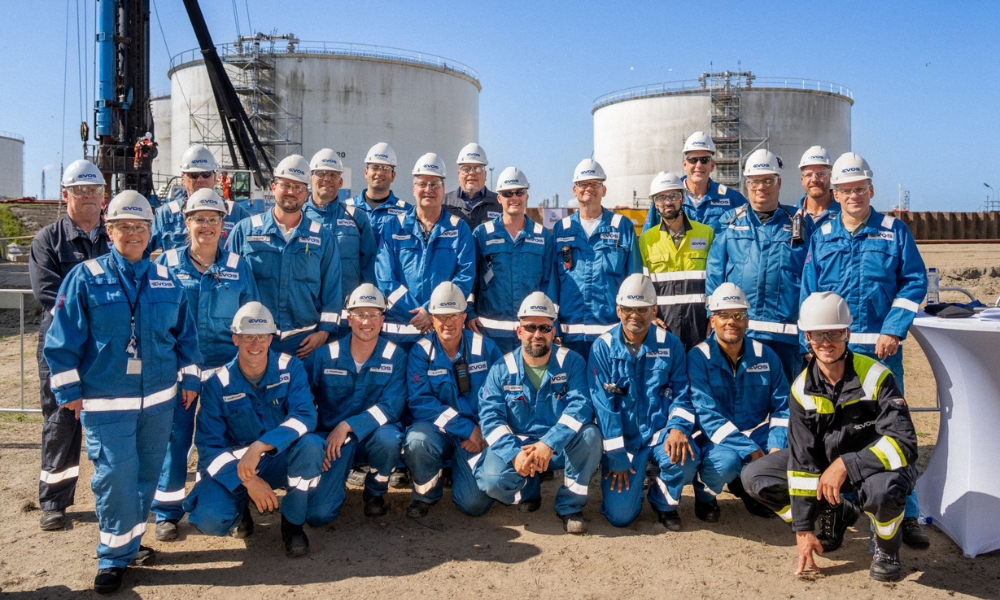
Evos Rotterdam on Thursday (25 June) said it has held the ground-breaking ceremony for its methanol and ethanol expansion project at the Port of Rotterdam, formally starting the construction phase of a major investment in additional terminal capacity.

The project comprises five new storage tanks with a combined gross capacity of 67,500 cubic metres, a new pump station and a new jetty, developed in close cooperation with the Port of Rotterdam. 

Once operational in early 2028, the expansion will give Evos Rotterdam greater capacity to handle methanol and ethanol for industrial customers, as well as for the developing market in cleaner, low-carbon marine fuels and bunkering.

Daan Vos, CEO of Evos, said: “This ground-breaking ceremony is the starting point for the construction phase of a project that has required close cooperation, technical focus and long-term commitment. 

“I would like to thank the Port of Rotterdam, our contractors and all project partners who joined us and who have helped bring the project to this stage. 

“This expansion strengthens Rotterdam’s position in methanol and ethanol logistics, including low-carbon methanol, and gives our customers the capacity they need as markets continue to change.”

Christiaan Kop, Managing Director Evos Rotterdam, said: “Thank you to everyone who joined us to officially start this project. It was a strong beginning for an excellent project. 

“I would also like to thank the project team for helping to organise the ceremony so well. The team has shown the professionalism and confidence this project deserves.”


Photo credit: Evos Rotterdam
Published: 29 June, 2026
Continue Reading

Newbuilding

Yang Ming names third 15,500 TEU LNG dual-fuel boxship in South Korea

Company held a naming ceremony at HD HHI shipyard in Ulsan, South Korea, for “YM Wayfinder”, the third vessel in its series of LNG dual-fuel container vessels built by HD HHI.

Admin

Published

on

By

Yang Ming names third 15,500 TEU LNG dual-fuel boxship in South Korea

Taiwanese shipping firm Yang Ming Marine Transport Corporation (Yang Ming) on Friday (26 June) said it held a naming ceremony at the HD Hyundai Heavy Industries (HD HHI) shipyard in Ulsan, South Korea, for YM Wayfinder.

It is the third vessel in its series of 15,500 TEU-class LNG dual-fuel container vessels built by HD HHI. 

Mrs. Wei-Nung Kao, the spouse of Yang Ming’s Chairman, Mr. Feng-Ming Tsai, was invited as the Godmother to officially name the vessel and perform the ceremonial cord-cutting.

As additional LNG dual-fuel vessels join the fleet, Yang Ming will enhance operational efficiency, strengthen service competitiveness, and further reduce fleet carbon intensity to provide customers with low-carbon transportation services.

This series of vessels built by HD HHI has a length overall (LOA) of 364.97 metres, a breadth of 51 metres, and a capacity of approximately 15,600 TEU. 

In alignment with the global net-zero emissions target by 2050, Yang Ming has been actively expanding its energy-efficient fleet and is the first container shipping company in Taiwan to operate vessels utilising LNG as an alternative fuel. 

Equipped with high-pressure dual-fuel main engines that run on both LNG and low-sulphur fuel oil, this series of vessels primarily utilises LNG as fuel upon delivery, which immediately reduces greenhouse gas emissions by approximately 20% compared to conventional fuel oil. 

Two sister vessels in the LNG dual-fuel series, YM Willpower and YM Worthiness, are already in service and primarily operate on LNG. To date, the two vessels have bunkered more than 11,158 metric tonnes (mt) of LNG, which is expected to reduce greenhouse gas emissions by up to 12,532 mt.

YM Wayfinder is scheduled to commence service on the Asia-North Europe FE3 service on 1 July. 

The vessel’s deployment will enable Yang Ming to maximise slot utilization and enhance the competitiveness of its service network while fulfilling the company’s commitment to providing comprehensive, efficient, and energy-saving transportation services for customers. 

The comprehensive port rotation for the FE3 service is: Qingdao – Ningbo – Yantian – Singapore – Felixstowe – Antwerp – Hamburg.


Photo credit: Yang Ming Marine Transport Corporation
Published: 29 June, 2026

Continue Reading

Ammonia

Pilbara Ports confirms plans for first ammonia bunkering trial in late 2026

This comes following Fortescue and CMB.TECH announcing their landmark agreement to introduce dual-fuelled ammonia bulk-carriers to the Pilbara.

Admin

Published

on

By

Pilbara Ports confirms plans for first ammonia bunkering trial in late 2026

Australia’s Pilbara Ports Authority on Friday (26 June) confirmed progress of its plans for the first ammonia bunkering trial at the Port of Port Hedland later this year.

On its website, the port authority said ammonia-fuelled vessels are expected to begin visiting Pilbara as early as this year. 

This comes following Fortescue and CMB.TECH announcing their landmark agreement to introduce dual-fuelled ammonia bulk-carriers to the Pilbara, a significant milestone in accelerating the transition to low-carbon shipping.

The port authority said the announcement reflects the growing global momentum behind ammonia as a marine fuel and the collective effort across industry to decarbonise supply chains. 

On 22 June, Fortescue said it signed an agreement with CMB.TECH for the charter of up to 12 ammonia-capable vessels.

Under the agreement, Fortescue will charter a fleet of 12 Newcastlemax dry bulk vessels (210,000 dwt) from Bocimar, CMB.TECH’s dry bulk shipping operator.

Up to three of the vessels will be delivered with dual-fuel ammonia engines and are expected to enter service by the end of 2026. The remaining nine vessels will be ammonia-ready and can be converted to operate on ammonia in the future.

“At Pilbara Ports, we’re proud to be supporting this transition, with plans progressing for our first ammonia refuelling trial at the Port of Port Hedland later this year,” the port authority said.

“This work will help ensure the Pilbara is ready – with the infrastructure, safety frameworks and operational capability needed to support the next generation of cleaner vessels.”


Photo credit: Pilbara Ports AuthorityPublished: 29 June, 2026

Continue Reading

Alternative Fuels

ICS report: LNG and biofuels seen as most viable marine fuels over next decade

This was followed closely by HFO combined with abatement technologies while methanol ranked in fourth place, according to ICS’s new Maritime Barometer Report.

Admin

Published

on

By

RESIZED william william on Unsplash

A new report by the International Chamber of Shipping (ICS), published on Tuesday (23 June) found that  LNG and biofuels are seen as the most viable marine fuels over the next decade.

This was followed closely by HFO (Heavy Fuel Oil) combined with abatement technologies while methanol ranked in fourth place. 

The report found that in 2025 to 2026, maritime leaders are displaying a preference for traditional fuels that have established supply mechanisms. 

The ICS Maritime Barometer Report 2025–2026 surveyed C-suite level leaders, shipowners, and operators worldwide to identify the key risk areas shaping shipping. 

Despite slight decline, LNG shared top spot with biofuels as one of three most viable future fuels over the next decade. 

LNG maintained its position as a joint leading fuel in the Barometer, with roughly 51.35% of leaders naming it as one of the most viable fuels over the next decade. 

“This is despite a marginal softening in sentiment amongst maritime leaders compared to last year’s survey, reflecting its continued role as the most immediately scalable alternative within the current fuel mix,” the report said. 

However, the report noted that this positioning is increasingly shaped not just by infrastructure maturity, but by how geopolitical instability translates into fuel-specific perceptions of security, routing exposure, and price volatility across global trade flows.

This is particularly evident in Asia-Pacific and the Middle East, where LNG’s role is reinforced through continued investment in import and bunkering infrastructure.

Singapore remains the world’s leading LNG bunkering hub, supported by expanding small-scale supply chains and vessel availability, while South Korea and China are rapidly scaling receiving and bunkering capacity to support both shipping and power demand growth.

Biofuels record one of the sharpest increases in sentiment across the future fuels landscape to match LNG at 51.35% in this year’s report.

“This could reflect a shift driven less by structural conviction and more by operational response to heightened uncertainty in global energy and trade systems,” it said. 

Their growing prominence could be closely linked to the increasing attractiveness of low-friction compliance options in a context where alternative fuels remain constrained by uneven infrastructure development, fragmented regulatory alignment, and delayed capital deployment across key regions.

Compared with LNG, which is shaped by infrastructure lock-in and geopolitical price exposure, biofuels offer immediate operational flexibility.

Japan has emerged as a key driver of marine biofuel adoption, with government-backed trials involving major shipping lines such as NYK testing biofuel blends on international routes. China has also expanded pilot programmes using biodiesel and waste-derived fuels in coastal shipping, reflecting a pragmatic approach to emissions reduction in regional trade flows.

Note: The ‘ICS Maritime Barometer Report 2025–2026’ can be viewed here


Photo credit: william william on Unsplash
Published: 26 June, 2026

Continue Reading

Trending