Connect with us
DNV Decarbonization Insight Series August 2026 - What maritime professionals should know about AI Training

Alternative Fuels

Repsol launches commercial co-processed marine fuel supply in Algeciras

Firm said this marked the deployment of immediate solutions produced by integrating renewable content directly into conventional refinery processes.

Admin

Published

on

Repsol launches commercial co-processed marine fuel supply in Algeciras

Spanish energy company Repsol on Thursday (18 June) said it has started the commercial supply of co-processed marine fuels with renewable content in the port of Algeciras, one of the main bunkering hubs in the Mediterranean. 

The company said this marked the deployment of immediate solutions produced by integrating renewable content directly into conventional refinery processes, supporting the decarbonisation of maritime transport.

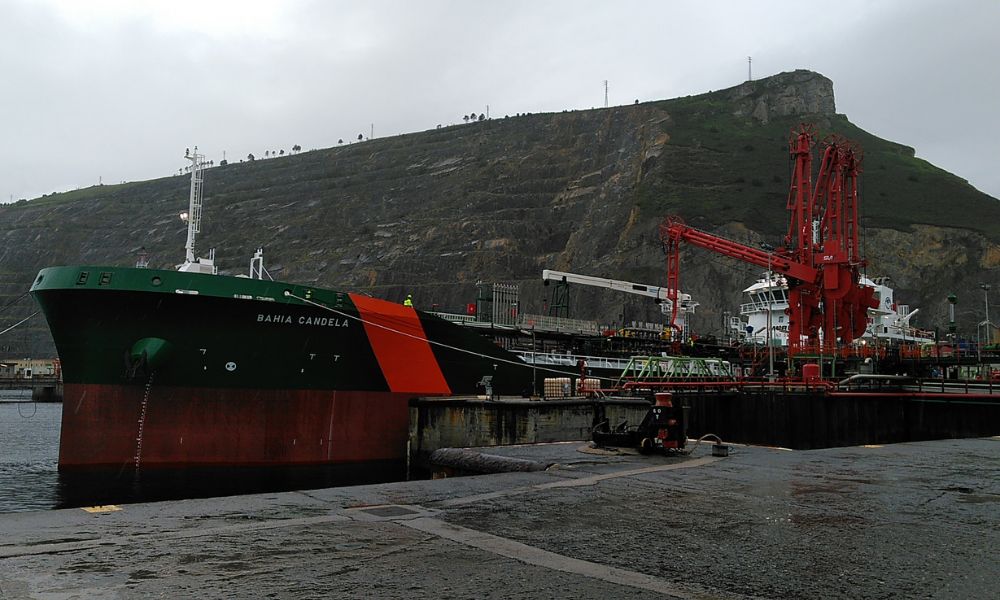
Last week, Repsol launched the first commercial voyage of its new generation bunkering vessel Bahía Candela. During this first voyage, the vessel loaded co-processed fuel at Repsol’s Petronor refinery in Bilbao, reinforcing the company’s end-to-end supply capability by integrating refining, logistics, and delivery.

Repsol reportedly chartered the bunkering vessel from shipowner Mureloil. 

Designed specifically for marine fuel supply, Bahía Candela features multiproduct capabilities and is prepared to operate with low-emission energy solutions. Its diesel-electric propulsion system and advanced energy storage enable optimised efficiency and reduced emissions during operations.

“This milestone marked Repsol’s entry into the supply of low-carbon marine fuels in Algeciras, leveraging its integrated value chain and expanding its multi-energy offering in the maritime sector, combining conventional products with low-carbon alternatives, thus, strengthening its ability to adapt to the diverse needs of its customers,” Repsol said in a statement. 

Co-processing enables the integration of renewable feedstocks, such as oils and residues, alongside conventional streams within refining processes. 

This generates fuels with a low-carbon footprint and supports a gradual transition towards solutions that will help to decarbonise the sector, providing a cost-efficient and scalable pathway to supply low-carbon fuels that are fully compatible with existing engines and infrastructure, without requiring changes to vessels or port assets, and using current industrial assets.

Related: Mureloil deploys hybrid chemical tanker for bunkering and terminal transport


Photo credit: Repsol
Published: 22 June, 2026

Continue Reading

Biofuel

MESD study finds existing Singapore harbour craft ready for B100 bio bunker fuel adoption

Results demonstrate the qualified readiness of existing large harbour craft in Singapore for B100 adoption, provided that appropriate fuel-handling, storage and additive practices are implemented.

Admin

Published

on

By

MESD study finds existing Singapore harbour craft ready for B100 bio bunker fuel adoption

Singapore’s Maritime Energy & Sustainable Development Centre of Excellence (MESD) on Wednesday (5 August) said the findings of its latest study indicate that existing large harbour craft in Singapore are ready for the adoption of B100 biodiesel, provided appropriate fuel handling, storage and additive practices are in place.

The findings were published in MESD’s public report, Study on the Readiness of Existing Large Harbour Craft for B100 Biodiesel in Singapore.

“Overall, the results demonstrate the qualified readiness of existing large harbour craft in Singapore for B100 adoption, provided that appropriate fuel-handling, storage and additive practices are implemented,” MESD said in a social media post. 

“This represents an important step towards supporting the wider adoption of sustainable marine fuels and advancing Singapore’s maritime decarbonisation journey.”

The study evaluated fuel storage stability, engine performance, emissions and operational readiness through controlled laboratory testing and sea trials involving a tugboat and a bunker tanker.

MESD said the findings are highly encouraging, which include:

  • Stable engine performance was maintained throughout the 200-hour sea trials, with no significant power loss, abnormal fuel-consumption trends or critical operational disruptions.
  • Antioxidant additives improved oxidation stability and helped reduce the risk of fuel degradation during storage.
  • B100 achieved brake thermal efficiency comparable to diesel, while producing lower carbon monoxide and particulate matter emissions, with a modest increase in nitrogen oxide emissions.

Led by the MESD, the study was conducted in collaboration with KST Maritime Pte Ltd, V-Bunkers Tankers, Alpha biofuels, Aderco, Maritec Naias and IHI Power Systems Co Ltd.

The Maritime and Port Authority of Singapore (MPA)​ and the ​Singapore Maritime Institute (SMI)​ also contributed to the study. 

MESD added that further research on long-term engine endurance, fuel stability and material compatibility is ongoing under its FAME 1000 project, with a related public report expected to be released later this year.

Note: The report can be accessed here.


Photo credit: Maritime Energy & Sustainable Development Centre of Excellence
Published: 7 August, 2026

Continue Reading

Methanol

COSCO Shipping deploys methanol-ready grain carrier on South America-China routes

“Guo Liang Hai” is equipped with a smart management system, low-carbon design features and a methanol-ready fuel interface, supporting future energy transition pathways.

Admin

Published

on

By

COSCO Shipping deploys methanol-ready grain carrier on South America-China routes

COSCO Shipping on Thursday (6 August) said a methanol-ready 80,000 DWT multi-purpose grain carrier, GUO LIANG HAI, has officially been delivered and entered service.

At nearly 230 metres in length, Guo Liang Hai is equipped with a smart management system, low-carbon design features and a methanol-ready fuel interface, supporting future energy transition pathways.

“As the sixth vessel in its series, she is part of the world’s first 80,000 DWT vessel class specifically designed for grain transportation. But grain is only part of the story,” the company said in a social media post. 

The company said the vessel combines the efficiency of a bulk carrier with the flexibility of a multi-purpose ship. 

In addition to commodities such as soybeans, maize and wheat, it can also transport grain and dry bulk cargo, containers, wind power equipment, rolling stock and rail equipment, new energy vehicles and large-scale industrial machinery.

“Already deployed on routes between South America and China, vessels in this series create value in both directions, carrying agricultural imports while supporting exports of Chinese-made equipment and technology,” the company added.


Photo credit: COSCO Shipping
Published: 7 August, 2026

Continue Reading

LNG Bunkering

EXMAR to convert LNG carrier into floating transshipment unit for bunkering

Vessel will soon undergo a dry-dock including modifications to make the vessel suitable as a floating transshipment unit, dedicated to the LNG bunkering market.

Admin

Published

on

By

EXMAR to convert LNG carrier into floating transshipment unit for bunkering

Ship owner EXMAR on Thursday (6 August) announced that it has taken delivery of the 146,000 m³ LNG Carrier SIMAISMA

The vessel is secured under an initial seven-year charter contract with a “first-class counterpart”. 

“The vessel will soon undergo a dry-dock including modifications to make the vessel suitable as a floating transshipment unit (FTU), dedicated to the LNG bunkering market,” it said in a statement. 

The FTU will receive large parcels of LNG from trading LNG carriers and specialised LNG bunkering vessels will load at the FTU before supplying it as a fuel to vessels that use this LNG as a bunker fuel.

EXMAR’s CEO, Carl-Antoine Saverys, said: “EXMAR is gladly assisting its client in further paving the way to unlock LNG as a fuel for the shipping industry. 

“The FTU is a smart solution with which our client brings down the costs of the logistics relating to the LNG bunkering. 

“With this solution, we are building upon EXMAR’s close to 50 years of LNG experience. We look forward to deploying more of these assets to unlock the full potential of LNG as a fuel for the maritime industry.”


Photo credit: EXMAR
Published: 7 August, 2026

Continue Reading

Trending