Connect with us

Alternative Fuels

SMW 2026: Singapore, LA, and Long Beach Ports renew Green, Digital Shipping Corridor MoU

All three ports have advanced their alternative fuels bunkering capabilities since the corridor’s launch which will prepare them for green fuel trials in the next phase of their partnership.

Admin

Published

on

Singapore, LA, and Long Beach Ports renew Green and Digital Shipping Corridor MoU

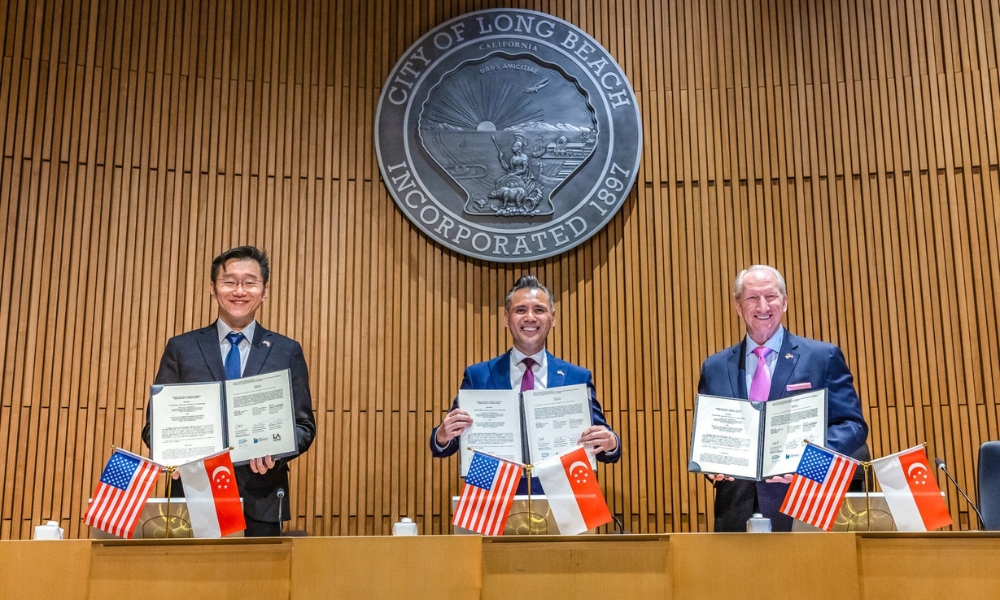
The Maritime and Port Authority of Singapore (MPA) on Monday (20 April) said it has renewed a Memorandum of Understanding (MoU) with Port of Los Angeles (POLA), and Port of Long Beach (POLB), with the support of C40 Cities, on the Green and Digital Shipping Corridor for another three years.

First signed in 2023, the renewal reinforces the ports’ commitment to decarbonisation and digitalisation along the Trans-Pacific route, one of the world’s busiest container trade lanes. It also supports efforts to strengthen supply chain resilience and energy security.

Since the corridor’s launch, several milestones have been achieved. These include the completion of a baseline study in 2024, onboarding of industry partners to explore potential pilot trials, and establishment of workstreams to advance pilot initiatives in alternative fuels, digitalisation, and energy efficiency. 

These initiatives support the development of more diversified and resilient energy pathways for international shipping.

All three ports have also advanced their alternative fuels bunkering capabilities. MPA completed methanol bunkering trials in 2023 and subsequently awarded three methanol bunkering supply licences. POLA and POLB have commissioned a Clean Fuels Study and are preparing for a methanol pilot in 2026. 

These developments prepare the three ports for green fuel trials in the next phase of their partnership. The partners have also conducted port-to-port data exchange testing and started pilot collaborations with Mitsui O.S.K. Lines.

Under the renewed MoU, the partners will continue working with industry to deploy low- and zero-emission fuels and digital solutions. This includes supporting fuel supply and infrastructure, developing pilot and demonstration projects, strengthening port-to-port data connectivity, and promoting interoperability, cybersecurity, and common standards.

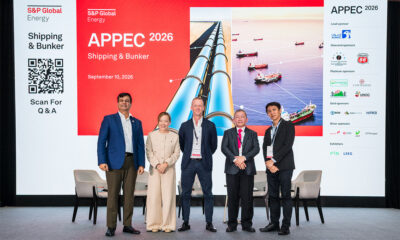
The MoU was signed ahead of the Singapore Maritime Week 2026 by Mr Ang Wee Keong, Chief Executive of MPA; Mr Gene Seroka, Executive Director of POLA; and Dr Noel Hacegaba, Chief Executive Officer of POLB. C40 Cities will continue to serve as a facilitator to convene partners, coordinate collaboration and provide communications support. 

Mr Ang Wee Keong, Chief Executive, MPA, said: “The Singapore-Los Angeles-Long Beach Green and Digital Shipping Corridor has made good progress, transitioning from intent to implementation. 

“The renewal of our partnership paves the way towards more sustainable shipping along the Trans-Pacific route. This gives industry greater confidence to plan investments and diversify energy options for greener shipping.”

Port of Los Angeles Executive Director Gene Seroka, said: “Decarbonising goods movement between the largest ports in the United States and Asia requires international cooperation and that’s exactly what we’re doing through our work on the Green and Digital Shipping Corridor. 

“We are committed to working toward the deployment of zero lifecycle carbon container ships on the corridor by 2030. This important corridor is the foundation upon which we’ll build the future of maritime shipping.”

Port of Long Beach CEO Dr. Noel Hacegaba, said: “Seaports sit at the intersection of trade, geopolitics, climate and technology. This convergence is what makes partnerships like the Green and Digital Shipping Corridor so impactful as a tool to decarbonise maritime shipping. 

“We call it the ‘green print’ for decarbonising the trans-Pacific route, the busiest trade route on Earth. It will be particularly important in the years ahead as we tackle our largest source of emissions, from cargo vessels, by accelerating the use of clean fuels such as methanol.”


Photo credit: Maritime and Port Authority of Singapore
Published: 21 April, 2026

Continue Reading

Alternative Fuels

MOL inks bio-LNG bunker fuel supply deals with Titan and Axpo for car carriers in Europe

Titan, part of Amsterdam-based Molgas, will continue to supply bio-LNG fuel in Northwest Europe, while Axpo will take charge of supply in the Mediterranean region.

Admin

Published

on

By

MOL inks bio-LNG bunker fuel supply deals with Titan and Axpo for car carriers in Europe

Mitsui OSK Lines (MOL) on Thursday (18 July) said it has signed new supply agreements in Northern Europe and the Mediterranean region to expand the use of bio-LNG marine fuel on MOL-operated LNG-fuelled car carriers.

Titan, part of Amsterdam-based Molgas, will continue to supply bio-LNG fuel in Northwest Europe, while Axpo will take charge of supply in the Mediterranean region.

MOL said the agreement makes it possible for its company to supply bio-LNG fuel for automobile carriers in the Mediterranean region, specifically Port of Malaga and Barcelona in Spain, following the bio-LNG fuel supply agreement in Western Europe, which commenced in March last year.

The bio-LNG fuel to be supplied in this initiative has a lifecycle carbon intensity (carbon dioxide emissions per unit of energy consumption) of -15 g-CO2/MJ or less, from production through consumption. Furthermore, this bio-LNG fuel has obtained International Sustainability and Carbon Certification (ISCC-EU). 

“Through this supply agreement, MOL has established a framework that ensures a continuous and stable supply of bio-LNG fuel not only in Northern Europe but also in the Mediterranean,” the company said.

As part of the group’s efforts to adopt alternative fuels and achieve net-zero greenhouse gas (GHG) emissions, it is utilising LNG-fuelled vessels as a bridge solution to facilitate the transition to carbon-neutral fuels such as bio-LNG and synthetic LNG (e-methane).

In 2025, MOL signed a bio LNG fuel supply agreement in Northwest Europe with Titan, part of the Molgas, and MOL has continued this bio LNG fuel supply agreement with the same company in 2026 as well.


Photo credit: Mitsui OSK Lines
Published: 19 June, 2026

Continue Reading

Biofuel

Kvasir Technologies lands EUR 10 million to scale bio bunker fuel production

The Danish biofuel startup raised the fund in a Series A investment round, which will provide capital to develop and design a new commercial production plant and scale climate-neutral drop-in marine fuel.

Admin

Published

on

By

Kvasir Technologies lands EUR 10 million to scale bio bunker fuel production

Danish biofuel startup Kvasir Technologies on Thursday (18 June) said it has raised EUR 10 million (USD 11.4 million) in a Series A investment round with participation from European Energy as a new investor, alongside existing investors EIFO, Maersk Growth and Footprint Fund. 

The Series A round provides capital to develop and design a new commercial production plant and scale climate-neutral drop-in fuel to be used in existing vessels.

At the same time, European Energy and Kvasir Technologies are entering into a strategic partnership by establishing the company KVEEN Biofuels, which is working towards the construction of a commercial-scale plant to produce biofuels using Kvasir Technologies’ patented technology.

“This investment round enables us to take the next crucial steps in developing and scaling our technology. At the same time, it underlines that there is still strong support for solutions that can deliver real climate impact in the maritime sector,” said Joachim Bachmann Nielsen, Ph.D. in Chemical Engineering and CEO of Kvasir Technologies.

Kvasir Technologies, a spin-out from research at the Technical University of Denmark (DTU), has developed a new technology to convert a wide range of non-edible lignin- based residues from agriculture and forestry into refined biofuels for shipping.

The climate-neutral biofuel can serve as an immediate replacement for fossil marine fuel without the need to modify ship engines or change existing infrastructure.

The new funding will be used, among other things, to scale the technology at Kvasir Technologies’ test facility in Fredericia, which can produce up to 2 metric tonnes (mt) of biofuel per day.

At the same time, development work will begin on the first commercial plant in the city of Aabenraa in the southern part of Jutland, which will demonstrate the technology on an industrial scale.


Photo credit: Kvasir Technologies
Published: 19 June, 2026

Continue Reading

Engine

BeHydro secures LR’s first class approval for 100% hydrogen marine engine

Engine has been developed and tested at ABC Engines’ facility in Ghent and is designed to operate entirely on hydrogen, without the need for pilot fuels.

Admin

Published

on

By

BeHydro secures LR’s first class approval for 100% hydrogen marine engine

Classification society Lloyd’s Register (LR) on Wednesday (17 June) said it has issued the first Type Approval Certificate for a 100% hydrogen-fuelled, spark-ignited marine engine.

The approval has been awarded to the hydrogen engine developed by BeHydro and confirms the design meets LR’s requirements for safety, performance and reliability in marine applications.

The engine has been developed and tested at ABC Engines’ facility in Ghent and is designed to operate entirely on hydrogen, without the need for pilot fuels. This simplifies system design and removes onboard carbon emissions at source, positioning the technology as a practical option for operators exploring zero-carbon propulsion.

Claudene Sharp-Patel, Global Technical Director, Lloyd’s Register, said: “The issue of this Type Approval Certificate demonstrates that hydrogen-fuelled internal combustion engine technology is continuing to mature as a viable option for maritime applications.

“For shipowners and operators, independent certification is essential in building confidence that emerging fuel technologies can meet the industry’s expectations for safety, reliability and operational performance.”

Tim Berckmoes, CEO at ABC Engines, said: “This LRS type approval of our BeHydro 100% hydrogen engines with zero emissions is a confirmation of the future proof technology that BeHydro can offer to innovative shipowners worldwide.

“The 100% hydrogen engine range is available from 900 kW till 2670 kW for different marine applications.”

LR previously awarded Type Approval to BeHydro for its hydrogen-powered dual-fuel engine in 2023, which was the first Type Approval for a dual-fuel hydrogen engine. 


Photo credit: Lloyd’s Register
Published: 19 June, 2026

Continue Reading

Trending