Connect with us

Biofuel

Argus Media: B100 seen attractive shipping fuel option after MEPC 83

Global biodiesel demand is likely to strengthen in the near-term following the emergence of clearer international pricing standards for GHG emissions, according to panellists at a Singapore conference.

Admin

Published

on

resized argusmedia

More buyers in the shipping sector will consider biofuel blends of up to B100 now a greenhouse gas (GHG) pricing mechanism has been laid out by the International Maritime Organization (IMO), according to panellists at the Argus Biofuels & Feedstocks Asia Conference.

25 April 2025

Global biodiesel demand is likely to strengthen in the near-term following the emergence of clearer international pricing standards for GHG emissions, they said.

“B100 seems to have great momentum based on the [83rd Marine Environment Protection Committee] MEPC meeting,” said French certification society Bureau Veritas’ VeriFuel global business development director Bill Stamatopoulos. MEPC 83 is “a clear indication that we have to work together and work fast” because there is a cost penalty for not switching away from conventional marine fuels, said Danish tanker owner Hafnia’s general manager of project and fleet sustainability, Pankaj Porwal.

Most maritime participants welcomed the two-tier GHG pricing framework approved by the IMO at MEPC 83 from 7-11 April, which is a key milestone as the maritime sector pushes for decarbonisation.

Biofuels like B24, B30, and B100 will gain more interest because of cost-savings for buyers when switching to cleaner fuels, said Singapore bunker supplier Equatorial Marine Fuel’s (EMF) chief operating officer Choong Sheen Mao. B24 is 24pc of used cooking oil methyl ester (Ucome) blended with 76pc of conventional fuel, such as very-low sulphur fuel oil (VLSFO), while B100 is pure biodiesel not blended with fossil fuels.

Panellists said bunkering B100 would provide significant advantages for ships with voyages in EU waters, where firms can “pool” multiple vessels within the EU Emissions Trading System (ETS) and FuelEU Maritime Regulation to balance compliance surpluses and deficits. But vessel shipowners would need to be “absolutely sure” of the amount of fuel required for the voyage, to avoid any unknown consequences if excess biofuels were mixed with other fuel types, said Hafnia’s Porwal.

The GHG pricing mechanism gives bunker buyers a “strong indication” of the cost of not switching to alternative marine fuels and this will drive biodiesel demand as buyers realise “they need to get involved in some way”, said EMF’s Choong, adding that suppliers can consider selling biodiesel if it is “commercially viable”.

There will be a minimum cost of compliance in adhering with IMO decarbonisation targets, but smaller shipowners should start running trials and “building quality control systems for your marine fuels so you’re prepared to take on greener fuels”, said International Bunker Industry Association (IBIA) Asia chair Rahul Choudhuri.

“At the moment hedging is very much focused on VLSFO and gasoil… but as exposures change and regulations change, we’ll see more instruments being used to counter [trading risks],” said shipbroker Braemar oil derivatives broker Rebecca Reed-Sperrin. As the decarbonisation mandates grow, “hopefully liquidity increases tremendously” for marine biofuels, she said.

Challenges

Panellists cited several barriers in the widespread uptake of biofuels in the shipping sector, such as availability of Ucome feedstock, controversies regarding feedstock origin, and limited biodiesel shelf life compared to conventional marine fuels.

Fuel pricing and costs associated with bunkering biofuels surfaced as key concerns. International regulations are complex and buyers have to assess “what is [the] real price” taking into account IMO regulations, said Bureau Veritas’ Stamatopoulos.

Charterers and tanker operators face difficulties in securing a price without hidden costs involved, Italian ship owner Fratelli Cosulich biofuel trading advisor Sebastiaan Bruins. B100 is available but suppliers are not actively selling it as buying interest has been limited, Bruins said.

China will be a “dominant force” for B100 supplies because of a larger Ucome volume, and market developments would depend on how China portions domestic and export volumes of Uco, said Choong.

Long-term uptake agreements for biofuel with major shipowners would be important in scaling up biofuel bunker supplies, said Indonesian state-owned refiner PT Pertamina’s marine fuels trading manager Justin Tan. Bunker buyers need to signal their interest regarding biofuels “so we know where to start too”, he said.

The maritime sector is still looking at a multifuel future since the supply of “Ucome alone cannot meet shipping’s needs”, said Danish tanker owner Maersk senior green fuel originator Felicia Ng.

By Cassia Teo


Photo credit and source: Argus Media
Published: 28 April, 2025

Continue Reading

Alternative Fuels

Auramarine: Marine fuel flexibility will be key to shipping’s energy transition

Operators who adapt best will be the ones who built in the flexibility to their marine fuel strategy to respond as conditions change, says CEO John Bergman.
Admin

Published

on

By

31 1

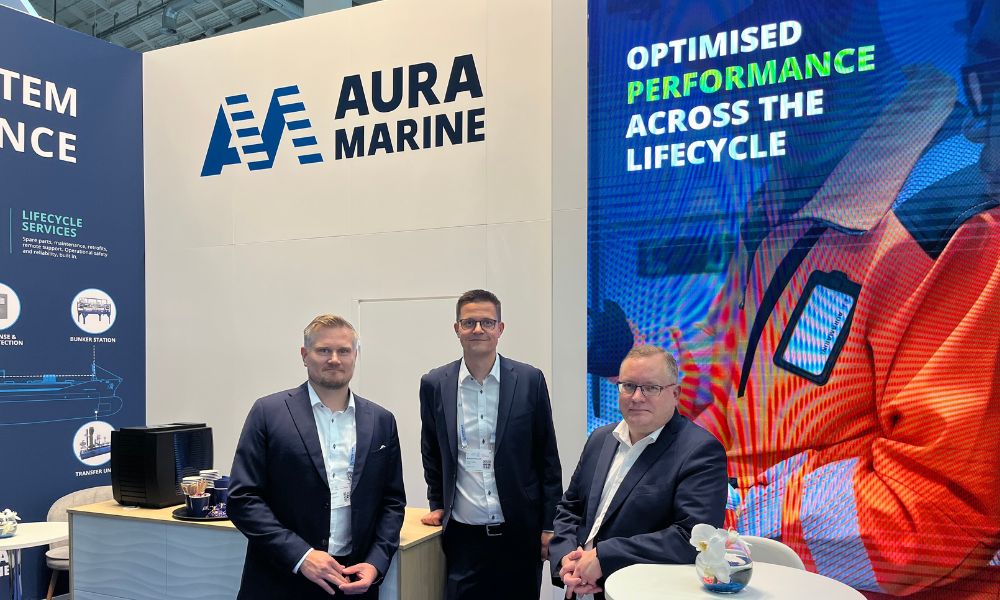
Finland-based fuel supply systems provider Auramarine on Wednesday (2 September) said it believes shipping’s energy transition is entering a phase where flexibility, not fuel choice, will determine which operators adapt successfully. 

With fuel price volatility, inconsistent alternative availability and tightening environmental regulation at different speeds across regions, Auramarine argued that the right approach to fuel supply infrastructure is now as strategically important as the fuel itself.

“The industry has spent years asking which fuel will win,” said John Bergman, CEO, Auramarine. 

“That may be the wrong question. No operator today can predict with confidence what will be available, compliant or commercially viable in five years. The operators who adapt best will be the ones who built in the flexibility to their fuel strategy to respond as conditions change.”

Auramarine’s own fuel split technology, first delivered in 2019 and now installed on around 20 vessels, reflects this thinking in practice. The retrofit system adds a fuel booster module onboard, allowing a ship to run different fuels through the same engine without the extended changeover procedures dual-fuel systems typically require.

This lets operators switch to MGO or biofuel, for example, to meet an ECA requirement, support maintenance schedules, or respond to fuel pricing shifts, without taking a vessel out of service. Delivered in sections through existing doors and hatches, it can be retrofitted to vessels already in operation.

Bergman sees this need for adaptability sharpening in sectors under the most operational and regulatory pressure. 

“Cruise and ferry operators feel this earliest and most acutely,” he said. 

“These vessels constantly move between regulatory zones and environmentally sensitive waters, so the ability to switch fuel supply without disrupting a schedule is an operational necessity. What’s notable is how many operators in this space still don’t know infrastructure like this exists, despite how directly it addresses what they’re already dealing with.”

Reliable flexibility requires a tailored approach, not just adding equipment. “The best results come from scoping flexibility to an owner’s actual fuel strategy, not adding complexity for its own sake,” Bergman added. 

Automated fuel changeover systems are designed to keep multi-fuel operations straightforward for crews, while a structured maintenance approach ensures inspection, testing and servicing can be carried out safely throughout the vessel’s lifecycle. This is where Auramarine’s lifecycle services play a central role, supporting operators well beyond initial installation with the ongoing servicing, spares and technical support needed to keep flexible fuel systems performing reliably for the long term, whatever the fuel landscape looks like in years to come.

“Over the next few years, operators who succeed will be the ones who stopped waiting for certainty and started building optionality instead,” Bergman added

“In a transition this uncertain, adaptability matters more than any single fuel bet. That’s the conversation we want the industry to have.”


Photo credit: Auramarine
Published: 7 September, 2026

Continue Reading

Alternative Fuels

DNV: Alternative-fuelled vessel orders hit highest monthly level since October 2024

LNG-fuelled vessels accounted for the vast majority of August activity while the strong summer performance marked a significant acceleration in ordering activity after a relatively slow start to the year.
Admin

Published

on

By

DNV: Alternative-fuelled vessel orders hit highest monthly level since October 2024

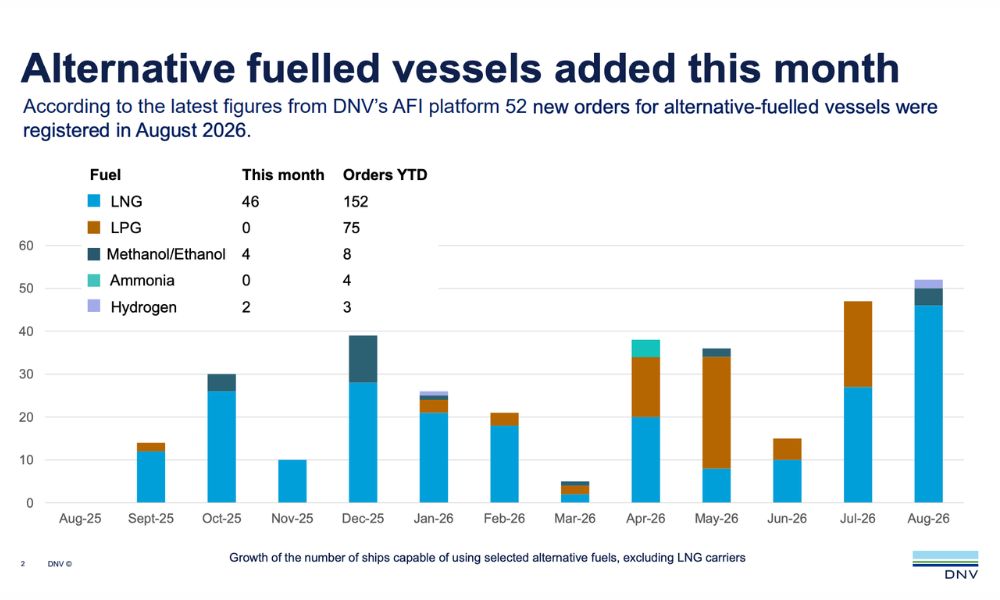
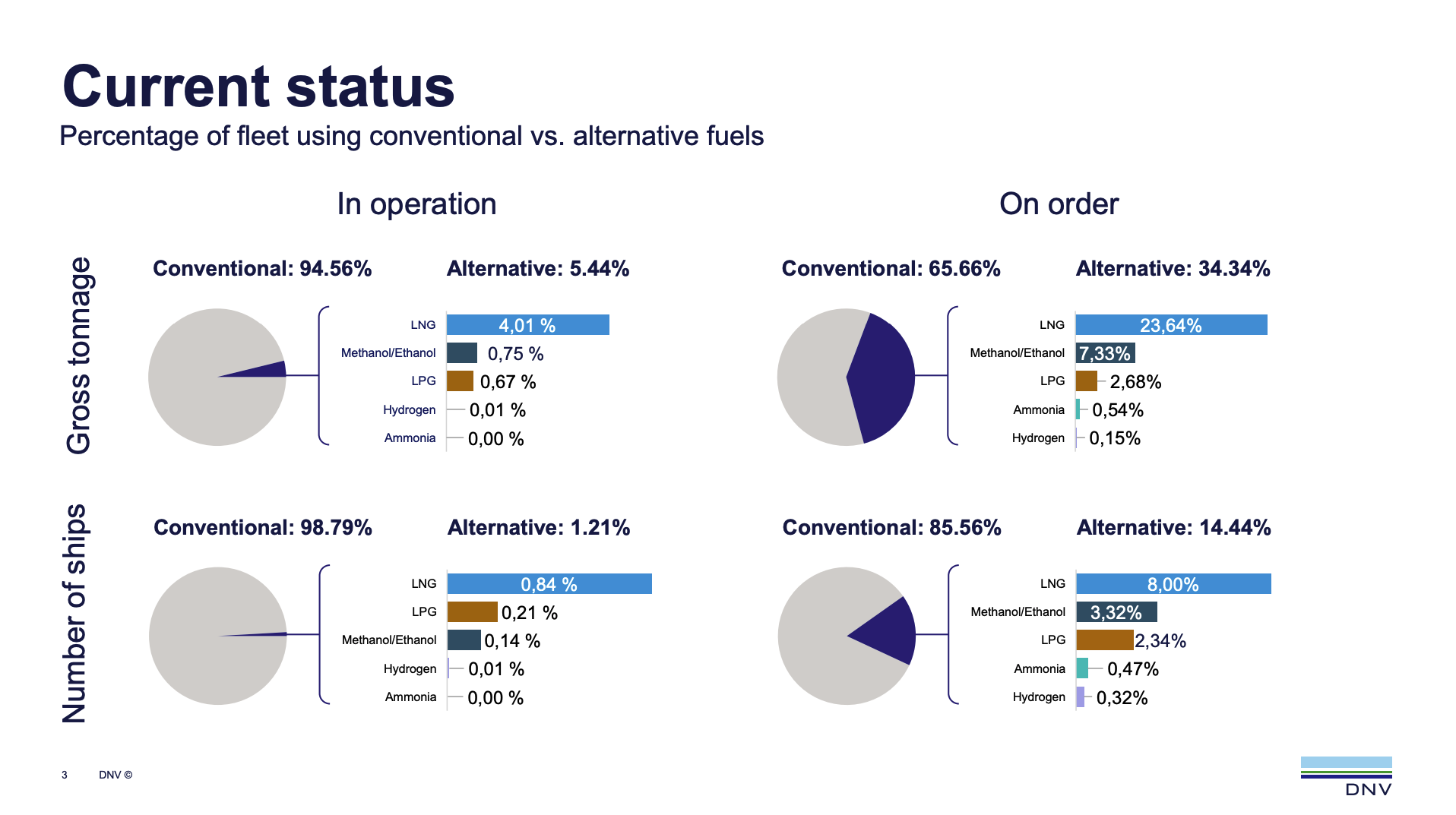
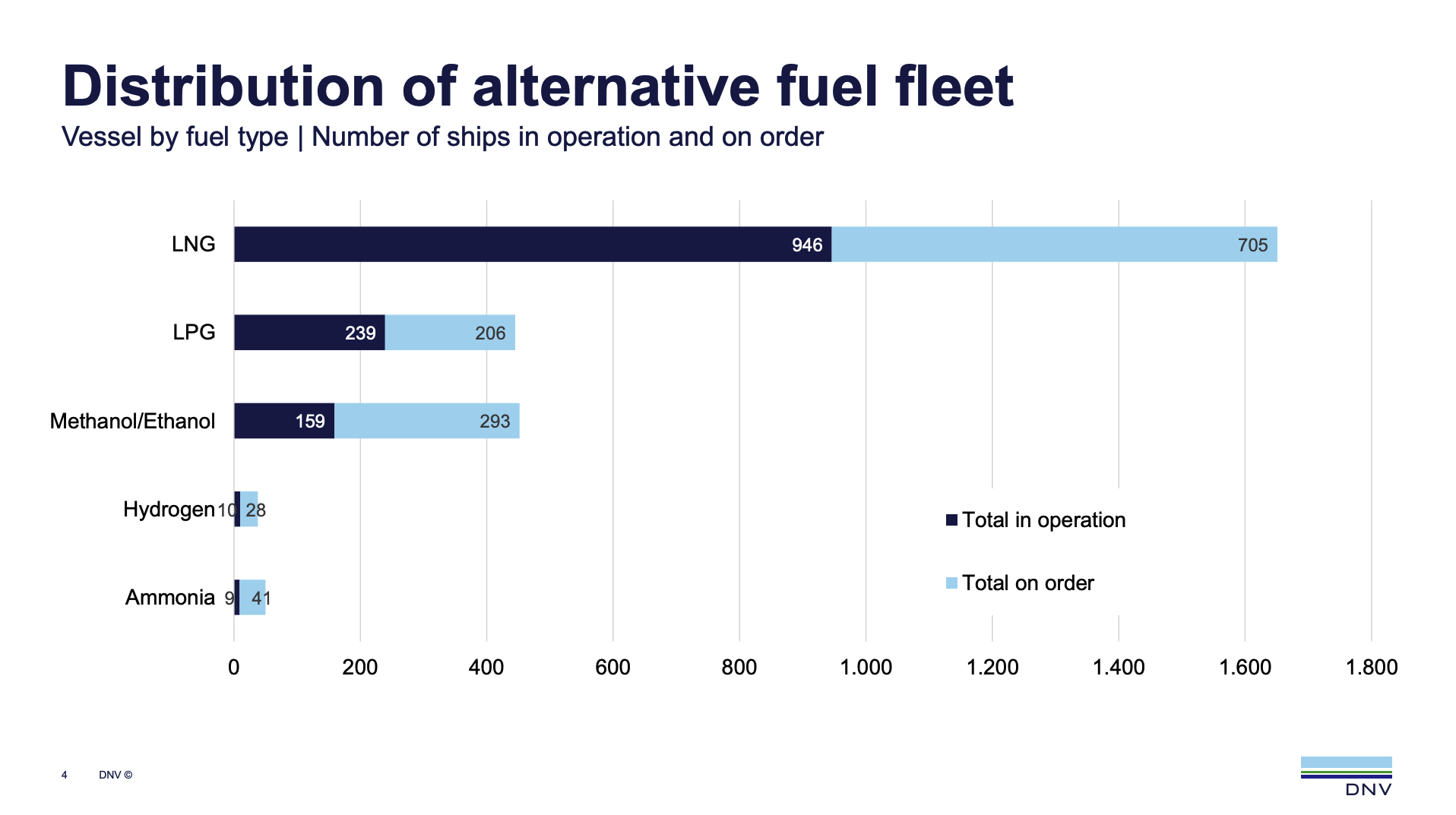
Latest data from classification society DNV’s Alternative Fuels Insight (AFI) platform alternative-fuelled vessel ordering was strong in August, with 52 new vessels added to the platform.

This is the highest monthly total since October 2024 and follows another active month in July, when 47 vessels were added to the database.

LNG-fuelled vessels accounted for the vast majority of August activity, with 46 orders recorded. The container segment led the way with 30 orders, while the car carrier segment contributed a further 12 LNG-fuelled vessels. In addition, four ethanol-fuelled bulk carriers and two hydrogen-powered bulk carriers were added during the month, as well as one LNG bunker vessel.

The strong summer performance marked a significant acceleration in ordering activity after a relatively slow start to the year. In total, 242 alternative-fuelled vessel orders have been placed in the first eight months of 2026, representing a 27% increase compared with the same period in 2025.

LNG remains the dominant fuel choice, accounting for 63% of all alternative-fuelled vessel orders registered so far this year. Container vessels represent the largest share of these LNG orders (59%), followed by car carriers (30%).

Jason Stefanatos, Global Decarbonization Director at DNV Maritime, said: “The past two months have been particularly strong for alternative-fuelled vessel ordering, with August recording the highest monthly total we’ve seen since October 2024. This has helped lift year-to-date orders to a level well above the same period last year.

“LNG remains the leading fuel choice, driven largely by activity in the container and car carrier segments. These sectors have been among the earliest adopters of alternative fuels, supported by predictable liner operations and increasing demand from cargo owners to reduce emissions across supply chains. 

“For many owners, LNG offers a combination of emissions reductions, fuel availability and future flexibility while the longer-term fuel landscape continues to evolve. 

“At the same time, the latest figures include orders for ethanol- and hydrogen-fuelled vessels, highlighting that owners continue to explore a range of decarbonization pathways. Different segments are making different fuel choices, but the overall level of activity demonstrates continued investment in lower-emission shipping.”
Screenshot 2026 09 04 at 12.29.26 PM Screenshot 2026 09 04 at 12.29.36 PM


Photo credit: DNV
Published: 4 September, 2026

Continue Reading

Alternative Fuels

Hercules Tanker Management’s ‘Ultra-Spec Series’ tanker “Vanessa” begins maiden voyage

Designed for worldwide deployment, the series can transport and supply conventional marine fuels as well as alternative fuels up to B100 and methanol.
Admin

Published

on

By

Hercules Tanker Management’s ‘Ultra-Spec Series’ tanker “Vanessa” begins maiden voyage

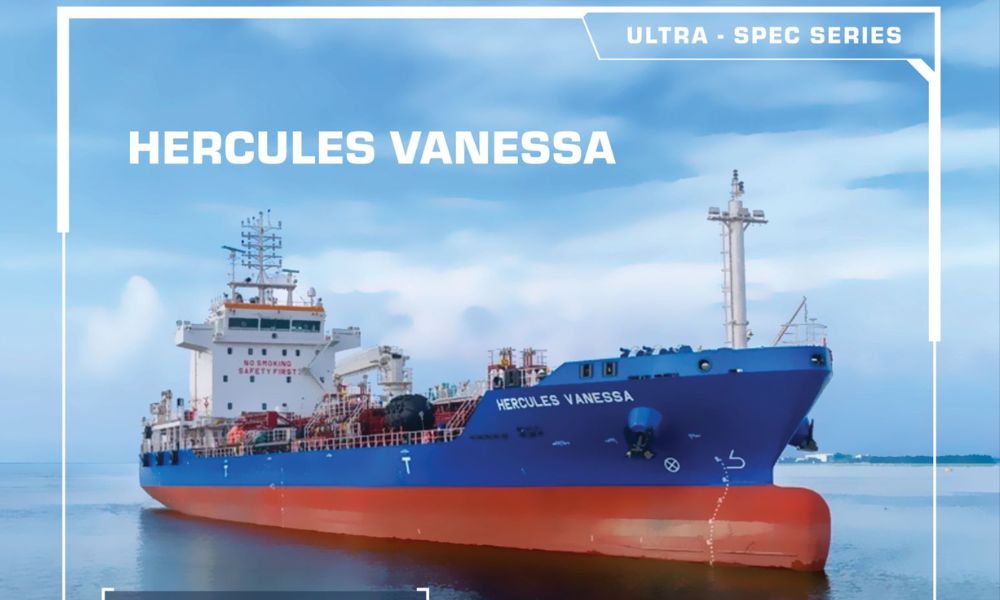
Hercules Tanker Management (HTM) on Wednesday (2 September) said its latest Ultra-Spec Series of next-generation tankers, Hercules Vanessa, has commenced her maiden voyage.

HTM is the shipping venture launched by John A. Bassadone, founder and CEO of independent marine fuel supplier Peninsula.

The 10-vessel programme forms part of the company’s long-term fleet renewal strategy, replacing ageing tonnage with more efficient vessels while delivering the future-ready capability needed to support the maritime industry’s evolving energy landscape. 

Designed for worldwide deployment, the series can transport and supply conventional marine fuels as well as alternative fuels up to B100 and methanol. 

Hercules Vanessa is also the first in the series to feature MarineLINE, a high-performance cargo tank coating system. 

The vessel is currently en route to Port Louis to take bunkers and provisions before continuing southbound towards Cape Town. It is scheduled to discharge a cargo of biofuel, loaded at Nansha Terminal in China, in Ghent later this year.

“HTM’s Ultra-Spec Series continues to gather momentum as we build a modern fleet capable of supporting cleaner marine fuel supply chains,” the company said. 

Related: Hercules Tanker Management launches ‘Ultra-Spec Series’ bunker tanker “Harriet”


Photo credit: Hercules Tanker Management
Published: 3 September, 2026

Continue Reading
Advertisement

OUR INDUSTRY PARTNERS


Trending