Connect with us

Decarbonisation

DNV expert highlights fragmented reality of shipping sector’s decarbonisation journey

‘Decarbonisation between shipping firms is fragmented with each facing different maturity and financial capability,’ states Dr Shahrin Osman.

Admin

Published

on

DNV expert highlights fragmented reality of shipping sector’s decarbonisation journey

Players within the maritime sector are operating at different levels of readiness in preparation for IMO 2030/2050 and other emissions regulations even though deadlines and goals are clear, observes an industry expert from classification society DNV.

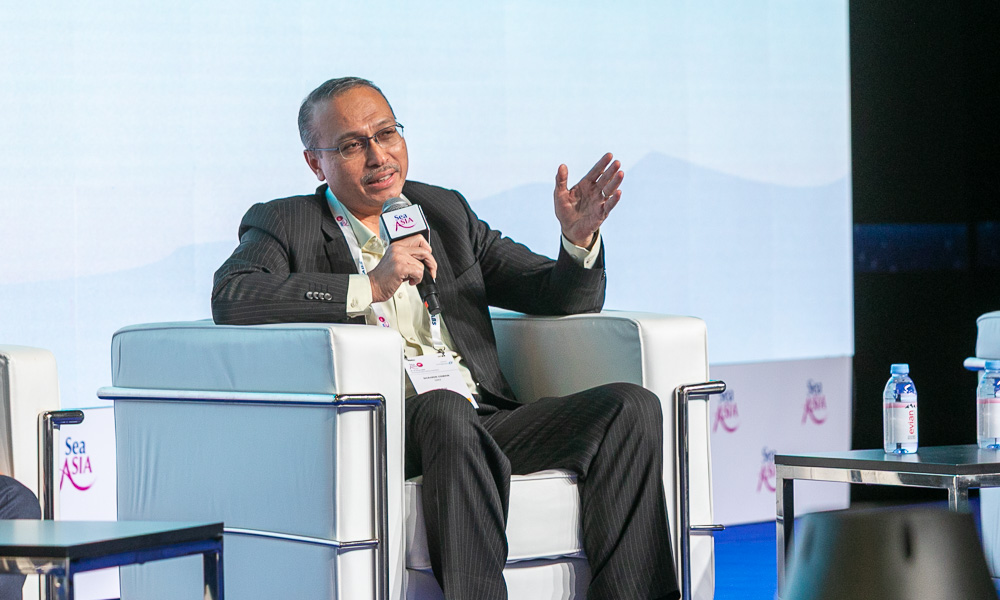
Dr Shahrin Osman, Director, Maritime Decarbonization and Smart Shipping Centre of Excellence (Singapore/Asia Pacific), Maritime Advisory noted the shipping sector being at a critical crossroads, with significant variations in technological readiness and strategic planning amongst different organisations.

“The shipping industry is really fragmented now, so you could not really size up its overall progress on decarbonisation to a certain state,” he told delegates during The Maritime Energy Mix panel discussion session at Sea Asia 2025.

“We have organisations such as MOL that are a lot more advanced in terms of their planning and decision making, while also having the organisation capability to analyse and make decisions.

“Unfortunately, a lot of organizations are not like MOL that are so advanced.”

As such, Dr Shahrin explained the need for tailored decarbonisation plans for each organisation and emphasised the need for expert advice and collaboration to make informed investment decisions in decarbonisation technologies.

He advised stakeholders to refer to DNV’s latest report Energy-efficiency measures and technologies – Key solutions and strategies for Maritime’s decarbonization journey that provides a comprehensive overview of more than 40 energy-efficiency measures, detailing their fuel-saving effects, cost figures, and suitability for specific ship types.

“It’s about planning, analysing and taking actions now and that is something that we can do for all shipowners,” shared Dr Shahrin.

“If all shipowners adopted energy efficiency technologies, we can save about 16% on bunker fuel and this saving is equivalent to 2,500 very large vessels or 55,000 small and medium vessels. That is a huge amount of savings that we can achieve just by working together.”

However, he noted data from Clarkson indicating the uptake of emissions reduction technologies by shipowners and operators to be still “very limited”.

“It’s not easy, because every investment will be between half a million to 1 million to introduce some of these technologies. Investments for Wind Assisted Propulsion is even worse and you are looking at maybe three to 6 million, but the savings are significant,” noted Dr Shahrin.

“You will need to have that expert advice and input to be able to go to the board or CFO to ask for that investment.

“Decarbonisation between shipping firms is fragmented with each facing different maturity and financial capability. Each shipowner needs to have their own action plan and seek advice from a professional if you do not have your own inhouse expertise.”

Related: DNV launches new report on energy-efficiency measures and technologies for shipowners


Photo credit: Manifold Times
Published: 4 April 2025

Continue Reading

Biofuel

South Korea: S-Oil launches B30-VLSFO bio bunker fuel supply

Company says it has established an integrated operating system in the Ulsan region covering the entire value chain, from feedstock procurement and blending to supply.

Admin

Published

on

By

South Korea: S-Oil launches B30-VLSFO bio bunker fuel supply

South Korean petroleum and refining company S-Oil on Wednesday (22 July) said it has started supplying B30 very low sulphur fuel oil (VLSFO), as the company seeks to support shipping’s decarbonisation efforts and growing demand for lower-carbon bunker fuels.

The company said its B30 VLSFO contains 30% sustainable biofuel blended with conventional VLSFO and can be used without requiring modifications to existing vessels, enabling shipowners to comply more readily with emissions regulations from the International Maritime Organization (IMO) and the European Union (EU).

S-Oil said it has established an integrated operating system in the Ulsan region covering the entire value chain, from feedstock procurement and blending to supply. The system combines VLSFO produced at its Onsan refinery with biofuel production facilities and storage infrastructure in the Ulsan region, allowing the entire process to be carried out within a single logistics hub.

According to the company, the integrated supply chain reduces transportation requirements during production while improving supply efficiency and reliability.

S-Oil also highlighted Ulsan Port as a strategic location for marine biofuel supply, noting the port has strong demand for bio-bunker fuels, particularly from car carriers, enabling prompt and stable deliveries to key customers.

An S-Oil official stated: “In the bio-marine fuel market, not only product quality but also securing a stable supply of raw materials and an efficient supply system are important competitive advantages.

“Based on our existing bunkering business capabilities and the excellent supply infrastructure in the Onsan area, we plan to supply stable and competitive low-carbon fuel.”


Photo credit: S-Oil
Published: 23 July, 2026

Continue Reading

Decarbonisation

Yang Ming and PSA to develop integrated sea-land decarbonisation solutions

Both will explore solutions spanning emissions measurement and verification, a digital Book-and-Claim framework, and a joint maritime-land inset token package.

Admin

Published

on

By

Yang Ming and PSA to develop integrated sea-land decarbonisation solutions

PSA International (PSA) on Monday (20 July) said it has signed a Memorandum of Understanding (MoU) with Yang Ming Marine Transport Corporation (Yang Ming) to jointly accelerate the adoption of low-carbon solutions across the maritime value chain.

Beyond emissions measurement and verification, the collaboration will focus on a digital Book-and-Claim framework and a joint maritime-land based inset token package. 

“This synergy provides cargo stakeholders with a transparent and accountable sea-land pathway to achieve their decarbonisation targets,” PSA said on its website. 

Yang Ming launched the green transport service, EcoSea+. This initiative integrates Yang Ming’s low-carbon navigation capabilities to empower customers with a flexible and transparent strategy to effectively reduce their Scope 3 transportation emissions. By joining forces with PSA, Yang Ming is able to expand the impact of these sustainability actions beyond the ocean.

Building on its position as a global port operator, PSA advances its Node to Network strategy through integrated port and supply chain capabilities that enable a green network of terminal and landside operations to reduce end-to-end supply chain emissions.

The agreement was officially signed by Mr Ivan Chiang, Chief Logistics Officer & Senior Vice President of Yang Ming, and Mr Eddy Ng, Group Head of Operations, Technology and Sustainability of PSA International. 

Mr Ong Kim Pong, PSA International Group CEO, said, “As responsible stewards of tomorrow, PSA is committed to delivering sustainable impact across the global port and supply chain ecosystem. 

“Tackling the challenges arising from climate change will require the collective efforts of all players in the maritime supply chain sector. We are excited to partner Yang Ming on the decarbonisation of global supply chains and support the transition towards a more sustainable global economy.”


Photo credit: PSA International
Published: 23 July, 2026

Continue Reading

Methanol

World Fuel and partners complete first green methanol bunkering of car carrier in Shanghai

Operation involved the delivery of approximately 2,800 MT of green methanol to “Arctic Tern” via a ship-to-ship transfer using SIPG Energy’s dedicated methanol bunkering vessel “M/V Hai Gang Zhi Yuan”.

Admin

Published

on

By

World Fuel and partners complete first green methanol bunkering of car carrier in Shanghai

Marine fuel provider World Fuel on Tuesday (21 July) said it successfully completed the first green methanol bunkering of M/V Arctic Tern, with EUKOR Car Carriers and SIPG Energy at the Port of Shanghai. 

Arctic Tern is the first vessel in the new Shaper Class series of car carriers. 

The operation involved the delivery of approximately 2,800 MT of green methanol to Arctic Tern via a ship-to-ship transfer using SIPG Energy’s dedicated methanol bunkering vessel M/V Hai Gang Zhi Yuan, the largest vessel of its kind in operation. 

The bunkering operation was carried out at Haitong Terminal, Waigaoqiao Port Area, Shanghai Port, with cargo handling operations conducted simultaneously during bunkering.

This marks EUKOR Car Carriers’ first green methanol operation and the first time Arctic Tern has bunkered methanol since its delivery on 9 July. The operation marked the first bunkering at Shanghai Port of green methanol produced locally in Shanghai for an international PCTC operator. 

It also demonstrated the city’s integrated green methanol value chain, spanning local production, storage and bunkering, and established a replicable “Shanghai Model” for green methanol supply.

World Fuel arranged the supply and delivery of the fuel on behalf of EUKOR Car Carriers, working with SIPG Energy as the physical supplier at the Port of Shanghai.

The green methanol supplied was produced from municipal solid waste, ISCC-EU certified, and had a carbon intensity value below 25 gCO₂e/MJ.

Arctic Tern is the first of fourteen Shaper Class vessels ordered by Wallenius Wilhelmsen. With a capacity of 9,300 car equivalent units and methanol dual-fuel capability, the vessel will be operated by EUKOR Car Carriers, jointly owned by Wallenius Wilhelmsen and Hyundai Motor Group. Following her first green methanol bunkering, Arctic Tern will continue her maiden voyage from Asia to Europe.

Xavier Leroi, COO Shipping Services at Wallenius Wilhelmsen and CEO of EUKOR Car Carriers, said: “Completing Arctic Tern’s first green methanol bunkering shortly after delivery is a significant milestone towards our decarbonisation ambition for both EUKOR Car Carriers and Wallenius Wilhelmsen. It demonstrates how investments in next-generation vessel technology and fuel flexibility are being translated into real-world operations. 

“This achievement reflects the strong collaboration between all parties involved. Together, we have shown how partnerships across the maritime value chain can help make lower-emission fuels available and operationally viable at scale.”

Mark Tamsitt, SVP Global Marine Sales at World Fuel, said, “The first bunkering event with a new fuel is a significant moment for any shipowner, and our role is to make it as seamless as possible. By connecting EUKOR Car Carriers with SIPG Energy’s proven green methanol capability at the Port of Shanghai, we were able to deliver on reliable supply, fuel quality, and safe processes. As more of our customers bring methanol dual-fuel tonnage into service, we are committed to being the partner that makes these kinds of operations routine.”

Mr. Zhang Da, General Manager of SIPG Energy, said, “Welcoming Arctic Tern to the Port of Shanghai for her first green methanol bunkering demonstrates the strength and maturity of our supply capability. Building on our well-established methanol ship-to-ship bunkering services for container vessels, we have already extended such services to pure car and truck carriers (PCTCs). This bunkering sets a new record for the largest single SIMOPs green methanol bunkering for PCTCs in China, marking another step in building Shanghai’s position as a global green energy hub for international shipping.”

This operation follows Wallenius Wilhelmsen’s announcement on 9 July that Arctic Tern would complete her first methanol bunkering shortly after delivery. The vessel entered service on routes between Asia and Europe immediately following handover from China Merchants Jinling Shipyard in Nanjing.


Photo credit: World Fuel
Published: 22 July, 2026

Continue Reading

Trending