Connect with us

Alternative Fuels

HySHIP project to develop and commercialise hydrogen as a carbon-neutral bunker fuel

EUR 8 million has been allocated for a ro-ro demonstration vessel running on hydrogen as well as the establishment of a hydrogen supply chain and bunkering platform.

Admin

Published

on

Screen Shot 2020 10 23 at 12.10.27 PM

The HySHIP project for design and construction of a new ro-ro demonstration vessel running on liquid green hydrogen (LH2), as well as the establishment of a viable LH2 supply chain and bunkering platform has received EUR 8 million in funding, according to global shipping firm Wilh. Wilhelmsen Holding ASA.

The ship will be operated by Wilhelmsen and will distribute LH2 to hydrogen hubs along the Norwegian coast. It is slated to be operational from 2024.

The project which involves 14 European partners aims to lower the development and operational cost of a wider move to LH2 for ship propulsion throughout Europe.

The EUR 8 million funding from the EU’s Research and Innovation programme Horizon 2020 under the Fuel Cells and Hydrogen Joint Undertaking (FCH2 JU) is subject to the signing of a grant agreement by the HySHIP partners by the end of this year.

‘Two-in-one’ solution

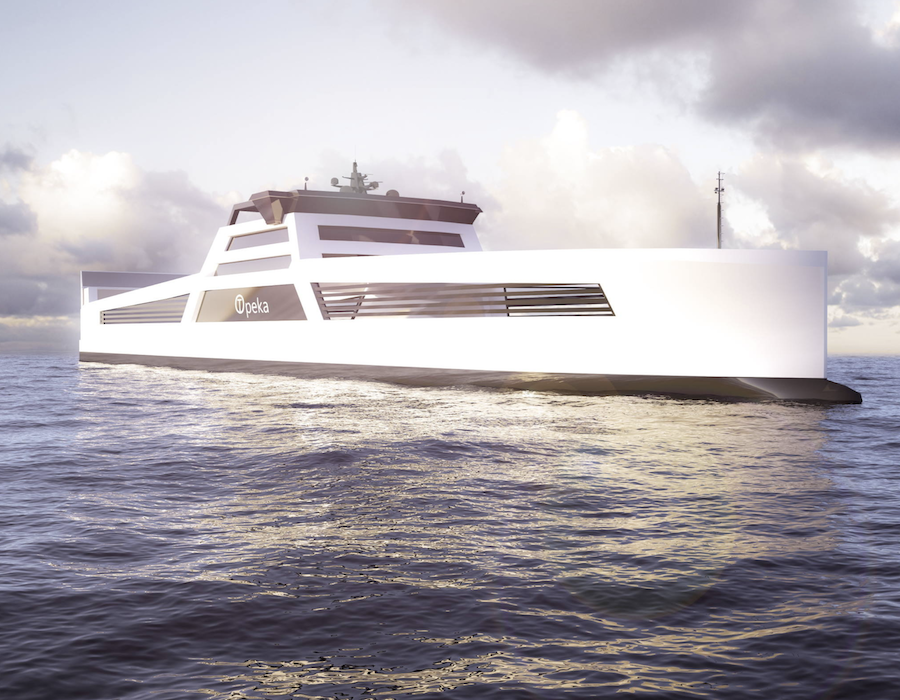
Going under the concept name “Topeka”, the vessel will be the first of its kind to enter commercial service. Providing a two-in-one solution, it will sail on a fixed schedule carrying both coastwise customer cargo and containerized LH2 to the bunkering hubs.

Norway’s west coast is dotted with bases serving the offshore industries, with base-to-base transport representing a heavy-duty transport route eminently suited to LH2.

HySHIP will be a large-scale validation of both the ship, its innovative power system, and the distribution network. The bunkering hubs will in the future supply LH2-powered vessels including ferries and seagoing tonnage.

“Hydrogen as a fuel enables opportunities for low, or zero-emission shipping. Topeka will be our first step towards scalable LH2 fuelled maritime operations,” says VP of special projects Per Brinchmann at Wilhelmsen, which is also coordinating the project.

“We shall create a full LH2 infrastructure and commercial ecosystem, while at the same time removing yearly some 25,000 trucks from the roads.”

Frida Eklöf Monstad, Vice President Logistics and emergency response in Equinor said: “A hydrogen driven coast-liner that has a regular frequency is very promising transportation alternative for Equinor’s bases on the west coast of Norway.”

“This zero-emission vessel service will also be a valuable demonstrator of the technology development supporting Equinor’s ambitions to move cargo from road to sea and to halve emissions from our maritime activities in Norway by 2030.”

“Maritime is a large contributor of global GHG emissions and thus a priority sector to decarbonise,” notes Bart Biebuyck, Executive Director at FCH2 JU.

“Hydrogen and fuel cells have the potential to propel vessels in a zero-emission fashion and various ship types are starting to integrate them. HySHIP will be a worldwide forerunner innovation project due to its use of liquid hydrogen, the size of the fuel cell and the concept for the LH2 distribution.”

Ensuring durability

The Topeka vessel will be built for zero emission through a combination of 1,000 kWh battery capacity and a three-megawatt PEM (proton exchange membrane) hydrogen fuel cell. Hydrogen will be sourced from the new LH2 production plant planned at Mongstad outside Bergen by BKK, Equinor and Air Liquide.

HySHIP will also conduct three replicator studies, including a smaller, 1MW tanker barge for use on inland waterways, a 3MW fast ferry and a scaling-up study on a larger, 20MW energy system for deepsea vessels using a capesize bulk carrier as the replicator.

World-class partners

The HySHIP consortium partners alongside project leader Wilhelmsen include Kongsberg Maritime (NO), LMG Marin (NO & FR), Equinor (NO), Norled (NO), PersEE (FR), Diana Shipping (GR), Stolt-Nielsen Inland Tanker Service BV (NL), Air Liquide (FR), NCE Maritime CleanTech (NO), DNV GL, ETH Zürich (CH), Strathclyde University (UK) and Demokritos (GR).


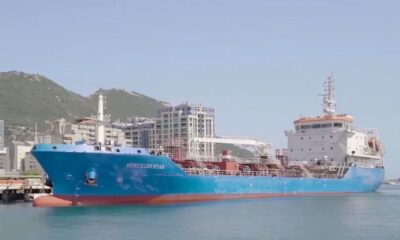
Photo credit: Wilh. Wilhelmsen Holding

Published: 23 October, 2020

Continue Reading

Biofuel

South Korea: S-Oil launches B30-VLSFO bio bunker fuel supply

Company says it has established an integrated operating system in the Ulsan region covering the entire value chain, from feedstock procurement and blending to supply.

Admin

Published

on

By

South Korea: S-Oil launches B30-VLSFO bio bunker fuel supply

South Korean petroleum and refining company S-Oil on Wednesday (22 July) said it has started supplying B30 very low sulphur fuel oil (VLSFO), as the company seeks to support shipping’s decarbonisation efforts and growing demand for lower-carbon bunker fuels.

The company said its B30 VLSFO contains 30% sustainable biofuel blended with conventional VLSFO and can be used without requiring modifications to existing vessels, enabling shipowners to comply more readily with emissions regulations from the International Maritime Organization (IMO) and the European Union (EU).

S-Oil said it has established an integrated operating system in the Ulsan region covering the entire value chain, from feedstock procurement and blending to supply. The system combines VLSFO produced at its Onsan refinery with biofuel production facilities and storage infrastructure in the Ulsan region, allowing the entire process to be carried out within a single logistics hub.

According to the company, the integrated supply chain reduces transportation requirements during production while improving supply efficiency and reliability.

S-Oil also highlighted Ulsan Port as a strategic location for marine biofuel supply, noting the port has strong demand for bio-bunker fuels, particularly from car carriers, enabling prompt and stable deliveries to key customers.

An S-Oil official stated: “In the bio-marine fuel market, not only product quality but also securing a stable supply of raw materials and an efficient supply system are important competitive advantages.

“Based on our existing bunkering business capabilities and the excellent supply infrastructure in the Onsan area, we plan to supply stable and competitive low-carbon fuel.”


Photo credit: S-Oil
Published: 23 July, 2026

Continue Reading

Bunker Fuel

Antwerp-Bruges biofuel bunker sales drops 36% on year in Q2 2026, LNG down 13.4%

Biofuel recorded 26,833 mt in Q2 2026 with 41,939 mt recorded in the same period the year before while port data showed 76,513 mt of LNG being delivered in Q2 2026, down from 88,328 mt.

Admin

Published

on

By

Port of Antwerp-Bruges, Deurganck Dock

The Port of Antwerp-Bruges recently published bunker fuel sales data for the second quarter (Q2) of 2026.

Total bunker sales at the port was 2.05 million metric tonnes (mt) in Q2 2026, compared to sales of 1.99 million mt (+3%) during the similar period in 2025.

Deliveries of ultra low sulphur fuel oil, very low sulphur fuel oil, high sulphur fuel oil and marine gas oil in Q2 2026 (against on year) recorded respectively 164,987 mt (+43.6%  from 114,917 mt), 537,926 mt (+12.8% from 476,746 mt), 659,182 mt (+11.6% from 590,544 mt) and 366,329 (-15.7% from 434,766 mt).

Biofuel recorded 26,833 mt in Q2 2026 with 41,939 mt (-36%) recorded in the same period the year before. 

Port data showed 76,513 mt of liquefied natural gas (LNG) being delivered as a marine fuel in Q2 2026, down by 13.4% from 88,328 mt in Q2 2025. Meanwhile, there has been no deliveries of methanol at the port for the year so far.

Related: Antwerp-Bruges biofuel bunker sales plunge 50.6% on year in Q1 2026, LNG soars 214%


Photo credit: Port of Antwerp-Bruges
Published: 23 July, 2026

Continue Reading

Methanol

World Fuel and partners complete first green methanol bunkering of car carrier in Shanghai

Operation involved the delivery of approximately 2,800 MT of green methanol to “Arctic Tern” via a ship-to-ship transfer using SIPG Energy’s dedicated methanol bunkering vessel “M/V Hai Gang Zhi Yuan”.

Admin

Published

on

By

World Fuel and partners complete first green methanol bunkering of car carrier in Shanghai

Marine fuel provider World Fuel on Tuesday (21 July) said it successfully completed the first green methanol bunkering of M/V Arctic Tern, with EUKOR Car Carriers and SIPG Energy at the Port of Shanghai. 

Arctic Tern is the first vessel in the new Shaper Class series of car carriers. 

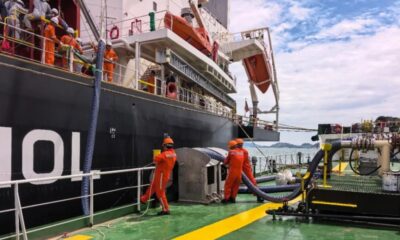
The operation involved the delivery of approximately 2,800 MT of green methanol to Arctic Tern via a ship-to-ship transfer using SIPG Energy’s dedicated methanol bunkering vessel M/V Hai Gang Zhi Yuan, the largest vessel of its kind in operation. 

The bunkering operation was carried out at Haitong Terminal, Waigaoqiao Port Area, Shanghai Port, with cargo handling operations conducted simultaneously during bunkering.

This marks EUKOR Car Carriers’ first green methanol operation and the first time Arctic Tern has bunkered methanol since its delivery on 9 July. The operation marked the first bunkering at Shanghai Port of green methanol produced locally in Shanghai for an international PCTC operator. 

It also demonstrated the city’s integrated green methanol value chain, spanning local production, storage and bunkering, and established a replicable “Shanghai Model” for green methanol supply.

World Fuel arranged the supply and delivery of the fuel on behalf of EUKOR Car Carriers, working with SIPG Energy as the physical supplier at the Port of Shanghai.

The green methanol supplied was produced from municipal solid waste, ISCC-EU certified, and had a carbon intensity value below 25 gCO₂e/MJ.

Arctic Tern is the first of fourteen Shaper Class vessels ordered by Wallenius Wilhelmsen. With a capacity of 9,300 car equivalent units and methanol dual-fuel capability, the vessel will be operated by EUKOR Car Carriers, jointly owned by Wallenius Wilhelmsen and Hyundai Motor Group. Following her first green methanol bunkering, Arctic Tern will continue her maiden voyage from Asia to Europe.

Xavier Leroi, COO Shipping Services at Wallenius Wilhelmsen and CEO of EUKOR Car Carriers, said: “Completing Arctic Tern’s first green methanol bunkering shortly after delivery is a significant milestone towards our decarbonisation ambition for both EUKOR Car Carriers and Wallenius Wilhelmsen. It demonstrates how investments in next-generation vessel technology and fuel flexibility are being translated into real-world operations. 

“This achievement reflects the strong collaboration between all parties involved. Together, we have shown how partnerships across the maritime value chain can help make lower-emission fuels available and operationally viable at scale.”

Mark Tamsitt, SVP Global Marine Sales at World Fuel, said, “The first bunkering event with a new fuel is a significant moment for any shipowner, and our role is to make it as seamless as possible. By connecting EUKOR Car Carriers with SIPG Energy’s proven green methanol capability at the Port of Shanghai, we were able to deliver on reliable supply, fuel quality, and safe processes. As more of our customers bring methanol dual-fuel tonnage into service, we are committed to being the partner that makes these kinds of operations routine.”

Mr. Zhang Da, General Manager of SIPG Energy, said, “Welcoming Arctic Tern to the Port of Shanghai for her first green methanol bunkering demonstrates the strength and maturity of our supply capability. Building on our well-established methanol ship-to-ship bunkering services for container vessels, we have already extended such services to pure car and truck carriers (PCTCs). This bunkering sets a new record for the largest single SIMOPs green methanol bunkering for PCTCs in China, marking another step in building Shanghai’s position as a global green energy hub for international shipping.”

This operation follows Wallenius Wilhelmsen’s announcement on 9 July that Arctic Tern would complete her first methanol bunkering shortly after delivery. The vessel entered service on routes between Asia and Europe immediately following handover from China Merchants Jinling Shipyard in Nanjing.


Photo credit: World Fuel
Published: 22 July, 2026

Continue Reading

Trending