Connect with us

LNG Bunkering

Wartsila: Cruise ships herald the age of LNG fuel

This year will see the first LNG-fuelled cruise ships come into service, and there are many more on order.

Admin

Published

on

5d019088d9a9f 1560383624

The following ‘Cruise ships herald the age of LNG fuel’ article was first published on the Wärtsilä magazine Twentyfour 7 in May 2019:

This year will see the first LNG-fuelled cruise ships come into service, and there are many more on order. Find out how Wärtsilä LNG solutions are playing a key role in meeting the industry’s high demands for space efficiency, safety and sustainability.

Very few still see LNG as a novelty and there is nothing new about a cruise ship. But until this year the two have never been combined.

This is about to change. In December, Carnival Cruise Line took delivery of AIDAnova, the first LNG-powered cruise ship. It will also put its second LNG vessel, the Costa Smeralda, into operation this summer. There are now about 20 new LNG-fuelled cruise ships on order, with all the major cruise companies – Carnival, MSC, Disney, Royal Caribbean, and TUI – betting big on the technology.

“We are talking about 50% of the normal order book for cruise ships in a year,” says Piero Zoglia, who leads the business development team for Wärtsilä's marine LNG business. “All the players are focusing 50% on LNG fuel.”

The tipping point

Zoglia believes the arrival of cruise operators marks the tipping point for the fuel, as port operators and fuel suppliers will now be forced to extend bunkering facilities in dozens of new ports.

LNG has, in the past, been seen as suitable for ships on repetitive routes in seas with strict emissions controls, and not for vessels like cruise ships, which can be sent to another hemisphere at short notice. But improving bunkering availability, and the arrival of the first global sulphur cap next year, has made the fuel look more attractive. Vessels running on heavy fuel oil now need to install scrubber systems or pay a premium for low sulphur fuel, improving the economics of LNG.

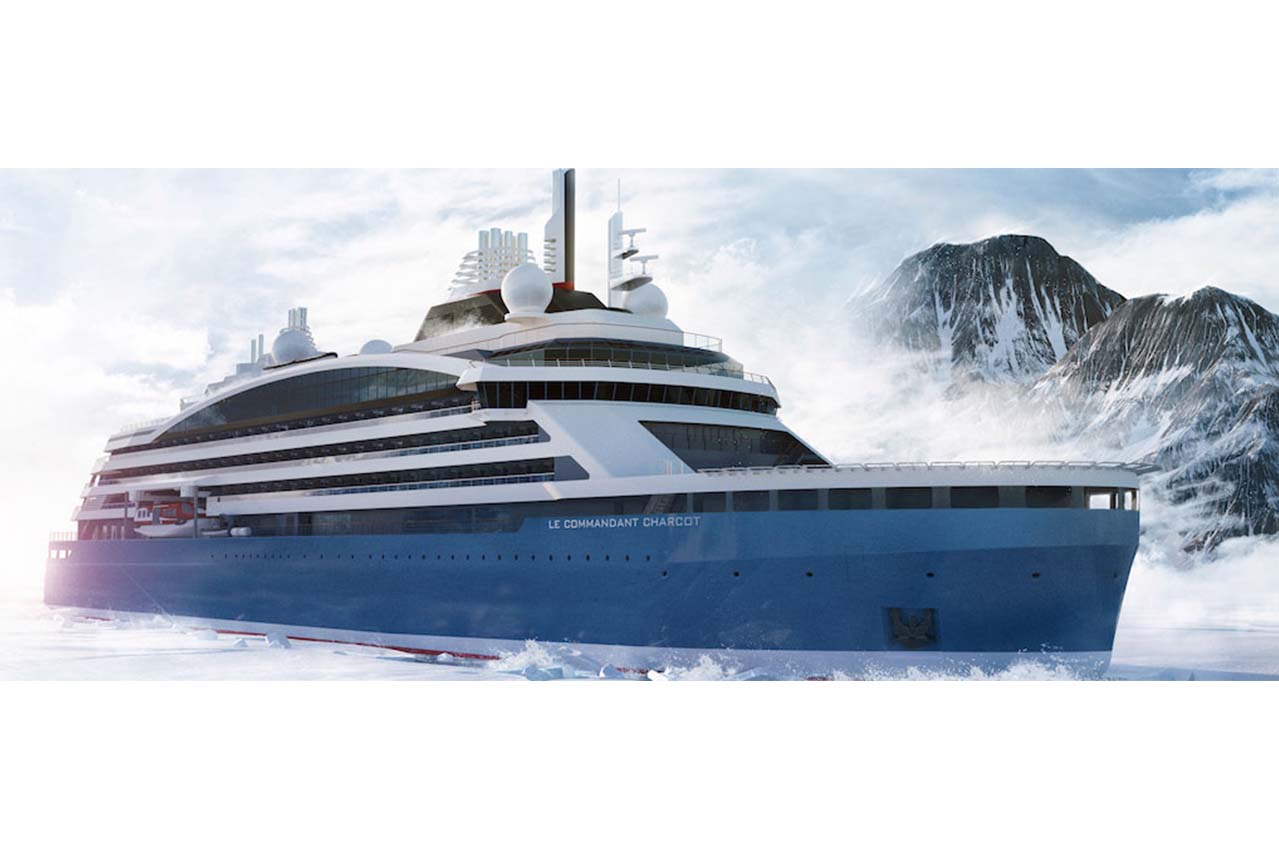
When France's Compagnie du Ponant ordered Le Commandant Charcot, a specialist ship which will take sightseers on luxury expeditions to the North Pole, around Greenland, through the Bering Straits and to the penguin colonies of Antarctica, it opted for Wärtsilä's LNG dual-fuel engines.

“They are sailing in the North Sea and the Baltic Sea and that's a nitrogen oxide emission control area (NECA), so they have two options: low sulphur MDO or LNG,” says Zoglia. “The fuel price is attractive, and you also save on maintenance costs because the engines are running on cleaner fuel.” IMO has committed to developing a ban on HFO, thereby making it no longer a realistic option for new projects in Arctic cruise.

Towards clean alternatives

But economics was not the only or even the main driver. The impacts of climate change are nowhere more visible than at the North and South Pole, where ships will be operating.

Public concern over environmental pollution affects the cruise industry more than any other sector. “They have to be clean. It is not only a matter of the rules and regulations but also a question of image,” explains Zoglia. “They have to go into ports at tourist destinations and in these ports, you don't want to have smoke emissions.”

With LNG there is no smoke at all. Switching from fuel oil to LNG cuts sulphur emissions to zero, particulate emissions by 98%, NOx emissions by 85%, and greenhouse gas emissions by a quarter. It should, therefore, be no surprise that the fuel is attractive.

Tailor-made solutions

The cruise ships currently on order are the first to be fuelled by LNG, meaning companies like Wärtsilä are having to work hard to meet entirely new demands.

“It is very complex, very difficult, with very demanding customers,” says Zoglia. “There's not one project which is like what anyone has done before.”

LNG's lower fuel density means that an LNG vessel typically requires twice as much tank space as one fuelled by diesel. Standard cylindrical tanks compound the problem, as they fill only about 40% of the rectangular space needed to house them.

This is a particular problem for cruise vessels, Zoglia points out: “In a cruise ship, every cubic metre you lose might be a cabin you give away.”

Wärtsilä worked with the French engineering company GTT to develop a membrane tank for the icebreaking cruise ship Le Commandant Charcot, which could be fitted to the shape of the hull. As much as 75% of the space was used for fuel storage. It is a technology which has been used on LNG carriers but never before on a cruise vessel.

Safety first and foremost

On another project, Wärtsilä supplied Bilobe Type C tanks, which use 60% of the available space for gas storage. Again, Wärtsilä is the first to supply this technology to a cruise ship. Because Bilobe tanks are pressure tanks made of stainless steel, they are one of the best technologies from a safety perspective.

Cruise ships have some of the strictest safety standards in the industry, and Wärtsilä has built triple redundancy into the LNG systems it has supplied.

This means having two LNG tank systems working in parallel and ready to take full control in case of a single failure. Even if both fail, the diesel used as pilot fuel in the engines is stored in sufficient quantities, so that the engines can switch to diesel and bring the vessel back to the nearest port.

“For a cruise ship that's particularly important because passengers don’t care if there is a technical problem on board: they have paid for the ticket and the cruise must go on,” says Zoglia. “Safety and reliability are of utmost importance on board these ships. They are the top priorities.”

Every year between now and 2026 (at least) will see new LNG-fuelled cruise ships hit the market, and their operators lobby hard to bring bunkering to all their key ports. At the same time, oil and gas companies will order LNG bunkering ships which will make LNG refuelling much more flexible. 

With the arrival of the cruise giants, it is time to stop talking about LNG's 'chicken-and-egg conundrum'. The fuel has come of age.

Source: Wartsila
Photo credit: Ponant – Stirling Design International
Published: 13 June, 2019


Continue Reading

LNG Bunkering

PIL’s LNG dual-fuel boxship “Kota Elok” arrives in Singapore on maiden call

As the first of 13 new 13,000 TEU vessels joining its fleet, Kota Elok is equipped to operate on LNG and low-sulphur fuel oil that helps reduce our greenhouse gas emissions.

Admin

Published

on

By

PIL's LNG dual-fuel boxship “Kota Elok” arrives in Singapore on maiden call

Singapore-based Pacific International Lines Pte Ltd on Monday (20 July) said its first 13,000 TEU LNG dual-fuel container vessel, Kota Elok, recently made her maiden call to Singapore on 15 July.

As the first of 13 new 13,000 TEU vessels joining its fleet, Kota Elok is equipped to operate on liquefied natural gas (LNG) and low-sulphur fuel oil that helps reduce our greenhouse gas emissions. 

The vessel also incorporated energy-saving features and digital technologies to reduce fuel consumption and enhance operational performance, as well as a bow windshield to improve aerodynamics, contributing to improved fuel efficiency and lower emissions over the course of long-haul voyages.

“Following Singapore, Kota Elok will continue her voyage on our East Coast Service 1 (ES1) route to South America, calling at ports in Brazil, Uruguay, and Argentina before returning to Asia,” the company said in a social media post. 

Kota Elok also became PIL’s first vessel to receive Lloyd’s Register certification for compliance with the IACS UR E26 and UR E27 cyber security requirements.

Developed by the International Association of Classification Societies (IACS), UR E26 and UR E27 are mandatory cyber resilience requirements for newbuild vessels contracted from 1 July 2024. 


Photo credit: Pacific International Lines
Published: 21 July, 2026

Continue Reading

LNG Bunkering

CIMC SOE secures order for 12,000-cbm LNG bunkering vessel from Sinopec Clean Energy

Once operational, the vessel is expected to strengthen Sinopec’s domestic coastal LNG bunkering network and help address gaps in China’s alternative fuel bunkering infrastructure.

Admin

Published

on

By

CIMC SOE secures order for 12,000-cbm LNG bunkering vessel from Sinopec Clean Energy

China’s Nantong CIMC Sinopacific Offshore & Engineering Co., Ltd. (CIMC SOE) recently signed a contract with Sinopec (Beijing) Clean Energy Co., Ltd. to build a 12,000-cubic metre (m3) LNG bunkering vessel, according to Chinese maritime media.

The vessel is scheduled for delivery in 2028 and will support Sinopec’s efforts to expand its presence in the marine clean energy sector.

Once operational, the vessel is expected to strengthen Sinopec’s domestic coastal LNG bunkering network and help address gaps in China’s LNG bunkering infrastructure.

With this signing , CIMC Pacific Offshore Engineering’s LNG bunkering vessel orderbook is further strengthened, maintaining its leading position in the global market for small and medium-sized LNG bunkering vessels.

The contract also marked another milestone for CIMC SOE, which has seen a sharp increase in orders and business performance this year amid a surge in domestic LNG vessel demand.


Photo credit: Nantong CIMC Sinopacific Offshore & Engineering
Published: 21 July, 2026

Continue Reading

Alternative Fuels

ENGINE on Fuel Switch Snapshot: LSMGO surges to greater premium over biofuel

B100 discount to LSMGO widens to $541/mt in Rotterdam; Singapore’s B100 drops to $106/mt below LSMGO; Rotterdam LBM at $639-833/mt discounts to LSMGO.

Admin

Published

on

By

ENGINE on Fuel Switch Snapshot: LSMGO surges to greater premium over biofuel

Once a week, bunker intelligence platform ENGINE will publish a snapshot of alternative and conventional bunker fuel prices in the world’s two biggest bunkering hubs. The following is the latest snapshot:

20 July 2026

  • B100 discount to LSMGO widens to $541/mt in Rotterdam
  • Singapore’s B100 drops to $106/mt below LSMGO
  • Rotterdam LBM at $639-833/mt discounts to LSMGO

B100’s premium over HSFO in Rotterdam has narrowed by $50/mt over the past week to $64/mt, while its discount to VLSFO has widened by $83/mt to $105/mt.

B100 has become far more competitive against LSMGO in Rotterdam, with its discount widening by $180/mt over the past week to $541/mt, as a surge in conventional fuel prices left B100 broadly unchanged by comparison.

B100’s price has risen by $109/mt in Singapore, but its discount to LSMGO has still widened by $102/mt to $106/mt, as LSMGO surged by an even greater $211/mt.

Rotterdam’s LNG premium over VLSFO has widened by $35/mt to $201/mt for vessels with Otto medium speed (Otto MS) engines. For vessels with diesel slow speed (diesel SS) engines, LNG has flipped to a $15/mt premium over VLSFO, from a $22/mt discount the prior week.

Liquefied biomethane (LBM) discounts to VLSFO in Rotterdam have narrowed by $50-52/mt to $203-396/mt over the past week. Against LSMGO, LBM discounts have widened by $45-47/mt to $639-833/mt, depending on engine type.

In Singapore, LNG is now $42/mt cheaper than LSMGO for vessels with Otto MS engines, and $134/mt cheaper for vessels with diesel SS engines.

ENGINE on Fuel Switch Snapshot: LSMGO surges to greater premium over biofuel

Liquid fuels

HSFO and VLSFO prices in Rotterdam have jumped by $66/mt and $99/mt respectively over the past week, while LSMGO has surged by an even steeper $196/mt. A $9.69/bbl ($71/mt) rise in front-month ICE Brent futures, to $87.94/bbl ($645/mt), drove bunker prices sharply higher across the board.

Bunker fuel availability is tight for prompt delivery dates in the ARA ports, with buyers advised to enquire about stems between 5-7 days ahead to get good coverage, a trader said.

Rotterdam’s B100 price has risen by $16/mt over the past week. Dutch ZRE A ticket prices were unchanged at €107.50/mtCO2e.

Singapore’s HSFO and VLSFO prices have risen by $130/mt and $132/mt respectively, while its LSMGO price has gained an even steeper $211/mt over the past week.

VLSFO availability in Singapore has been tight, with several suppliers reporting low stock levels. Recommended lead times have widened from 13–17 days last week to 14–19 days now.

Liquid gases

Rotterdam’s LNG prices have surged by $134-136/mt over the past week, while its LBM prices have climbed by $149-151/mt.

LBM discounts to LNG in Rotterdam have narrowed by $15/mt to $404-411/mt.

Singapore’s LNG bunker benchmarks have surged by $196-197/mt over the past week.

By Erik Hoffmann


Photo credit and source: ENGINE
Published: 21 July, 2026

Continue Reading

Trending