Connect with us

Bunker Fuel

Speakers at ARACON 2025 in Rotterdam to examine marine fuel supply chain

Speakers will examine each element of the marine fuel supply chain – including fuel quality, fuel availability and pricing, and supply trends in the ARA region – to see how they are adapting to change.

Admin

Published

on

Speakers at ARACON 2025 in Rotterdam to examine marine fuel supply chain

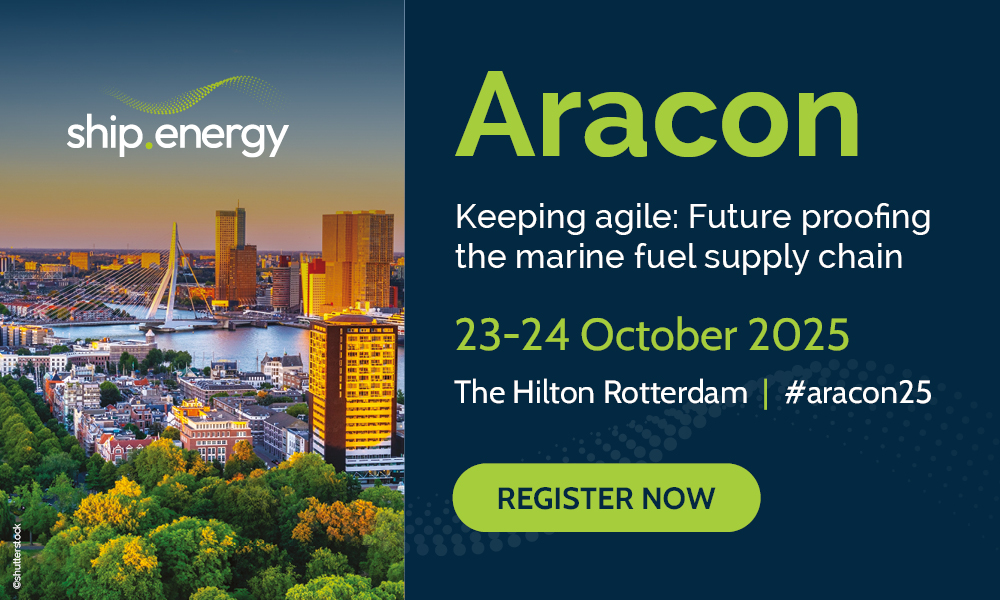
ship.energy on Tuesday (19 August) announced ARACON 2025, scheduled for 23–24 October 2025, at the Hilton Rotterdam Hotel in Rotterdam. 

Under the theme Keeping Agile: Future Proofing the Marine Fuel Supply Chain, ARACON 2025 will convene leading stakeholders from across the marine fuels and shipping sectors to address evolving market dynamics, regulatory shifts and technological innovations. 

The global shipping and bunker industries are responding to geopolitical challenges, market volatility, tightening environmental regulation, technological innovation, and a widening marine fuel pool – all while striving to maintain competitiveness.

ARACON 2025 will focus on making the right strategic choices so that marine fuel companies can adapt efficiently and effectively to new and upcoming commercial, operational and regulatory imperatives.

Speakers in Rotterdam will examine each element of the marine fuel supply chain – including fuel quality (biofuels provenance and certification), fuel availability and pricing, and supply trends in the ARA region – to see how they are adapting to change. As alternative (and more expensive) marine fuels increasingly enter the mix, discussions will cover credit lines and credit risk, and whether higher fuel price exposure may prompt consolidation among smaller and mid-sized bunker players. 

Regulatory topics will be front and centre: how shipping adapts to a more complex European regulatory environment and how the bunker industry supports compliance. ARACON 2025 will also assess outcomes from the mid-October Marine Environment Protection Committee session, offering expert verdicts on the IMO’s Net Zero Framework’s final “shape” for global GHG regulation in shipping. Moreover, timing ahead of the mass flow meter mandate implementation at Rotterdam and Antwerp ports in early 2026 makes market readiness discussions – covering eBDNs and wider digitalisation – especially pertinent.

“In a rapidly changing marine fuels landscape, agility and foresight are critical. ARACON 2025 will bring together topflight speakers and engaged delegates to tackle the pressing challenges and opportunities in future-proofing the supply chain,” said Lesley Bankes-Hughes, Managing Director, ship.energy

Event Details

Dates: 23–24 October 2025
Venue: Hilton Rotterdam Hotel, Netherlands
Theme: Keeping Agile: Future Proofing the Marine Fuel Supply Chain
Format: Two-day conference with opening remarks, panel discussions, case studies, an Industry Leaders Session to close, plus exhibition space for networking.
Rates: Early Bird Conference Pass at £995 (saving £400) until 24 July 2025; Standard Rate £1,395 thereafter. Group rates available for multiple delegates.

Note: To register and for updates on agenda, logistics and accommodation, visit here.


Photo credit: ship.energy
Published: 20 August, 2025

Continue Reading

Bunker Fuel

Singapore: Bunker fuel sales drops by 6.8% on year in May 2026

4.55 million mt of various marine fuel grades were delivered at the world’s largest bunkering port in May, down from 4.88 million mt recorded during the similar month in 2025, according to MPA data.

Admin

Published

on

By

Singapore: Bunker fuel sales drops by 6.8% on year in May 2026

Sales of marine fuel at Singapore port dropped by 6.8% on year in May 2026, according to data from the Maritime and Port Authority of Singapore (MPA).

In total, 4.55 million metric tonnes (mt) (exact 4,548,000 mt) of various marine fuel grades were delivered at the world’s largest bunkering port in May, down from 4.88 million mt (4,878,100 mt) recorded during the similar month in 2025.

Deliveries of marine fuel oil, low sulphur fuel oil, ultra low sulphur fuel oil, marine gas oil and marine diesel oil in May (against on year) recorded respectively 1.79 million mt (-5.3% from 1.89 million mt), 2.29 million mt (-6.5% from 2.45 million mt), zero (-100% from 1,200 mt), 600 (35.2% from 1,700 mt) and zero (from zero).

Singapore: Bunker fuel sales drops by 6.8% on year in May 2026

Bio-blended variants of marine fuel oil, low sulphur fuel oil, ultra low sulphur fuel oil, marine gas oil and marine diesel oil in May, (against on year) recorded respectively 11,600 mt (-71.6% from 40,900 mt), 36,400 mt (-62.1% from 96,100 mt), zero (from zero), zero (from zero) and zero (from zero). B100 biofuel bunkers, introduced in February last year, recorded 12,800 mt (+573.7% from 1,900 mt). 

LNG and methanol sales were 70,300 mt (+56.2% from 45,000 mt) and zero (from zero) respectively. There were no recorded sales of ammonia for the month and so far since 2025.


Photo credit: Maritime and Port Authority of Singapore
Published: 15 June, 2026

Continue Reading

Bunker Fuel Quality

Bunker flash: High concentrations of catalytic fines, elevated acid numbers found in Singapore

Maritec-Naias issued an alert regarding high levels of catalytic fines and elevated acid numbers present in multiple VLSFO bunker samples from deliveries in the Singapore port.

Admin

Published

on

By

RESIZED Hans Reniers on Unsplash

Bunker fuel testing and marine surveying business Maritec-Naias on Friday (12 June) issued an alert regarding high levels of catalytic fines and elevated acid numbers present in multiple VLSFO bunker samples from deliveries in the Singapore port: 

During the period of 20 May 2026 and 02 June 2026, Maritec Pte. Ltd. (hereafter referred to as Maritec-Naias) conducted testing on five samples representing Very Low Sulphur Fuel Oil (VLSFO) deliveries from two suppliers in the Singapore port. The analyses revealed Aluminium and Silicon (Al+Si) concentrations ranging from 61 mg/kg to 68 mg/kg.

It is important to note; these values exceed the ISO 8217:2010/2017 specification limit of 60 ppm but remain within the permissible tolerance limit of 72 ppm under ISO 4259 for a single test result. In this regard, Catalytic Fines content, (Aluminium+Silicon), above 60 ppm is regarded as high. Of the five samples, three originated from one supplier, while the remaining two were from another.

Aluminium and Silicon constitute the principal classes of abrasive solids in fuels. Elevated concentrations of such particles at the engine inlet can precipitate abnormal wear and tear of fuel system components, piston rings, and cylinder liners. To safeguard against this, many engine manufacturers stipulate a maximum threshold of 15 mg/kg Al+Si at the engine inlet.

The primary method of mitigating Catfines is through an efficiently operating fuel purification system. Monitoring Aluminium and Silicon levels both before and after centrifugation provides a reliable measure of the system’s effectiveness in removing these contaminants.

During a similar period, Maritec-Naias also tested fifteen bunker fuel samples representing VLSFO that exhibited elevated Acid Numbers, ranging from 2.0 mg KOH/g to 2.5 mg KOH/g. While these values remain within specification limits, they are nonetheless considered at higher side. Elevated Acid Numbers may stem from contamination with acidic compounds such as Phenolic compounds and Alkyl Resorcinols, often associated with Estonian Shale Oil. Such contaminants can lead to operational complications including sludge formation, fuel pump seizures, and compromised injection equipment cleanliness.

Maritec-Naias Recommendations

  • High Catfines monitoring: Maritec-Naias advises collecting samples at critical points within the fuel system — including the fuel oil tank transfer pump, before and after centrifuge, service tank, and after fine-filter — to evaluate the efficiency of fuel cleaning.
  • Elevated Acid Numbers: For fuels with elevated Acid Numbers, Maritec-Naias recommends conducting Gas Chromatography-Mass Spectrometry (GC-MS) using the Solid Phase Extraction (SPE) method to identify the specific acidic compounds present or upgrading your marine fuel testing package to MFTP Plus, which enables pre-emptive monitoring to detect major harmful substances prevalent in the market, such as Cashew Nut Shell Liquid (CNSL), Phenolic compounds and Alkyl Resorcinols that cause damage to equipment.

Maritec-Naias states, while all data and findings presented in this document are true, it does not reflect on the overall quality of fuel being supplied in Singapore region. If you intend to bunker at this region, please request for a Certificate of Quality (CoQ) prior to loading.


Photo credit: Hans Reniers on Unsplash
Published: 15 June, 2026

Continue Reading

Alternative Fuels

Hong Kong expands support for alternative bunker fuels with new vessel incentives

Port Dues Incentive Scheme for Green Maritime Fuel-related Vessels and the Green Vessels Registration Incentive Scheme will be launched on 16 June for a period of three years.

Admin

Published

on

By

Hong Kong

The Marine Department (MD) on Friday (12 June) announced that the Port Dues Incentive Scheme for Green Maritime Fuel-related Vessels and the Green Vessels Registration Incentive Scheme will be launched on 16 June for a period of three years, with a view to encouraging more vessels to bunker green maritime fuels in Hong Kong and accelerating the green transformation of the Hong Kong fleet.

To leverage the trend of decarbonisation in the international shipping industry, the Government has committed in the Action Plan on Green Maritime Fuel Bunkering promulgated in November 2024 the provision of various financial incentives to help lower the cost of transitioning to green maritime fuels by the maritime industry and expedite the development of Hong Kong as a green port. 

In this year’s Budget, the Government has allocated approximately $34 million to implement relevant initiatives, including providing port dues concessions for vessels powered by green maritime fuels as well as those carrying green maritime fuels, and offering incentives for green fuel-powered vessels registered in Hong Kong.

The Port Dues Incentive Scheme for Green Maritime Fuel-related Vessels provides concessions for green maritime fuel-related vessels, including ocean-going vessels (OGVs) powered by or bunkering specified green maritime fuels in Hong Kong, and OGVs carrying green maritime fuels for supply in Hong Kong. 

Specified green maritime fuels covered under the Scheme refer to liquefied natural gas (LNG), methanol, ammonia, hydrogen, and bio-diesel (blended with at least 20% bio-fuel). Eligible OGVs conducting specified operation(s) throughout their stay in Hong Kong may apply for a reimbursement of their port dues (including port facilities and light dues, anchorage dues, buoy dues and fees for port clearance permits) paid in accordance with the Shipping and Port Control Regulations (Cap. 313A). The amount of the incentive is equivalent to 25% or 50% of the port dues paid.

Eligible shipowners or their agents must submit the application form together with the required supporting documents to the MD within three months of their vessels’ completion of the above operation(s) in and departure from Hong Kong. The approved incentive amount will generally be disbursed within 30 working days. The amounts of incentives applicable to different types of OGVs are set out in the Annex.

A spokesman for the MD, said: “Following the launch of the Green Maritime Fuel Bunkering Incentive Scheme last year, the new initiative further provides incentives to encourage the industry to adopt green maritime fuels, which are often more expensive than traditional fuels, and to build up demand for green maritime fuel bunkering services in Hong Kong early. 

“This will in turn attract other players in the green maritime fuel bunkering supply chain, such as bunker suppliers, bunker operators and traders, to establish and expand their operations in Hong Kong. We expect this scheme to attract more than 1,000 visits to Hong Kong by green maritime fuel-related vessels.”

Meanwhile, the Green Vessels Registration Incentive Scheme provides incentives to green fuel-powered vessels currently or newly registered in the Hong Kong Shipping Registry (HKSR), thereby attracting and retaining the registration of green vessels in Hong Kong.

Under the scheme, all Hong Kong-registered ships that use green maritime fuels as their primary propulsion fuel, which include LNG, methanol, ammonia and hydrogen but exclude conventional fuels and biofuels, will be eligible to apply. 

During the three-year period of the scheme, each eligible vessel will be provided with a subsidy of HKD 60,000 once every year, and may enjoy one or at most three years’ incentives depending on the timing and duration that the vessel is registered with the HKSR. 

Each vessel is eligible to receive a maximum subsidy of HKD 180,000. Approval and disbursement of the incentives will take approximately three months from the receipt of an application with all required supporting documents. The vessel’s Hong Kong registration status must be maintained on the date the incentive is disbursed. 

The spokesman, said: “This scheme will encourage vessels using green maritime fuels to register in Hong Kong and promote the green transformation of the Hong Kong fleet, which will further enhance the overall competitiveness of the HKSR. We estimate that this scheme will attract approximately 100 vessels powered by green maritime fuels to register with the HKSR. Alongside the vessels powered by green maritime fuels currently registered in Hong Kong, we expect that around 170 such vessels registered in Hong Kong will benefit from the scheme within three years of implementation.”

Note: For details of the Port Dues Incentive Scheme for Green Maritime Fuel-related Vessels and the Green Vessels Registration Incentive Scheme, visit the MD’s webpages (www.mardep.gov.hk/filemanager/en/share/forms/pdf/md558.pdf ; www.mardep.gov.hk/filemanager/en/share/forms/pdf/md743.pdf).


Photo credit: M on Unsplash
Published: 15 June, 2026

Continue Reading

Trending