Connect with us
DNV Decarbonization Insight Series August 2026 - What maritime professionals should know about AI Training

Port & Regulatory

Port of Rotterdam rejects NGO’s demand to phase out of fossil fuel activities

Port Authority says it cannot fulfil AftF’s demand to force companies to limit fossil fuel activities in Rotterdam because this is not aligned with current European and Dutch climate policy and is not part of its role.

Admin

Published

on

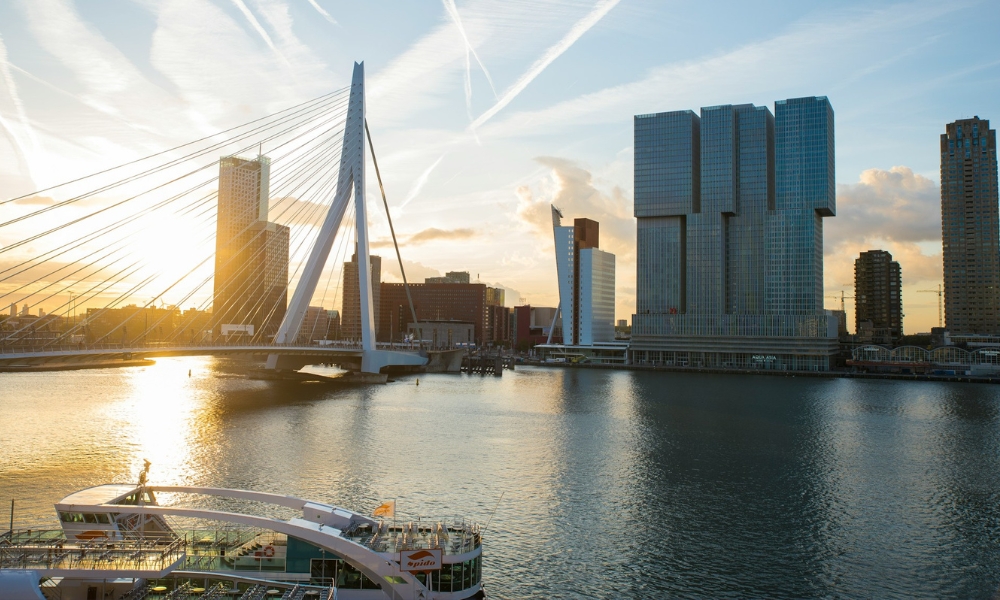
Daniel Agudelo on Unsplash

The Port of Rotterdam Authority recently responded to the demand letter from Advocates for the Future (AftF), reaffirming its commitment to achieving a climate-neutral port by 2050 while rejecting the demand to phase out fossil-fuel activities. 

On 12 May, the legal NGO summoned the Port Authority to take responsibility for its role in the climate crisis and to present a concrete plan for the controlled but rapid phase-out of fossil fuel activities in the Port of Rotterdam.

The Port Authority said it reinforces the need for a transition to a climate neutral port in 2050 and explains how it is actively taking efforts to achieve this goal in collaboration with companies and governments.

“The transition is a priority for the Port Authority. However, it cannot fulfil the AftF’s demand to force companies to limit fossil fuel activities in Rotterdam because this is not aligned with current European and Dutch climate policy and is not part of the Port Authority’s role,” the Port Authority said on its website. 

“Furthermore, it is an ineffective way to reduce worldwide CO2 emissions. The Port Authority is concerned that ceasing fossil fuel activities in Rotterdam could have major consequences, including for the security of supply of energy and the position of European industry.”

The Port Authority also said it does not expect that limiting fossil fuel activities in Rotterdam would contribute to a reduction in global emissions. 

“At present, there is still an insufficient supply of sustainable energy and raw materials to keep society running. Companies therefore continue to fulfil the demand for fossil energy and fossil fuels, while gradual investments are made in the production of sustainable energy and fuels, such as recycled plastics, hydrogen and biofuels,” it added.

“We are seeing the first examples of this in the port, including the largest cluster for biofuels in Europe and two large hydrogen plants under construction.”

The Port Authority said it will continue to implement its strategy and approach to creating a climate neutral port, as laid down in the Climate Transition Plan. 

“At the moment, the Port Authority is refining its scenarios for the transition up to 2050. We are mapping out various paths to a climate neutral, competitive and resilient port and include this in our approach,” it added.

“The Port Authority is certainly open to a continued dialogue with Advocates for the Future and other parties involved in the port.”


Photo credit: Daniel Agudelo on Unsplash
Published: 30 June, 2026
Continue Reading

Port & Regulatory

Gard: Sulphur-related bunker claims rise amid tighter China MSA enforcement

Claims involving excessive sulphur content in marine fuels have been rising, while stricter inspections by the China MSA have heightened the focus on sulphur compliance, particularly in the Bohai Sea.

Admin

Published

on

By

shraga kopstein on Unsplash

Maritime protection and indemnity (P&I) club Gard on Wednesday (12 August) highlighted that claims involving excessive sulphur content in marine fuels have been rising, while stricter inspections by the China MSA have heightened the focus on sulphur compliance, particularly in the Bohai Sea:

Rise in off-spec sulphur claims

Recent claims experience indicates that bunker quality continues to pose a significant operational risk for shipowners. In our earlier review of bunker-related claims during the first five months of 2026, we highlighted a rise in off-specification bunker incidents amid increased pressure on global fuel supply chains following the escalation of the conflict in the Middle East. 

Specifically for Sulphur compliance, between January and June 2026, the number of sulphur-related cases increased by more than threefold compared with the same period in 2025. Notably, the number of cases recorded in the first six months of this year has already exceeded the total number reported during the whole of last year by approximately 40%. 

While each case is fact-specific, the increase is notable because excessive sulphur content constitutes a MARPOL compliance issue. Unlike many other bunker quality problems, sulphur non-compliance identified through port state inspections can result in vessel delays, enforcement action, and substantial costs associated with debunkering and fuel disposal. 

The map below illustrates the geographical distribution of sulphur-related claims recorded during the first six months of 2026, based on the location where the bunkers were stemmed.

Distribution of sulphur related claims

China MSA steps up sulphur compliance enforcement

According to our correspondent, Huatai, on 5 June 2026, the maritime authorities of Tianjin, Hebei, Liaoning and Shandong jointly launched a special campaign on ship pollution prevention and control in the Bohai Sea region. The campaign involves coordinated supervision by local MSA branches across the region and is expected to last nearly five months. It covers major ports and surrounding port areas in the Bohai Sea region, including Tianjin, Tangshan, Qinhuangdao, Huanghua, Jinzhou, Yingkou and Longkou. 

While the initiative is broader than bunker sulphur compliance alone, its scope includes inspections relating to air pollution prevention, SOx emissions, fuel compliance and other high-pollution-risk operations. Enforcement measures are expected to comprise onboard inspections, cross-regional enforcement activities, unannounced spot checks and remote monitoring. These efforts will be supported by a combination of UAV patrols, maritime patrol vessels, shore-based monitoring systems and rapid on-site fuel testing. 

As a result, vessels trading in the Bohai Sea region may experience increased scrutiny of fuel compliance documentation, fuel sampling records, onboard fuel management procedures, and the handling or disposal of suspected non-compliant fuel.

Documents typically requested by China MSA

Based on our recent experience, including the case discussed above, and subject to the specific requirements of the local MSA office, owners and operators may be requested to provide supporting documentation such as: 

  • Bunker documentation – Bunker Delivery Notes (BDNs), MARPOL fuel sample records, fuel test reports, and relevant fuel quality certificates. 
  • Statutory certificates – including the International Air Pollution Prevention (IAPP) Certificate and International Oil Pollution Prevention (IOPP) Certificate. 
  • Operational records – engine logbooks, deck and navigation logbooks, Oil Record Book entries, and records relating to fuel transfers, storage and consumption. 
  • Sampling documentation – the Master’s statement and any records demonstrating how fuel samples were drawn, sealed, labelled, handled and retained. 
  • Correspondence records – communications with the authorities, bunker suppliers, charterers and other relevant stakeholders. 
  • Fuel disposal records – approved disposal plans, debunkering documentation, receipts and evidence of final disposal, where applicable. 

The exact documentation required will depend on the nature of the investigation, the findings of the inspection, and the requirements of the local enforcement authority. 

Possible regulatory consequences in China

Under the Air Pollution Prevention and Control Law of the People’s Republic of China, ocean-going vessels are required to use fuel oil meeting atmospheric pollutant control requirements after berthing. Vessels operating within designated emission control areas must also comply with applicable emission standards. Article 106 provides that where vessel fuel oil fails to meet applicable standards or requirements, the competent maritime authorities may impose fines ranging from RMB 10,000 to RMB 100,000. Liability may extend to shipowners, ship operators and ship managers depending upon the circumstances of the case. 

Recommendation

Sulphur compliance should be treated as both a fuel quality and regulatory risk. Owners and operators are encouraged to take preventive steps before bunkering, act promptly if non-compliant fuel is suspected, and preserve evidence carefully if an inspection or claim arises. Under amended 

Resolution A.1206(34), Appendix 18, 2.1.5, if the BDN shows compliant fuel, but the master has independent test results of the fuel oil sample taken by the ship during the bunkering which indicates non-compliance, the master may document this by notifying the ship’s flag Administration, with copies to: 

  • the competent authority of the relevant port of destination, 
  • the Administration under whose jurisdiction the bunker deliverer is located, 
  • and to the bunker deliverer.


Photo credit: shraga kopstein on Unsplash / Gard
Published: 14 August, 2026

Continue Reading

LNG Bunkering

Shell expands LNG bunkering footprint in Spain with Valencia

As one of the region’s key maritime hubs, the company said Valencia expands the options available to shipowners seeking LNG supply along major shipping routes.

Admin

Published

on

By

Shell expands LNG bunkering footprint in Spain with Valencia

British oil giant Shell on Thursday (13 August) said Valencia has joined its growing network of bunkering locations, making LNG available as a marine fuel.

The successful completion of the first LNG bunkering operation in Valencia marked an important milestone for Spain and further strengthened Shell’s LNG supply capabilities across the Mediterranean. 

In a video shared by the company, bunkering vessel Alice Consulich was shown supplying an undisclosed volume of LNG to the container ship MSC Sabrina.

“As one of the region’s key maritime hubs, Valencia expands the options available to shipowners seeking LNG supply along major shipping routes,” Shell said in a social media post. 

Shell said the achievement reflected the strong collaboration across the maritime value chain, including MSC Mediterranean Shipping Company, the Port of Valencia and Fratelli Cosulich Group.

“We look forward to making more LNG bunker deliveries in Valencia and across the Mediterranean as LNG infrastructure and capabilities continue to expand,” the company said. 


Photo credit: Shell
Published: 14 August, 2026

Continue Reading

LNG Bunkering

Énestas and Power LNG join forces on Galveston bunkering

Énestas will provide capital, LNG transport and storage equipment, and downstream expertise to support Power LNG’s planned liquefaction and marine bunkering facility on Pelican Island.

Admin

Published

on

By

Stabilis Solutions enter 10-year LNG bunkering supply deal for Port of Galveston

Power LNG (Power LNG) and Mexico’s LNG infrastructure and downstream natural gas company Énestas on Wednesday (12 August) announced the execution of definitive agreements establishing a strategic partnership to accelerate the development of LNG infrastructure at the Port of Galveston.

Under the agreement, Énestas will provide capital, LNG transportation and storage equipment, and downstream operating expertise to support the development of the Harborside Terminal and Project Seawolf, Power LNG’s planned LNG liquefaction and marine bunkering facility on Pelican Island.

The partnership creates an immediate pathway to begin LNG distribution by truck while Project Seawolf is under development, supporting marine fueling, virtual pipeline customers, industrial users, and LNG exports throughout the Gulf Coast, Latin America, and the Caribbean.

“Our vision has always been to establish Galveston as the premier LNG hub for the Gulf Coast,” said Austin Terry, Founder and CEO of Power LNG. 

“Énestas brings years of operational experience, proven LNG infrastructure, and a talented team that understands how to deliver LNG safely and efficiently. Together, we can immediately begin serving customers while laying the foundation for one of the most strategic LNG bunkering facilities in North America.”

Project Seawolf will provide LNG for marine bunkering, truck loading, virtual pipeline distribution, and international exports. The facility is strategically located at the Port of Galveston, serving one of the fastest-growing cruise, cargo, and energy corridors in the United States.

For Énestas, the transaction represented an important milestone in the company’s international growth strategy.

“This partnership represents a natural evolution for Énestas as we expand our downstream LNG business into the United States,” said Caio Zapata, Chief Executive Officer of Énestas. 

“For more than a decade, Énestas has developed and operated LNG infrastructure throughout Mexico, helping customers transition to cleaner, more reliable energy. Partnering with Power LNG allows us to leverage that experience in one of the most attractive LNG markets in North America. We see tremendous opportunities in marine bunkering, virtual pipeline logistics, industrial LNG supply, and exports to Latin America and the Caribbean, and we are excited to build that future together.”

The companies expect the partnership to support near-term LNG truck loading operations while advancing the long-term development of Project Seawolf, which is designed to become a regional hub for LNG production, marine fueling, and distribution.

The collaboration also establishes a platform to pursue additional downstream LNG opportunities throughout the Gulf Coast, utilising Énestas’ operational expertise together with Power LNG’s project development capabilities.


Photo credit: Port of Galveston
Published: 14 August, 2026

Continue Reading

Trending