The following article regarding regional bunker fuel availability outlook for the East of Suez region has been provided by online marine fuels procurement platform ENGINE for publication on Singapore bunkering publication Manifold Times:
- Availability tight across all grades in Singapore
- Several East Asian ports brace for Typhoon Dolphin
- Bunker demand low across several South Korean ports
Singapore and Malaysia
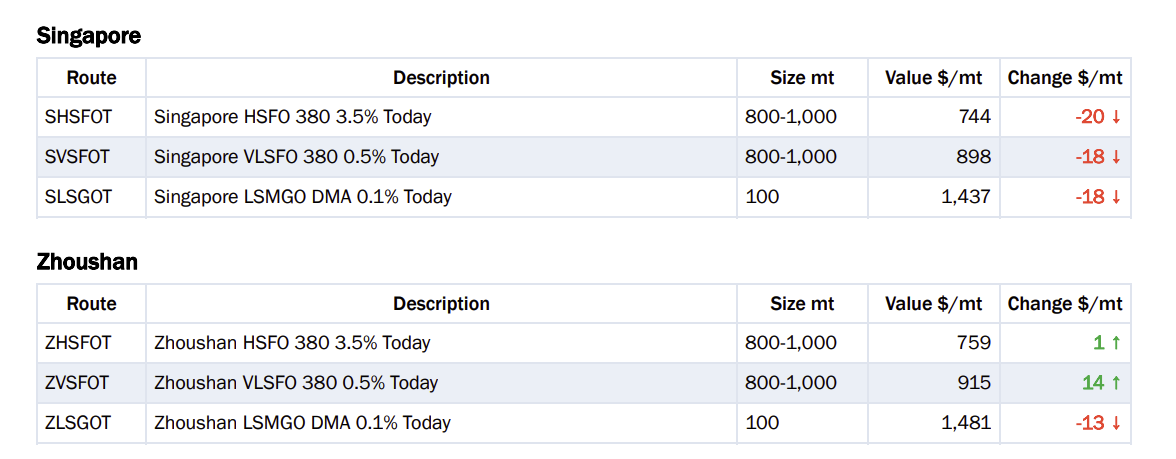
VLSFO availability in Singapore remains tight, with suppliers recommending lead times of 12-24 days, compared with 16-20 days last week. Supply continues to be under pressure as the port’s fuel oil inventories have yet to recover to pre-conflict levels, while cargo inflows remain affected by renewed US-Iran hostilities that have disrupted traffic through the Strait of Hormuz.
Enterprise Singapore data shows that fuel oil inventories declined from more than 23 million bbls in March to below 18 million bbls in June. Although stocks edged higher in July, they remained below 19 million bbls.
HSFO supply remains tight, with recommended lead times widening to 10-24 days, from 12-15 days a week earlier. Meanwhile, LSMGO requires lead times of 2-11 days, compared with 5-8 days last week.
In Malaysia’s Port Klang, bunker fuel supply remains constrained. Prompt VLSFO availability is tight, LSMGO supply is limited, and HSFO continues to face supply pressure.
East Asia
VLSFO availability in Zhoushan remains under pressure despite muted bunker demand. Suppliers are now advising lead times of around 12 days, up from roughly nine days previously. Lead times for both, LSMGO and HSFO, have also lengthened to about 10 days, compared with around seven days earlier.
Weather could add further strain to the port. Bunker operations across Zhoushan’s anchorages may be suspended as Typhoon Dolphin approaches, according to a source. China’s Meteorological Administration expects the typhoon to track westward and remain away from the country’s coastal waters until Thursday.
Across northern China, bunker fuel supply conditions continue to differ by port. Dalian and Qingdao have adequate VLSFO and LSMGO availability, although HSFO remains tight in Qingdao. Supply of all three major bunker grades is constrained in Tianjin, while Shanghai continues to face limited VLSFO and HSFO availability. LSMGO supply in Shanghai remains relatively steady.
Supply pressures persist across southern China as well. Fuzhou continues to see tight availability of both VLSFO and LSMGO. Xiamen has sufficient VLSFO supply, but prompt LSMGO stems remain harder to secure. Both VLSFO and LSMGO availability are also constrained in Yangpu and Guangzhou.
Hong Kong’s bunker market remains largely unchanged, with suppliers continuing to recommend lead times of around seven days for all major fuel grades.
In Taiwan, VLSFO and LSMGO can be supplied within about two days in Hualien and Taichung, while deliveries in Kaohsiung require around 3-4 days. Keelung has seen a marked improvement, with lead times easing to around two days from 4-5 days last week.
Lead times in Keelung had lengthened after one bunker barge suffered a major technical failure while another was undergoing dry dock maintenance. A bunker barge from Taichung has since been deployed temporarily to support operations, helping reduce waiting times. The damaged barge is expected to return to service on Friday, a Taiwan-based trader said.
The trader also warned that Typhoon Dolphin could disrupt bunkering operations at Taiwanese ports from Thursday onward.
South Korea’s southern ports, including Busan, Ulsan, Masan, Onsan, Yeosu and Kwangyang, have seen bunker availability improve amid subdued demand. Recommended lead times for VLSFO, LSMGO and HSFO have shortened to 3-7 days, from 6-8 days last week, reflecting looser supply conditions.
The same pattern is evident at the country’s western ports—Incheon, Daesan, Dangjin, Pyeongtaek and Taean—where lead times for all three fuel grades have also narrowed to 3-7 days, from 6-8 days a week ago.
Demand has been dampened by weather disruptions linked to Typhoon Dolphin, and most suppliers are only confirming stems subject to weather conditions, the source added. Weather-related delays are forecast at Busan, Ulsan and Yeosu between 7-12 August, and at Daesan from 8-13 August.
Bunker fuel supply has tightened sharply across Japan following the renewed US-Iran conflict. A refiner has imposed ex-wharf restrictions on VLSFO and HSFO until 15-20 August, triggering a nationwide supply squeeze. Suppliers in the Tokyo Bay region—Tokyo, Chiba, Kawasaki and Yokohama—are now quoting the earliest delivery dates around 20-22 August. Earlier deliveries are available only at premiums of $20-30/mt, according to a Japan-based trader.
Tight supply conditions continue across Japan’s major bunkering hubs, including Tokyo, Chiba, Kawasaki, Nagoya, Yokkaichi, Osaka, Kobe, Mizushima and Oita, where only a limited number of suppliers are offering VLSFO, LSMGO and HSFO. Kashima is also experiencing constrained availability of VLSFO and HSFO.
Oceania
VLSFO availability remains stable across Western Australia, with suppliers in Kwinana and Fremantle continuing to recommend lead times of around seven days. Both ports depend on a single supplier, and all bunker deliveries are carried out by barge.
Supply conditions are more mixed along Australia’s east coast. In Port Kembla, VLSFO can be supplied by either truck or pipeline, while suppliers in Sydney maintain adequate stocks of both VLSFO and LSMGO. HSFO availability is relatively tighter in Sydney, with suppliers generally advising lead times of about seven days.
In Queensland, VLSFO and LSMGO remain readily available in Brisbane and Gladstone, where lead times continue to hover around one week.
Further south, Melbourne and Geelong also have comfortable VLSFO inventories. However, both ports rely on a single bunker barge, keeping recommended lead times at approximately seven days. HSFO supply has tightened further in Melbourne and Brisbane.
Meanwhile, one supplier is offering all major bunker grades in Brisbane, Sydney and Melbourne with lead times of roughly five days.
In Western Australia, pipeline-based bunker deliveries to Dampier Cargo Wharf (DCW) remain suspended until around the end of September due to ongoing repair work. Limited truck-based deliveries are still possible, subject to vessel size. During the disruption, the supplier has designated the Toll Supply Base (TSB) in Dampier as the preferred location for bunker operations, according to a source.
Across the Tasman, bunker fuel availability in New Zealand is broadly unchanged. VLSFO remains readily available in Tauranga and Auckland, with suppliers recommending lead times of about four days. At Marsden Point, both VLSFO and LSMGO can be delivered directly to vessels via pipeline.
Weather continues to pose the biggest operational risk in New Zealand. Bunker deliveries in Wellington and ports across the South Island remain particularly susceptible to delays during periods of adverse weather.
South Asia
Monsoon weather is set to disrupt bunker operations at several Indian ports over the coming days, with weather-related delays expected to affect bunker deliveries. Kandla and Sikka are forecast to experience operational disruptions between 5-8 August, while rough sea conditions could hamper bunkering in Mumbai, Cochin and Visakhapatnam from 4-8 August.
In Sri Lanka, bunker availability has become tighter at both Colombo and Hambantota, with at least one supplier advising lead times of around 10 days.
Weather conditions are also expected to intermittently disrupt bunker operations in Colombo and Trincomalee between 4-8 August, increasing the risk of delays to bunker deliveries.
Middle East
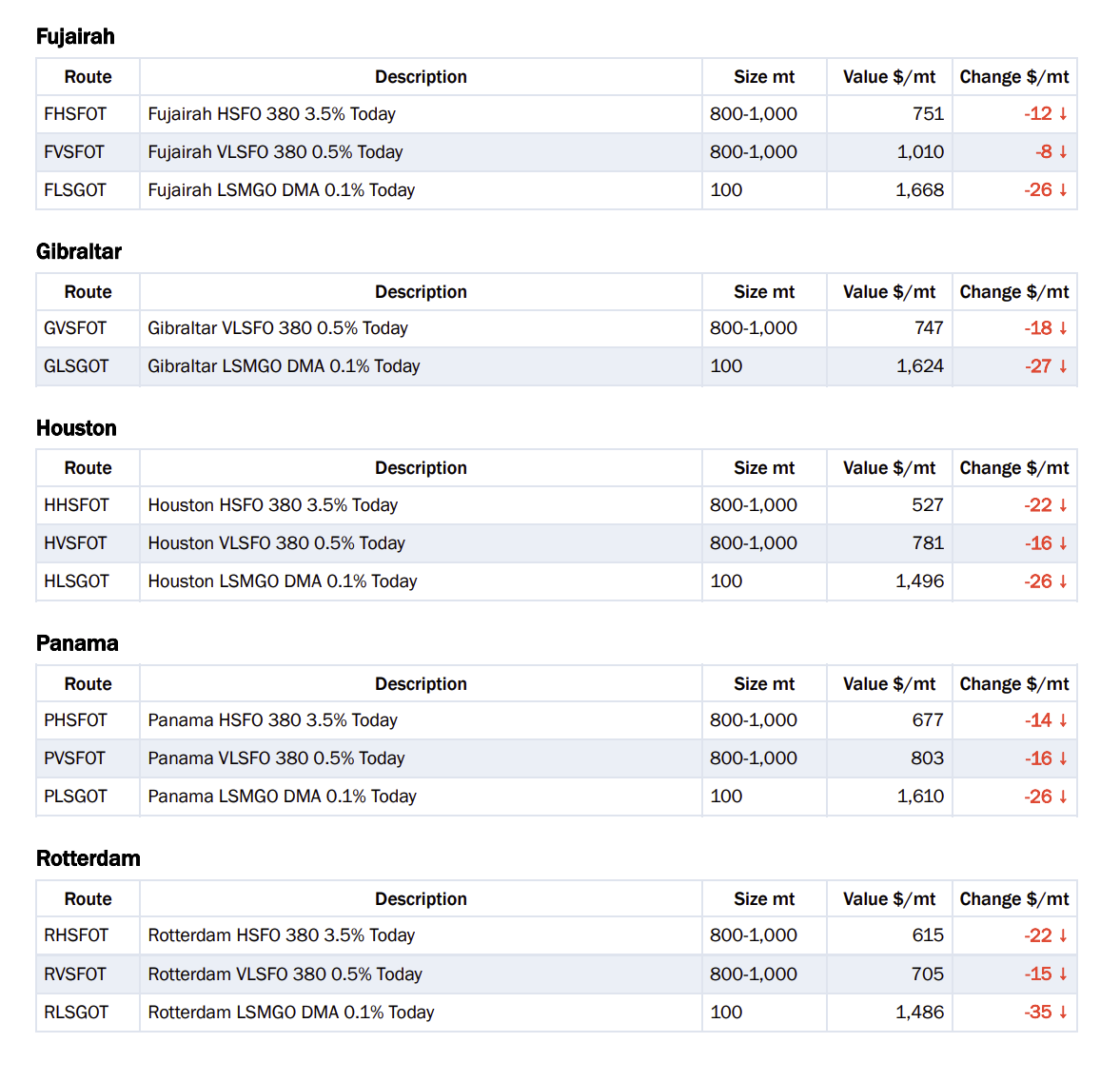
Renewed tensions between the US and Iran around the Strait of Hormuz have continued to strain bunker fuel supply in Fujairah. Availability of VLSFO and LSMGO remains tight, largely unchanged from last week, with only a limited number of suppliers able to offer LSMGO. HSFO supply, however, has shown some improvement.
Supply conditions are more comfortable at the nearby UAE hub of Khor Fakkan, where both VLSFO and HSFO remain readily available. Demand for bunkers has nevertheless picked up at both Fujairah and Khor Fakkan, following the latest regional escalation, a Middle East-based source said.
Elsewhere in the UAE, operations continue without disruption at Jebel Ali, Hamriyah, Dibba and Sharjah, while ports in Ras Al Khaimah remain fully operational. RAK Ports has, however, kept its marine risk surcharge in place for vessels calling at its ports, harbours and anchorages since March. Ship-to-ship (STS) transfers have also resumed at Dubai waters anchorage with tug assistance, although each operation will be evaluated individually, according to Inchcape Shipping.
Saudi Arabian ports are operating normally, with no alerts currently issued by local port authorities. In Jeddah, VLSFO and LSMGO supply remains steady, despite stronger demand. However, rough weather could interrupt bunker operations in Jeddah on 6 and 8 August, and in Yanbu on 6–7 August.
Port operations in Kuwait’s Shuaiba and Shuwaikh continue without any reported disruption.
All Qatari ports are also functioning normally, although bunker availability remains constrained at Ras Laffan, where both VLSFO and LSMGO supplies are still limited.
“While the region experiences occasional challenges from time to time, operations across Middle Eastern ports continue as normal,” an Oman-based trader said.
Across Oman’s key ports—including Salalah, Muscat, Duqm and Sohar—LSMGO availability remains stable, with recommended lead times of 2–3 days depending on the port and nomination. High waves forecast in Salalah between 4–8 August could, however, temporarily disrupt bunkering operations, according to a source.
Egyptian ports remain fully operational, but bunker inventories at Port Suez are critically low across all three conventional fuel grades.
Further south, availability of all major bunker fuel grades also remains limited in Djibouti.
Meanwhile, port and bunker operations are continuing normally across Jordan, Iraq, Cyprus and Pakistan, according to Inchcape Shipping.
By Tuhin Roy
Photo credit and source: ENGINE
Published: 5 August, 2026









 Winding up6 days ago