Connect with us

Decarbonisation

Singapore: MPA and GCNS to collaborate in carbon accounting and management

Both will work together to develop training workshops to meet the carbon accounting and management needs of maritime companies, including information sharing on green financing and funding schemes.

Admin

Published

on

RESIZED Singapore Flag

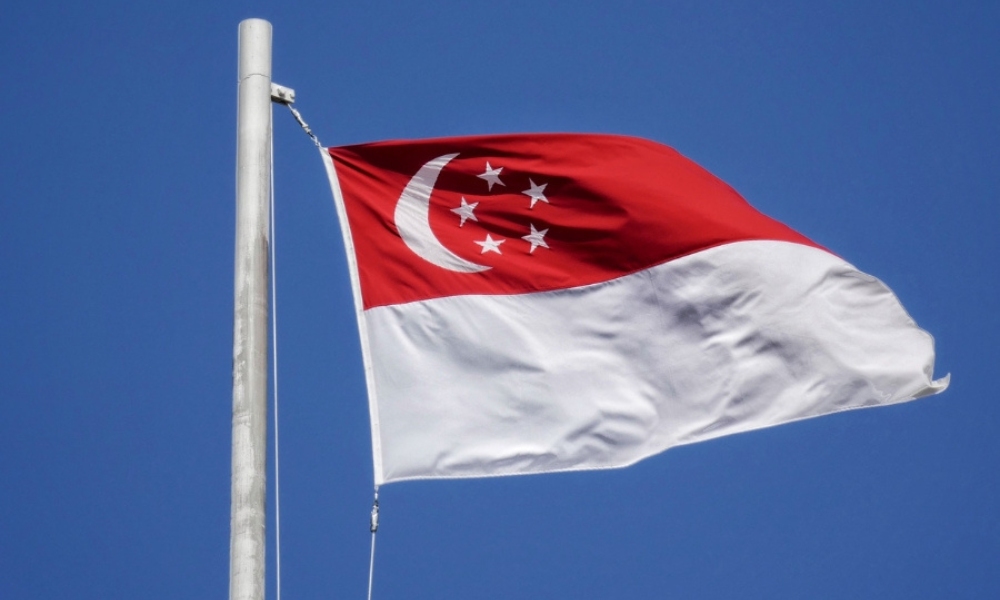
The Maritime and Port Authority of Singapore (MPA) on Wednesday (14 August) said it signed a memorandum of understanding (MoU)  with UN Global Compact Network Singapore (GCNS) to help strengthen the maritime industry’s capacity in carbon accounting and management. 

The MoU builds on the long-standing collaboration between MPA and GCNS to raise sustainability capabilities in the maritime sector, which includes an MoU signed in 2017 to provide maritime companies with training on sustainability reporting. 

The MoU was further expanded to include Singapore Shipping Association (SSA) in 2021 to support the development of capabilities in carbon accounting through training and recognition. Through the initiative, 15 companies have since been awarded the Maritime Singapore LowCarbon50 Award  over the past three years for their decarbonisation plans and accurate carbon accounting.

Under the new MoU signed today, MPA and GCNS will collaborate with key industry associations, including the Association of Regional Ferry Operators, Association of Singapore Marine & Offshore Energy Industries (ASMI), the Singapore Association of Shipsuppliers and Services (SASS), and SSA to train their members through workshops on the use of the Carbon Emissions Recording Tool (CERT) to measure and monitor their companies carbon emissions. 

The MoU partners will work together to develop training workshops to meet the carbon accounting and management needs of maritime companies, including information sharing on green financing and funding schemes that maritime companies can tap on to reduce their deployment cost of low and zero-carbon emission technologies and vessel designs. 

Mr Teo Eng Dih, Chief Executive of MPA, said, “This MoU with GCNS reaffirms the importance of carbon accounting and management tools, to help maritime companies to accurately measure, report and verify their carbon emissions. We look forward to collaborating with GCNS and industry associations to help maritime companies meet their emission targets and compliance requirements.”   

Ms Veronica Lai, Vice President of GCNS, said, “GCNS is delighted to strengthen this vital partnership with MPA and the trade associations of ASMI, ARFO, SASS and SSA. We firmly believe that collaboration within the industry is essential for advancing Singapore’s maritime decarbonisation efforts, and this MoU is a testament of that commitment.  We look forward to working hand in hand with MPA and our industry partners to equip local companies with the resources and knowledge to effectively manage their emissions. We are excited to support and facilitate the maritime sector in navigating their transition towards a low-carbon future.”

Mr Simon Kuik, President of ASMI, said, “The Marine & Offshore Energy is transforming, pivoting towards greener and cleaner product solutions. Our sector is building up ESG competencies across its value chains. Through ASMI Decarbonisation Champion Initiative launched in April 2023, we have trained 86 individuals from 33 companies so far and aim to train a further 160 for our member companies. This MPA-GCNS-Industry MoU marks another significant milestone of our collective journey, contributing to the effective decarbonisation and green transition of the sector.”

Mr Danny Lien, President of SASS, said, “SASS is looking forward to this collaboration with MPA, GCNS and the respective maritime associations to train and prepare the ship supplies industry in its decarbonisation journey. Equipping the industry with resources, know-how, and best practices will certainly help accelerate the net zero transition in the maritime industry. SASS and its members are committed to the Singapore maritime industry’s net zero goal.”

Ms Caroline Yang, President of SSA, said, “SSA is pleased to partner with GCNS and offer our members access to workshops where they will be introduced to CERT to manage their emissions. Additionally, they will benefit from shared information on green financing and funding initiatives. These advantages align with SSA’s 2030 Vision and support the industry’s transition to a greener future. Furthermore, we note that this collaboration brings together all maritime-related trade associations within the ecosystem, signalling a positive step towards a greener Maritime Singapore.” 


Photo credit: Justin Lim on Unsplash
Published: 14 August, 2024 

Continue Reading

Biofuel

South Korea: S-Oil launches B30-VLSFO bio bunker fuel supply

Company says it has established an integrated operating system in the Ulsan region covering the entire value chain, from feedstock procurement and blending to supply.
Admin

Published

on

By

South Korea: S-Oil launches B30-VLSFO bio bunker fuel supply

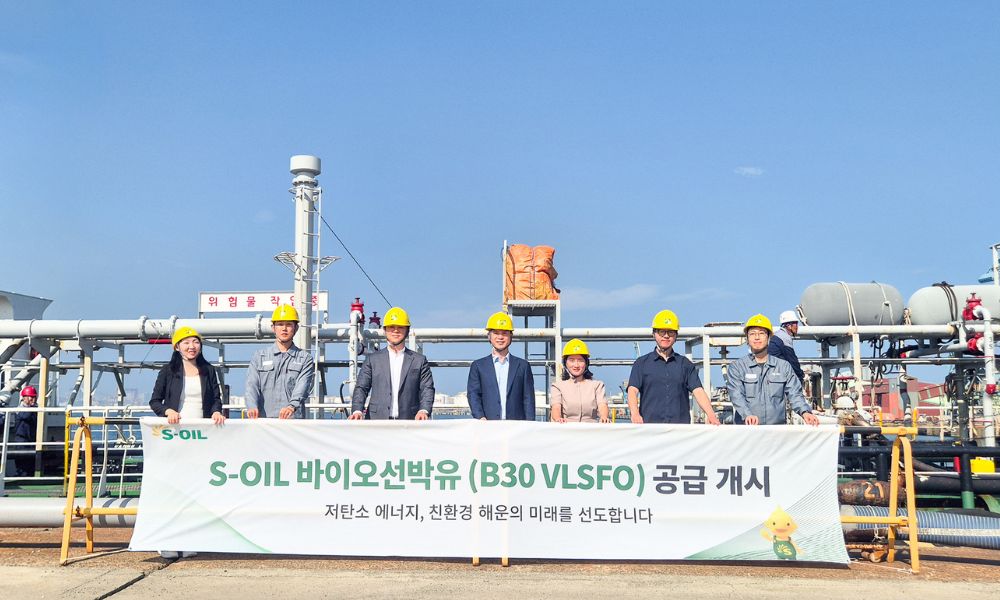
South Korean petroleum and refining company S-Oil on Wednesday (22 July) said it has started supplying B30 very low sulphur fuel oil (VLSFO), as the company seeks to support shipping’s decarbonisation efforts and growing demand for lower-carbon bunker fuels.

The company said its B30 VLSFO contains 30% sustainable biofuel blended with conventional VLSFO and can be used without requiring modifications to existing vessels, enabling shipowners to comply more readily with emissions regulations from the International Maritime Organization (IMO) and the European Union (EU).

S-Oil said it has established an integrated operating system in the Ulsan region covering the entire value chain, from feedstock procurement and blending to supply. The system combines VLSFO produced at its Onsan refinery with biofuel production facilities and storage infrastructure in the Ulsan region, allowing the entire process to be carried out within a single logistics hub.

According to the company, the integrated supply chain reduces transportation requirements during production while improving supply efficiency and reliability.

S-Oil also highlighted Ulsan Port as a strategic location for marine biofuel supply, noting the port has strong demand for bio-bunker fuels, particularly from car carriers, enabling prompt and stable deliveries to key customers.

An S-Oil official stated: “In the bio-marine fuel market, not only product quality but also securing a stable supply of raw materials and an efficient supply system are important competitive advantages.

“Based on our existing bunkering business capabilities and the excellent supply infrastructure in the Onsan area, we plan to supply stable and competitive low-carbon fuel.”


Photo credit: S-Oil
Published: 23 July, 2026

Continue Reading

Decarbonisation

Yang Ming and PSA to develop integrated sea-land decarbonisation solutions

Both will explore solutions spanning emissions measurement and verification, a digital Book-and-Claim framework, and a joint maritime-land inset token package.
Admin

Published

on

By

Yang Ming and PSA to develop integrated sea-land decarbonisation solutions

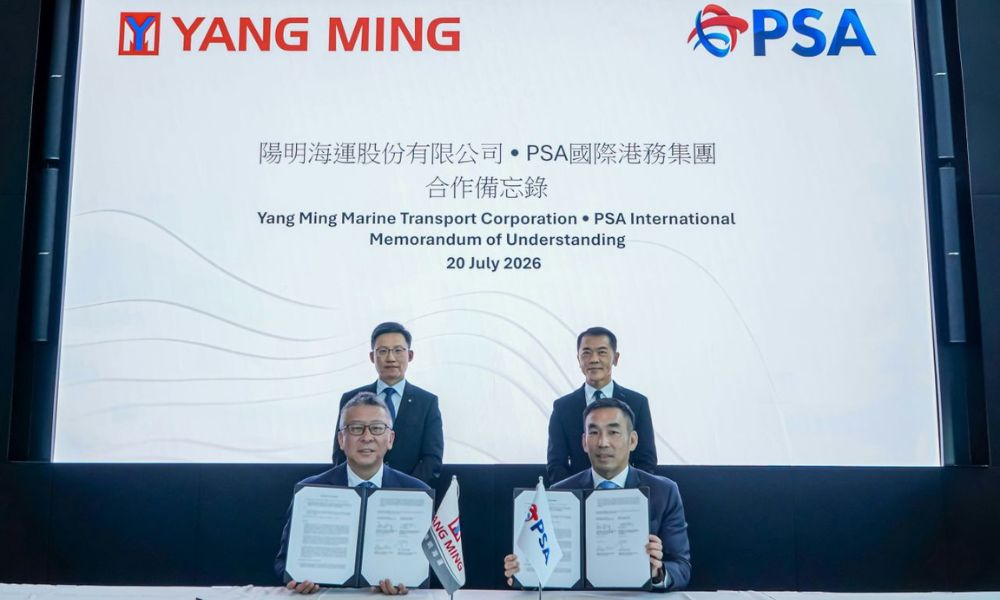
PSA International (PSA) on Monday (20 July) said it has signed a Memorandum of Understanding (MoU) with Yang Ming Marine Transport Corporation (Yang Ming) to jointly accelerate the adoption of low-carbon solutions across the maritime value chain.

Beyond emissions measurement and verification, the collaboration will focus on a digital Book-and-Claim framework and a joint maritime-land based inset token package. 

“This synergy provides cargo stakeholders with a transparent and accountable sea-land pathway to achieve their decarbonisation targets,” PSA said on its website. 

Yang Ming launched the green transport service, EcoSea+. This initiative integrates Yang Ming’s low-carbon navigation capabilities to empower customers with a flexible and transparent strategy to effectively reduce their Scope 3 transportation emissions. By joining forces with PSA, Yang Ming is able to expand the impact of these sustainability actions beyond the ocean.

Building on its position as a global port operator, PSA advances its Node to Network strategy through integrated port and supply chain capabilities that enable a green network of terminal and landside operations to reduce end-to-end supply chain emissions.

The agreement was officially signed by Mr Ivan Chiang, Chief Logistics Officer & Senior Vice President of Yang Ming, and Mr Eddy Ng, Group Head of Operations, Technology and Sustainability of PSA International. 

Mr Ong Kim Pong, PSA International Group CEO, said, “As responsible stewards of tomorrow, PSA is committed to delivering sustainable impact across the global port and supply chain ecosystem. 

“Tackling the challenges arising from climate change will require the collective efforts of all players in the maritime supply chain sector. We are excited to partner Yang Ming on the decarbonisation of global supply chains and support the transition towards a more sustainable global economy.”


Photo credit: PSA International
Published: 23 July, 2026

Continue Reading

Methanol

World Fuel and partners complete first green methanol bunkering of car carrier in Shanghai

Operation involved the delivery of approximately 2,800 MT of green methanol to “Arctic Tern” via a ship-to-ship transfer using SIPG Energy’s dedicated methanol bunkering vessel “M/V Hai Gang Zhi Yuan”.
Admin

Published

on

By

World Fuel and partners complete first green methanol bunkering of car carrier in Shanghai

Marine fuel provider World Fuel on Tuesday (21 July) said it successfully completed the first green methanol bunkering of M/V Arctic Tern, with EUKOR Car Carriers and SIPG Energy at the Port of Shanghai. 

Arctic Tern is the first vessel in the new Shaper Class series of car carriers. 

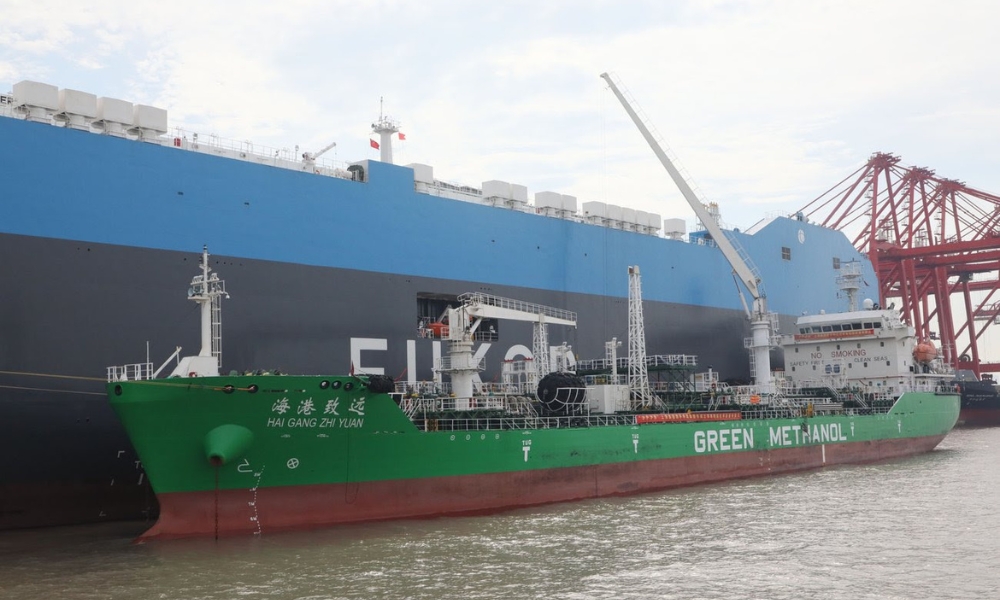
The operation involved the delivery of approximately 2,800 MT of green methanol to Arctic Tern via a ship-to-ship transfer using SIPG Energy’s dedicated methanol bunkering vessel M/V Hai Gang Zhi Yuan, the largest vessel of its kind in operation. 

The bunkering operation was carried out at Haitong Terminal, Waigaoqiao Port Area, Shanghai Port, with cargo handling operations conducted simultaneously during bunkering.

This marks EUKOR Car Carriers’ first green methanol operation and the first time Arctic Tern has bunkered methanol since its delivery on 9 July. The operation marked the first bunkering at Shanghai Port of green methanol produced locally in Shanghai for an international PCTC operator. 

It also demonstrated the city’s integrated green methanol value chain, spanning local production, storage and bunkering, and established a replicable “Shanghai Model” for green methanol supply.

World Fuel arranged the supply and delivery of the fuel on behalf of EUKOR Car Carriers, working with SIPG Energy as the physical supplier at the Port of Shanghai.

The green methanol supplied was produced from municipal solid waste, ISCC-EU certified, and had a carbon intensity value below 25 gCO₂e/MJ.

Arctic Tern is the first of fourteen Shaper Class vessels ordered by Wallenius Wilhelmsen. With a capacity of 9,300 car equivalent units and methanol dual-fuel capability, the vessel will be operated by EUKOR Car Carriers, jointly owned by Wallenius Wilhelmsen and Hyundai Motor Group. Following her first green methanol bunkering, Arctic Tern will continue her maiden voyage from Asia to Europe.

Xavier Leroi, COO Shipping Services at Wallenius Wilhelmsen and CEO of EUKOR Car Carriers, said: “Completing Arctic Tern’s first green methanol bunkering shortly after delivery is a significant milestone towards our decarbonisation ambition for both EUKOR Car Carriers and Wallenius Wilhelmsen. It demonstrates how investments in next-generation vessel technology and fuel flexibility are being translated into real-world operations. 

“This achievement reflects the strong collaboration between all parties involved. Together, we have shown how partnerships across the maritime value chain can help make lower-emission fuels available and operationally viable at scale.”

Mark Tamsitt, SVP Global Marine Sales at World Fuel, said, “The first bunkering event with a new fuel is a significant moment for any shipowner, and our role is to make it as seamless as possible. By connecting EUKOR Car Carriers with SIPG Energy’s proven green methanol capability at the Port of Shanghai, we were able to deliver on reliable supply, fuel quality, and safe processes. As more of our customers bring methanol dual-fuel tonnage into service, we are committed to being the partner that makes these kinds of operations routine.”

Mr. Zhang Da, General Manager of SIPG Energy, said, “Welcoming Arctic Tern to the Port of Shanghai for her first green methanol bunkering demonstrates the strength and maturity of our supply capability. Building on our well-established methanol ship-to-ship bunkering services for container vessels, we have already extended such services to pure car and truck carriers (PCTCs). This bunkering sets a new record for the largest single SIMOPs green methanol bunkering for PCTCs in China, marking another step in building Shanghai’s position as a global green energy hub for international shipping.”

This operation follows Wallenius Wilhelmsen’s announcement on 9 July that Arctic Tern would complete her first methanol bunkering shortly after delivery. The vessel entered service on routes between Asia and Europe immediately following handover from China Merchants Jinling Shipyard in Nanjing.


Photo credit: World Fuel
Published: 22 July, 2026

Continue Reading

Trending