
Business
Fuel Waxing: Minimising the Impact on Marine Operations
A serious concern for those handling Marine Fuel is waxing – the formation of wax crystals that can have a variety of negative impacts, shares expert.

Vasco Passanha, Technical Manager EMEA at Aderco, on Monday (20 February) shared the impact of marine fuel waxing in an article on LinkedIn and explained how the phenomenon can be avoided. The following is an excerpt from the article:
A serious concern for those handling Marine Fuel is waxing – the formation of wax crystals that can have a variety of negative impacts.
Vasco explains it is more prone to low viscosity VLSFO fuel due to its higher paraffinic nature and shared how waxing can be minimized through proper temperature management.
Vasco explains “Paraffinic fuels contain a different mix of molecules than more aromatic-based fuels, making them more sensitive to changes in temperature and therefore more prone to waxing. When fuel drops below its Cloud Point (the temperature at which wax crystals can first form), these crystals will Agglomerate together inside the storage tanks, fuel lines and filters, clogging these components up significantly. Engineers will see this in the filters and fuel waxing can also affect the operations of the separator. To counter this issue, it’s imperative that fuel is heated correctly so that the wax crystals are reincorporated correctly back into the fuel blend.”
He continues “The key takeaway here is that when it comes to heating VLSFOs, less is often more. Excessive temperatures should not be used as this can increase costs and may destabilise the fuel creating asphaltenic sludge. As VLSFO is more paraffinic the rules are not the same as HFO and needs a higher temperature than the original suggests to avoid waxing, although a higher viscosity VLSFO can still adhere to HFO temperature guidance.
Usually, a Pour Point plus 10 degrees Celsius should be sufficient in managing fuel temperature and preventing wax build-up within tanks, fuel lines and filters, however, performing a lab test to confirm the exact temperature to operate could save many operational issues.
By sticking within these parameters and making sure all other aspects of storage remain consistent, it should be easier to avoid most issues related to wax build-up in VLSFOs.”
There is an issue, he continues, with ISO 8217 catching up, as the Pour Points were based on HFO, with VLSFO being adopted as the main fuel oil only fairly recently and correct guidance is still catching up.”
The table below has been created by Alfa Laval in June 2019, as a general guide to heating storage tanks and also provides separation temperature to limit operational issues.
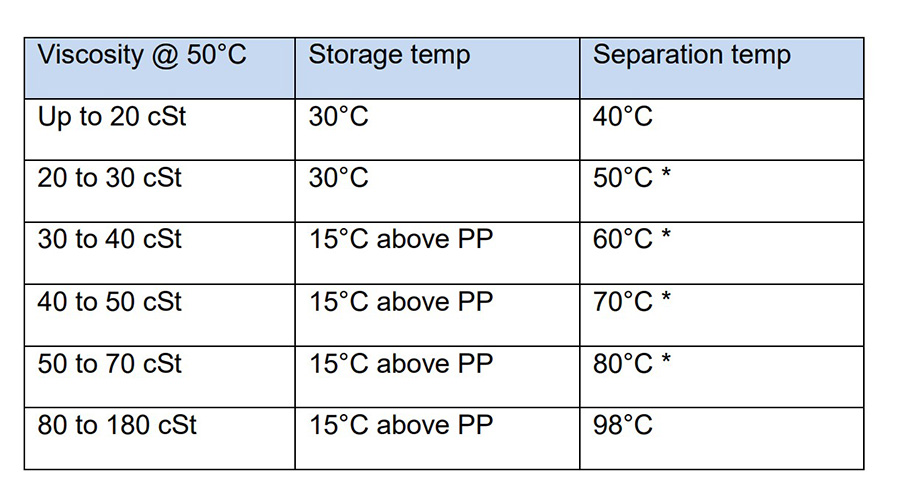
“To really understand your fuel, it’s best to test it regularly for determining wax liquefaction temperature. Having it tested in a lab will reveal the correct temperatures to store and handle fuel at its best.”
“One issue” He continues “heating in some storage tanks don’t go above certain temperatures, this might be due to the placement of heating coils, or goods that are being transported etc. Also, wax crystals can exist that can’t be seen, due to temperature being marginally cooler than in the ‘Goldilocks zone’ and then the separator cannot distinguish between sludge and wax crystals and therefore sends waxy fuel to the sludge tank wasting fuel and money.”
So, what can Aderco do? “Although Aderco fuel conditioners can’t help the issue itself, they can clean the engine. Aderco helps to reincorporate and restabilise fuel, post waxing. A good example in which Aderco is applied in this instance is when a ship has to shut off heating before dry dock, treat with Aderco prior, to stabilise, and to help homogenise when vessel comes out of dry dock.”
Note: The original article on LinkedIn can be obtained here.
Photo credit: Aderco
Published: 27 February, 2023
Winding up
Singapore: Notice of intended dividend issued for Xihe Holdings’ subsidiaries
Creditors will need to produce proofs of debt to liquidators of Da Xin Tankers and Nan Chiau Maritime by 5 August, according to Government Gazette notice.

Biofuel
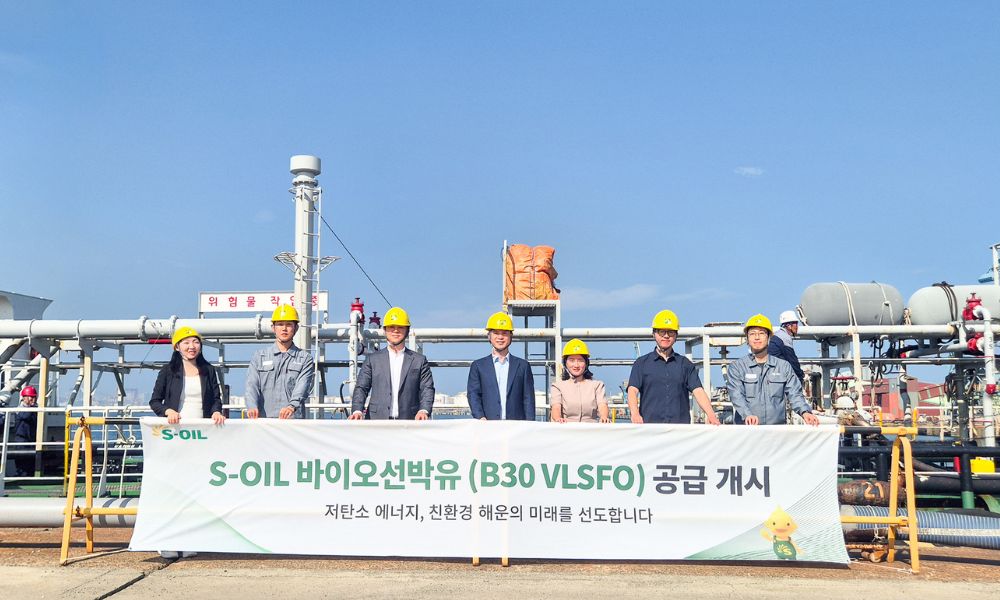
South Korea: S-Oil launches B30-VLSFO bio bunker fuel supply
Company says it has established an integrated operating system in the Ulsan region covering the entire value chain, from feedstock procurement and blending to supply.
Decarbonisation
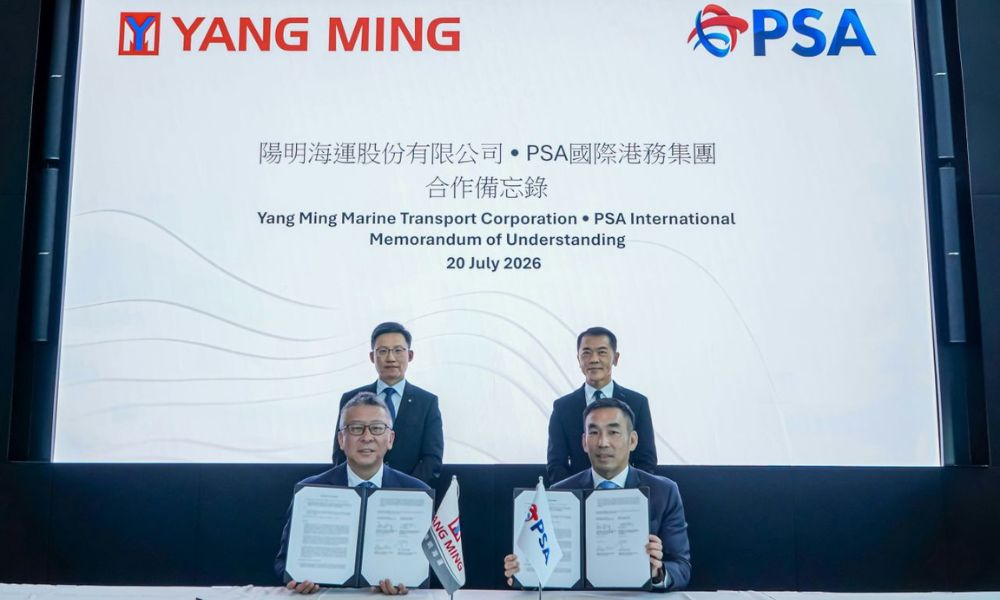
Yang Ming and PSA to develop integrated sea-land decarbonisation solutions
Both will explore solutions spanning emissions measurement and verification, a digital Book-and-Claim framework, and a joint maritime-land inset token package.

OUR INDUSTRY PARTNERS

Singapore: Notice of intended dividend issued for Xihe Holdings’ subsidiaries

South Korea: S-Oil launches B30-VLSFO bio bunker fuel supply

Yang Ming and PSA to develop integrated sea-land decarbonisation solutions

Panama bunker fuel sales drops by 10.7% on year in June 2026

Antwerp-Bruges biofuel bunker sales drops 36% on year in Q2 2026, LNG down 13.4%

Shipergy names Lina Molfetas Trading Manager, promotes two traders

ENGINE: Europe and Africa Fuel Availability Outlook (22 July 2026)

Malaysia: Maharani Freeport to implement MFM and e-BDN technologies for enhanced bunkering transparency

Singapore retains world’s leading maritime centre ranking in 2026 ISCD Index

ENGINE: East of Suez Fuel Availability Outlook (14 July 2026)

Singapore: MPA issues circular on resolutions adopted by IMO MEPC 84

DNV awards TADC to Econowind for VentoFoil 3-Series

Singapore: Bunker fuel sales up by 1.6% on year in June 2026

Malaysia: MMEA detains tugboat with undocumented 10,000 litres of diesel in Kuala Langat
-
 Technology1 week ago
Malaysia: Maharani Freeport to implement MFM and e-BDN technologies for enhanced bunkering transparency
-
 Business2 weeks ago
Singapore retains world’s leading maritime centre ranking in 2026 ISCD Index
-
 Bunker Fuel1 week ago
ENGINE: East of Suez Fuel Availability Outlook (14 July 2026)
-
 Port & Regulatory1 week ago
Singapore: MPA issues circular on resolutions adopted by IMO MEPC 84
-
 Wind-assisted6 days ago
DNV awards TADC to Econowind for VentoFoil 3-Series
-
 Bunker Fuel1 week ago
Singapore: Bunker fuel sales up by 1.6% on year in June 2026
-
 Vessel Arrest1 week ago
Malaysia: MMEA detains tugboat with undocumented 10,000 litres of diesel in Kuala Langat
-
 Alternative Fuels1 week ago
Port of Santos hosts Brazil’s first bioethanol bunkering of deep-sea containership