
Business
JLC China Bunker Market Monthly Report (August 2022)
China’s bonded bunker fuel sales continued to rise in August as bonded bunker fuel demand improved and supply from Zhoushan and Shanghai grew, JLC data showed.

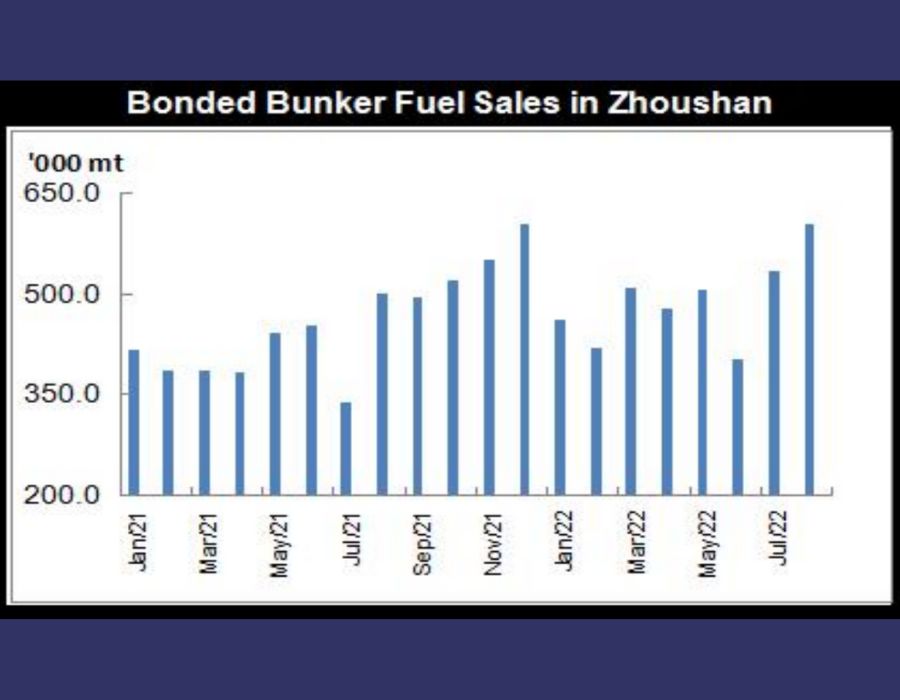
Beijing-based commodity market information provider JLC Network Technology Co. recently shared its JLC China Bunker monthly report for August 2022 with Manifold Times through an exclusive arrangement:
Bunker Fuel Demand
Bonded bunker fuel sales rise on more demand in Aug
China’s bonded bunker fuel sales continued to rise in August, as bonded bunker fuel demand improved and the supply from Zhoushan and Shanghai grew when local spread of the virus slowed down.
The country’s bonded bunker fuel sales climbed to around 1.80 mln mt in the month, up by 7.14% from a month earlier, JLC’s data shows. In detail, Chimbusco and Sinopec Zhoushan sold about 670,000 mt and 745,000 mt of bonded bunker fuel in August, JLC’s data indicates. Bonded bunker fuel sales by SinoBunker and China ChangJiang Bunker (Sinopec) were about 80,000 mt and 60,000 mt, respectively. About 245,000mt of bonded bunker fuel sales were made by suppliers who held local licenses, with PetroChina Zhoushantaking 110,800 mt.
China saw higher monthly growth in bonded bunker fuel exports in July, as the country continued to ramp upits production of low-sulfur fuel oil (LSFO, with the maximum sulfur content at 0.5%) amid new quota and substantial margins.
China recorded approximately 1.69 million mt of bonded bunker fuel exports in July 2022, jumping 12.06% month on month, according to data from the General Administration of Customs of PRC (GACC).
The exports of heavy bunker fuel and light marine gas oil were about 1.60 million mt and 99,900 mt in the month, respectively occupying 94.1% and 5.9% of the total.
State-owned enterprises exported roughly 1.45 million mt of bonded bunker fuel over the month, making up 85.44%, while the exports by local independent enterprises rose to 246,700 mt, accounting for 14.56%.
On a year-on-year comparison, however, the bonded bunker fuel exports declined by 9.44%in July, GACC data indicates. The drop came as supply tightened after China’s imports of bonded bunker fuel plunged amid high costs and the bonded bunker fuel market was still depressed by the epidemic.


Domestic bunker fuel demand stabilizes in August
Domestic-trade heavy bunker fuel demand stabilized at 400,000 mt in August, as the consumption in the shipping market was relatively steady. The majority of market participants stood on the fence when bunker fuel prices remained high, resulting in light trading and limited new contracts. On the other hand, the demand for light bunker fuel ascended by 10,000 mt or 6.67% to roughly 160,000 mt in the month. Despite downward pressure from high temperatures and rising diesel prices, the demand for light bunker fuel was still supported by rigid demand.
Bunker Fuel Supply
China records steep fall in bonded bunker fuel imports
China’s bonded bunker fuel imports sharply slumped in July, amid a surge in the output of low-sulfur fuel oil (LSFO) and a decline in domestic bunker fuel prices.
The country imported about 352,600 mt of bonded bunker fuel in July 2022, a plunge of 31.85% month on month and 21.24% year on year, according to the data from the General Administration of Customs of PRC(GACC).
Encouraged by the release of this year’s third batch of LSFO export quota and still good margins, Chinaramped up its production of LSFO during the month, relieving the ongoing supply tension to some extent. As a result, the country slashed its bonded bunker fuel imports when the booming production managed to meet more domestic demand.
In addition, China’s bunker fuel prices kept sliding over the month, making domestic bunker fuel prices more competitive. At the same time, certain market participants who were pessimistic about imported LSFO prices reduced their procurement of imported low-sulfur resources because they thought that prices would continue to dip in the short run.
Despite a smaller share of the imports from Malaysia, the country still led all suppliers by exporting 83,400 mt of bonded bunker fuel to China, accounting for 24% of China’s total imports of bonded bunker fuel. Japan overtook the UAE and ranked second with the imports from it at 79,200 mt and accounting for 22%. The followings were Russia, South Korea and the UAE, with 77,900 mt from Russia, 69,000 mt fromSouth Korea and 42,100 mt from the UAE, accounting for 22%, 20% and 12% respectively. There were only 1,000 mt of bonded bunker fuel imports coming from Singapore in the month.

Domestic blended bunker fuel supply creeps up in August
Domestic blended bunker fuel supply increased in August, as blending margins were relatively good in the month, underpinned by higher bunker fuel prices.
Chinese blenders supplied a total of about 480,000 mt of heavy bunker fuel in August 2022, an uplift of 30,000 mt or 6.67% from a month earlier, JLC’s data shows.
In detail, the supply of low-sulfur asphalt, an important blendstock for heavy bunker fuel, increased in the month as blenders were keen to make purchases. However, the supply was inadequate in some regions, including Sichuan, due to the power rationing. The supply of shale oil also increased, while that of coal-based diesel and light coal tar tightened.
Meanwhile, the supply of domestic marine gas oil (MGO) rallied to around 180,000 mt, up by 20,000 mt or 5.00% from July.

Bunker Prices, Profits


Editor
Yvette Luo
+86-020-38834382
[email protected]
Sales (Beijing)
Tony Tang
+86-10-84428863
[email protected]
Sales (Singapore)
Ginny Teo
+65-31571254
[email protected]
[email protected]
JLC Network Technology Co., Ltd is recognized as the leading information provider in China. We specialized in providing the transparent, high-value, authoritative market intelligence and professional analysis in commodity market. Our expertise covers oil, gas, coal, chemical, plastic, rubber, fertilizer and metal industry, etc.
JLC China Bunker Fuel Market Monthly Report is published by JLC Network Technology Co., Ltd every month on China bunker market, demand, supply, margin, freight index, forecast and so on. The report provides full-scale & concise insight into China bunker oil market.
All rights reserved. No portion of this publication may be photocopied, reproduced, retransmitted, put into a computer system or otherwise redistributed without prior authorization from JLC.
Related: JLC China Bunker Market Monthly Report (July 2022)
Related: JLC China Bunker Market Monthly Report (June 2022)
Related: JLC China Bunker Market Monthly Report (May 2022)
Related: JLC China Bunker Market Monthly Report (April 2022)
Related: JLC China Bunker Market Monthly Report (March 2022)
Related: JLC China Bunker Market Monthly Report (February 2022)
Related: JLC China Bunker Market Monthly Report (January 2022)
Note: China-based commodity market information provider JLC Technology has been providing Singapore bunkering publication Manifold Times China bunker volume data since 2020. Data from that period is available here.
Photo credit: JLC Network Technology
Published: 12 September, 2022
Legal
Shell Singapore charged over Pulau Bukom oil leaks, reporting delays
Shell faces four charges under Singapore’s Prevention of Pollution of the Sea Act over two 2024 oil discharge incidents at its Pulau Bukom facility.
Incident
MPA probes Singapore Strait collision involving fishing vessel, bulk carrier
MPA says there were no reported injuries among the crew of either vessel in the incident involving China-registered fishing vessel “Lu Qing Yuan Yu” and Panama-registered bulk carrier “First Margaux” .
Mass Flowmeter
TFG Marine deploys first MFM-equipped bunker barge in Jamaica
Bunker barge “Kingston Trader” is currently on its way to Jamaica following the successful installation of a Coriolis mass flow meter (MFM) system, certified to ISO 22192.

OUR INDUSTRY PARTNERS

Shell Singapore charged over Pulau Bukom oil leaks, reporting delays

MPA probes Singapore Strait collision involving fishing vessel, bulk carrier

TFG Marine deploys first MFM-equipped bunker barge in Jamaica

Seascale Energy names Gaetan Perret co-CEO as Olivier Josse prepares to retire

DNV: New research shows how regulation could reshape shipping

Stena Line orders two new hybrid ferries for Sweden – Denmark route

ENGINE: Americas Bunker Fuel Availability Outlook (24 Sep 2026)

Singapore: Marine fuel testing firm CCIC Singapore faces winding up application

High Court of Singapore issues winding up order against Hengli Petrochemical International

APPEC 2026: Digitalisation in bunkering not merely a ‘paper-to-screen’ swap, states panellists

APPEC 2026: Panellists navigate maritime decarbonisation and alternative marine fuel strategies

LDA’s methanol-powered “Spirit of Toulouse” gets Norsepower rotor sail in Shanghai

Goldwind green methanol facility completes trial production, ships first 500 mt

Singapore: Bunker fuel sales down by 4% on year in August 2026
-
 Winding up2 weeks ago
Singapore: Marine fuel testing firm CCIC Singapore faces winding up application
-
 Winding up2 weeks ago
High Court of Singapore issues winding up order against Hengli Petrochemical International
-
 Technology2 weeks ago
APPEC 2026: Digitalisation in bunkering not merely a ‘paper-to-screen’ swap, states panellists
-
 Alternative Fuels2 weeks ago
APPEC 2026: Panellists navigate maritime decarbonisation and alternative marine fuel strategies
-
 Wind-assisted2 weeks ago
LDA’s methanol-powered “Spirit of Toulouse” gets Norsepower rotor sail in Shanghai
-
 Methanol2 weeks ago
Goldwind green methanol facility completes trial production, ships first 500 mt
-
 Alternative Fuels2 weeks ago
Singapore: Bunker fuel sales down by 4% on year in August 2026
-
 Bunker Fuel2 weeks ago
APPEC 2026: Equatorial and Kuwait Petroleum Corporation discuss Middle East bunker market dynamics