Connect with us

Alternative Fuels

SEA-LNG: Let’s call it Renewable Synthetic LNG

LNG has been referred to variously as e-methane, eLNG, Synthetic Natural Gas, and others; among SEA-LNG members, naming of the product is not always consistent.

Admin

Published

on

post 51729

Global multi-sector industry coalition SEA-LNG on Friday (3 December) released a post recommending the shipping and oil industry to consistently refer carbon-neutral LNG as “renewable synthetic LNG”.

SEA-LNG exists to support the ongoing development of the LNG decarbonisation pathway and is dedicated to helping shipping thrive through the energy transition. The end goal of this pathway, to deliver net-zero greenhouse gas (GHG) emissions, requires the production of synthetic liquefied natural gas (LNG) from renewable electricity.

Renewable synthetic LNG, chemically identical to fossil LNG, but carbon-neutral, has made big advances in recent months – the ElbBlue, for example, became the first ever ocean-going vessel to be bunkered with synthetic LNG produced from renewable electricity, when it docked in Brunsbüttel, Germany, in late September. The drop-in versatility of renewable synthetic LNG and its biogenic relation, bioLNG, vindicates the continued pursuit of their commercialisation, as the order book for LNG powered ships expands.

The pathway faces challenges: loud calls for a winner takes all approach to fuel choice, when many of the fuels being championed are still at the starting gate; unthinking warnings of stranded assets, when investments made in LNG today can utilise its bio and synthetic cousins; misleading statements about methane slip, when developments by engine manufacturers are underway to eliminate it within the next few years; and confusion about the environmental performance, readiness, costs and availability of other alternative marine fuels.

The LNG pathway makes sense – from an emissions perspective and both commercially and operationally. However, anyone reading about the LNG pathway could easily be confused by the variety of terms used to describe the carbon-neutral forms of the fuel. In recent months, ‘renewable synthetic LNG’ has been referred to variously as carbon-based liquid methane, e-methane, eLNG, Synthetic Natural Gas, SNG, electro-methane, green methane, liquid green methane, liquefied synthetic methane (LSM), and hydrogen-based LNG.

Among SEA-LNG members, naming of the product is not always consistent.

SEA-LNG is committed to ensuring all our communications use the term renewable synthetic LNG. We’ve taken this step because we feel the term is clear and self-explanatory:

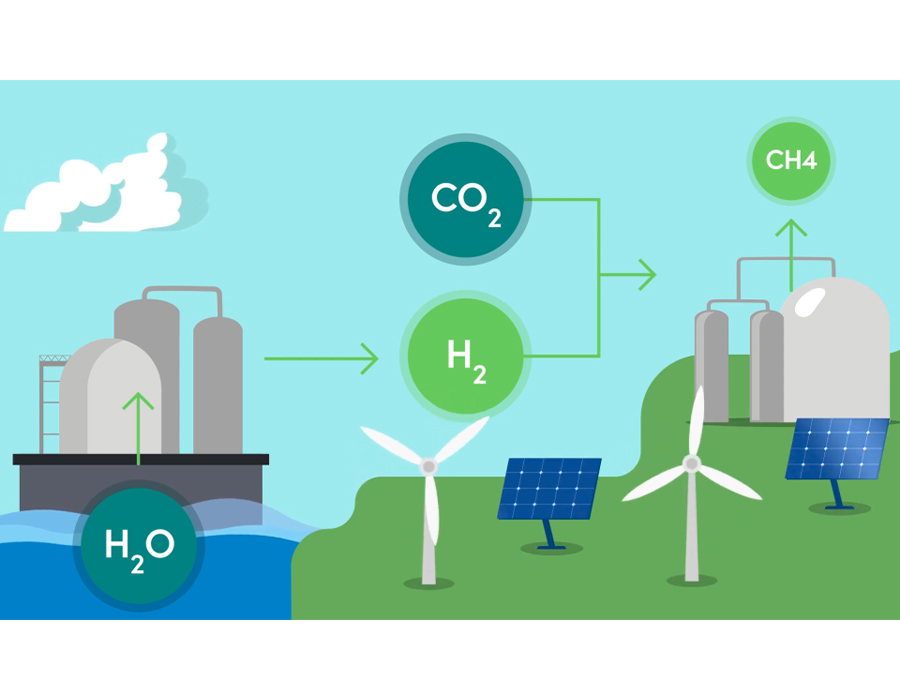
Renewable – It is produced from renewable electricity, for example solar and wind, and carbon from sustainable biomass or captured directly from the air around us.

Synthetic – It is manufactured through established technological processes and is not based on fossil-fuels nor derived directly from biomass.

LNG – It is chemically identical to the fuel used in shipping for more than 50 years. Implicit in this is that it can be burned in existing LNG-fuelled ships and utilise the existing network of supply infrastructure.

Though it is understandable that as our sector develops technologies for the LNG pathway, we may on occasion use different terms to describe the fuel, ultimately, we are talking about the same thing. We should aim to be consistent.

This month, SEA-LNG publishes a new animation explaining the LNG pathway, and the major role that renewable synthetic LNG has to play as the ultimate destination of that pathway. 

SEA-LNG and its members would like the video to be an introduction and a crib for anyone interested in alternative marine fuels, whether individuals are in the industry, provide services or, like the vast majority of individuals and organisations, simply want to see action taken to address climate change now.

Note: To view the new video on SEA-LNG’s YouTube channel, please click here.


Photo credit: SEA-LNG
Published: 7 December, 2021

Continue Reading

Biofuel

South Korea: S-Oil launches B30-VLSFO bio bunker fuel supply

Company says it has established an integrated operating system in the Ulsan region covering the entire value chain, from feedstock procurement and blending to supply.

Admin

Published

on

By

South Korea: S-Oil launches B30-VLSFO bio bunker fuel supply

South Korean petroleum and refining company S-Oil on Wednesday (22 July) said it has started supplying B30 very low sulphur fuel oil (VLSFO), as the company seeks to support shipping’s decarbonisation efforts and growing demand for lower-carbon bunker fuels.

The company said its B30 VLSFO contains 30% sustainable biofuel blended with conventional VLSFO and can be used without requiring modifications to existing vessels, enabling shipowners to comply more readily with emissions regulations from the International Maritime Organization (IMO) and the European Union (EU).

S-Oil said it has established an integrated operating system in the Ulsan region covering the entire value chain, from feedstock procurement and blending to supply. The system combines VLSFO produced at its Onsan refinery with biofuel production facilities and storage infrastructure in the Ulsan region, allowing the entire process to be carried out within a single logistics hub.

According to the company, the integrated supply chain reduces transportation requirements during production while improving supply efficiency and reliability.

S-Oil also highlighted Ulsan Port as a strategic location for marine biofuel supply, noting the port has strong demand for bio-bunker fuels, particularly from car carriers, enabling prompt and stable deliveries to key customers.

An S-Oil official stated: “In the bio-marine fuel market, not only product quality but also securing a stable supply of raw materials and an efficient supply system are important competitive advantages.

“Based on our existing bunkering business capabilities and the excellent supply infrastructure in the Onsan area, we plan to supply stable and competitive low-carbon fuel.”


Photo credit: S-Oil
Published: 23 July, 2026

Continue Reading

Bunker Fuel

Antwerp-Bruges biofuel bunker sales drops 36% on year in Q2 2026, LNG down 13.4%

Biofuel recorded 26,833 mt in Q2 2026 with 41,939 mt recorded in the same period the year before while port data showed 76,513 mt of LNG being delivered in Q2 2026, down from 88,328 mt.

Admin

Published

on

By

Port of Antwerp-Bruges, Deurganck Dock

The Port of Antwerp-Bruges recently published bunker fuel sales data for the second quarter (Q2) of 2026.

Total bunker sales at the port was 2.05 million metric tonnes (mt) in Q2 2026, compared to sales of 1.99 million mt (+3%) during the similar period in 2025.

Deliveries of ultra low sulphur fuel oil, very low sulphur fuel oil, high sulphur fuel oil and marine gas oil in Q2 2026 (against on year) recorded respectively 164,987 mt (+43.6%  from 114,917 mt), 537,926 mt (+12.8% from 476,746 mt), 659,182 mt (+11.6% from 590,544 mt) and 366,329 (-15.7% from 434,766 mt).

Biofuel recorded 26,833 mt in Q2 2026 with 41,939 mt (-36%) recorded in the same period the year before. 

Port data showed 76,513 mt of liquefied natural gas (LNG) being delivered as a marine fuel in Q2 2026, down by 13.4% from 88,328 mt in Q2 2025. Meanwhile, there has been no deliveries of methanol at the port for the year so far.

Related: Antwerp-Bruges biofuel bunker sales plunge 50.6% on year in Q1 2026, LNG soars 214%


Photo credit: Port of Antwerp-Bruges
Published: 23 July, 2026

Continue Reading

Methanol

World Fuel and partners complete first green methanol bunkering of car carrier in Shanghai

Operation involved the delivery of approximately 2,800 MT of green methanol to “Arctic Tern” via a ship-to-ship transfer using SIPG Energy’s dedicated methanol bunkering vessel “M/V Hai Gang Zhi Yuan”.

Admin

Published

on

By

World Fuel and partners complete first green methanol bunkering of car carrier in Shanghai

Marine fuel provider World Fuel on Tuesday (21 July) said it successfully completed the first green methanol bunkering of M/V Arctic Tern, with EUKOR Car Carriers and SIPG Energy at the Port of Shanghai. 

Arctic Tern is the first vessel in the new Shaper Class series of car carriers. 

The operation involved the delivery of approximately 2,800 MT of green methanol to Arctic Tern via a ship-to-ship transfer using SIPG Energy’s dedicated methanol bunkering vessel M/V Hai Gang Zhi Yuan, the largest vessel of its kind in operation. 

The bunkering operation was carried out at Haitong Terminal, Waigaoqiao Port Area, Shanghai Port, with cargo handling operations conducted simultaneously during bunkering.

This marks EUKOR Car Carriers’ first green methanol operation and the first time Arctic Tern has bunkered methanol since its delivery on 9 July. The operation marked the first bunkering at Shanghai Port of green methanol produced locally in Shanghai for an international PCTC operator. 

It also demonstrated the city’s integrated green methanol value chain, spanning local production, storage and bunkering, and established a replicable “Shanghai Model” for green methanol supply.

World Fuel arranged the supply and delivery of the fuel on behalf of EUKOR Car Carriers, working with SIPG Energy as the physical supplier at the Port of Shanghai.

The green methanol supplied was produced from municipal solid waste, ISCC-EU certified, and had a carbon intensity value below 25 gCO₂e/MJ.

Arctic Tern is the first of fourteen Shaper Class vessels ordered by Wallenius Wilhelmsen. With a capacity of 9,300 car equivalent units and methanol dual-fuel capability, the vessel will be operated by EUKOR Car Carriers, jointly owned by Wallenius Wilhelmsen and Hyundai Motor Group. Following her first green methanol bunkering, Arctic Tern will continue her maiden voyage from Asia to Europe.

Xavier Leroi, COO Shipping Services at Wallenius Wilhelmsen and CEO of EUKOR Car Carriers, said: “Completing Arctic Tern’s first green methanol bunkering shortly after delivery is a significant milestone towards our decarbonisation ambition for both EUKOR Car Carriers and Wallenius Wilhelmsen. It demonstrates how investments in next-generation vessel technology and fuel flexibility are being translated into real-world operations. 

“This achievement reflects the strong collaboration between all parties involved. Together, we have shown how partnerships across the maritime value chain can help make lower-emission fuels available and operationally viable at scale.”

Mark Tamsitt, SVP Global Marine Sales at World Fuel, said, “The first bunkering event with a new fuel is a significant moment for any shipowner, and our role is to make it as seamless as possible. By connecting EUKOR Car Carriers with SIPG Energy’s proven green methanol capability at the Port of Shanghai, we were able to deliver on reliable supply, fuel quality, and safe processes. As more of our customers bring methanol dual-fuel tonnage into service, we are committed to being the partner that makes these kinds of operations routine.”

Mr. Zhang Da, General Manager of SIPG Energy, said, “Welcoming Arctic Tern to the Port of Shanghai for her first green methanol bunkering demonstrates the strength and maturity of our supply capability. Building on our well-established methanol ship-to-ship bunkering services for container vessels, we have already extended such services to pure car and truck carriers (PCTCs). This bunkering sets a new record for the largest single SIMOPs green methanol bunkering for PCTCs in China, marking another step in building Shanghai’s position as a global green energy hub for international shipping.”

This operation follows Wallenius Wilhelmsen’s announcement on 9 July that Arctic Tern would complete her first methanol bunkering shortly after delivery. The vessel entered service on routes between Asia and Europe immediately following handover from China Merchants Jinling Shipyard in Nanjing.


Photo credit: World Fuel
Published: 22 July, 2026

Continue Reading

Trending