Connect with us

Business

BIMCO: New Port State Control bunker fuel sampling procedures effective from April

Shipowners should expect requests to sample from the ships’ bunker tanks and not only from the fuel oil line between service tank and auxiliary engine, said BIMCO.

Admin

Published

on

BIMCO logo

International shipping association BIMCO on Wednesday (3 March) said the 75th session of International Maritime Organization’s (IMO) Marine Environment Protection Committee (MEPC 75) has in November 2020 adopted amendments to MARPOL Annex VI, introducing a method for fuel oil sampling from ships’ fuel oil tanks to verify the sulphur content.

The new amendments will enter into force on 1 April 2022, noted BIMCO.

As a result of the introduced method, shipowners and the officers on board ships should be prepared to handle potential requests from port State Control (PSC) to sample from the ships’ bunker tanks and not only from the fuel oil line between the service tank and auxiliary engine(s).

IMO has in addition released new guidelines for on board sampling of fuel oil intended to be used or carried for use on board a ship.

BIMCO members can read more about statutory fuel sampling here and download the new guidelines for on board sampling.

In this context it continues to be crucial that countries step-up and implement and enforce a bunker licensing scheme for fuel oil suppliers operating within their jurisdiction – both to ensure that fuel oil supplied to ships actually complies with the statutory sulphur limit but also to ensure that the fuel oil meet the high-level quality targets stipulated in regulation 18 of MARPOL Annex VI, for instance by ensuring that fuel oil meet the parameters of ISO standard ISO 8217:2017:

“… the fuel oil shall not include any added substance or chemical waste which jeopardizes the safety of ships or adversely affects the performance of the machinery or is harmful to personnel, or contributes overall to additional air pollution.” 

BIMCO together with ICS, INTERTANKO and World Shipping Council submitted a proposal to MEPC 75, encouraging all countries to implement and enforce mandatory licensing schemes for bunker suppliers operating within their jurisdiction. The proposal is currently being debated in IMO and will hopefully be an annex to the existing IMO Guidance for best practice for Member State/coastal State (MEPC.1/Circ.884).


Photo credit: BIMCO
Published: 5 March, 2021

Continue Reading

Biofuel

China conducts first dedicated marine biofuel spill response drill in Tangshan

Exercise simulated a leak of 10 metric tonnes of biodiesel from a vessel experiencing a spill during cargo operations at a terminal.
Admin

Published

on

By

China conducts first dedicated marine biofuel spill response drill in Tangshan

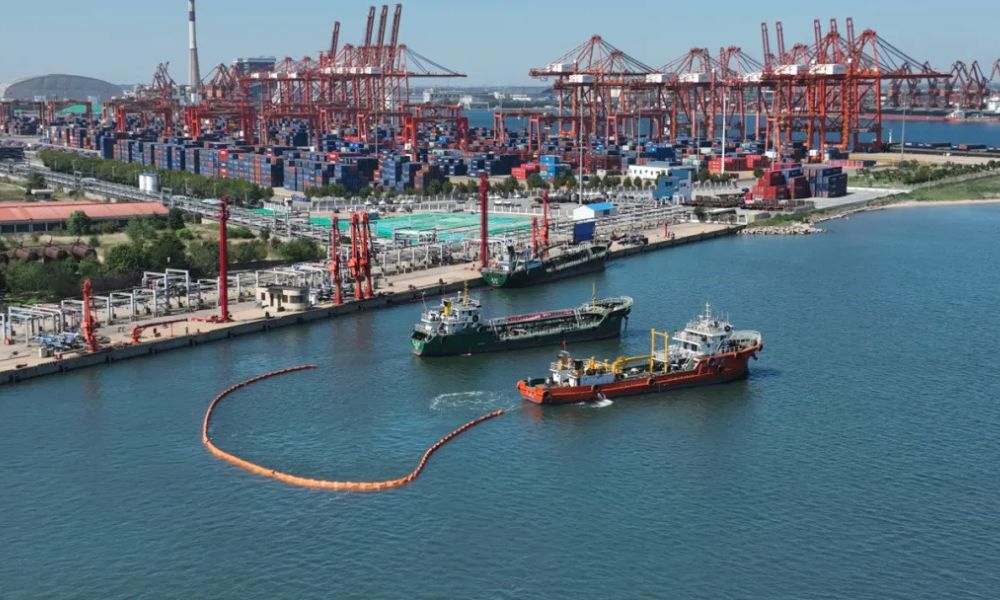
China’s Tangshan Maritime Safety Administration (MSA) on Thursday (10 September) conducted the country’s first dedicated emergency response exercise for a marine biofuel spill at Jingtang Port in Tangshan, Bohai Sea.

The “2026 Green Power Mission” exercise simulated a leak of 10 metric tonnes of biodiesel from a vessel experiencing a spill during cargo operations at a terminal. 

Following the incident report, the Tangshan MSA’s vessel traffic management centre activated its emergency response procedures, issued a navigation warning and established a traffic control area.

The maritime patrol vessel Haixun 04501 arrived at the scene to coordinate the response, involving a drone unit, an oil spill response vessel and terminal emergency personnel.

A drone equipped with fluorescence detection equipment was deployed to identify the contaminated area. Terminal personnel used oil recovery equipment, while response vessels deployed containment booms to limit the spread of the spill and spraying equipment to remove the surface oil film.

The exercise also trialled the use of 355-nanometre ultraviolet light combined with drone-mounted fluorescence detection equipment to locate biodiesel contamination.

The Tangshan MSA said unlike conventional fuel oil, biodiesel spill traces can be difficult to identify by eye under natural light. The fluorescence detection system can identify biodiesel’s characteristic fluorescence signal, enabling responders to determine the spill boundary and support subsequent containment and recovery operations.

While biodiesel is biodegradable and has a lower sulphur content than conventional fuel oil, its behaviour following a spill and the methods required to detect it differ from those used for conventional oil spills, the MSA said.

The exercise tested response procedures covering incident reporting, aerial monitoring, surface containment, spill recovery and residual pollution removal.

The Tangshan MSA said it will use the exercise to improve biofuel spill emergency response plans, specialist training and equipment development as part of its “Green Bohai Sea” initiative.

The authority will also strengthen pollution risk prevention and accident response capabilities for vessels using new and clean energy fuels, it said.


Photo credit: Tangshan Maritime Safety Administration
Published: 16 September, 2026

Continue Reading

LNG Bunkering

Kairong and MannTek receive BV AiP for STS LNG bunkering crane master system

Crane Master is a multifunctional integrated bunkering and hoisting system that combines crane handling capabilities with LNG transfer functions in a single solution.
Admin

Published

on

By

Kairong and MannTek receive BV AiP for STS LNG bunkering crane master system

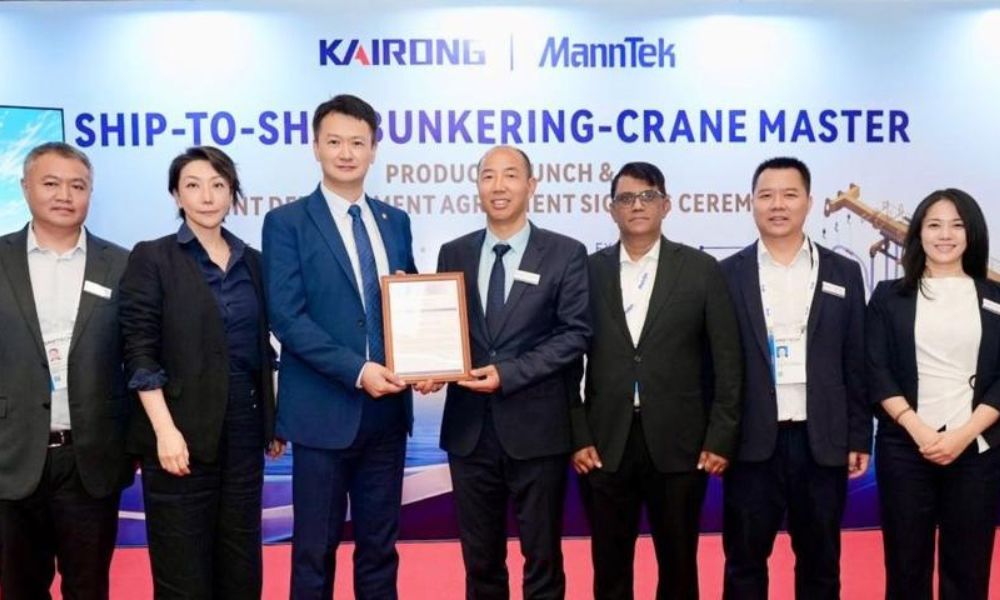
Bureau Veritas Marine & Offshore (BV) on Monday (14 September) said it awarded Approval in Principle (AiP) to Ningbo Kairong New Energy (Kairong) and Sweden-based MannTek for their jointly developed Ship-to-Ship LNG Bunkering Crane Master system at at Gastech 2026 in Bangkok.

Earlier the same day, Kairong and MannTek signed a Joint Development Cooperation Agreement and unveiled the latest Crane Master system. 

Designed specifically for ship-to-ship LNG bunkering operations, the Crane Master is a multifunctional integrated bunkering and hoisting system that combines crane handling capabilities with LNG transfer functions in a single solution.

The design aims to address operational challenges associated with LNG bunkering in busy port environments by integrating bunkering and lifting operations while maintaining high standards of safety and operational efficiency.

As part of the approval process, BV conducted a review of the design in accordance with applicable classification requirements. The assessment focused on key aspects including LNG bunkering system safety principles, low temperature leakage protection, emergency shutdown and release arrangements, and spare-parts hoisting operations. 

The AiP confirmed that the concept complies in principle with the relevant classification requirements and provides a foundation for further development and implementation.

“The certification highlights the growing importance of safe and reliable LNG bunkering infrastructure as the maritime industry advances its decarbonization journey,” BV said.

As LNG continues to play an important role as a transitional marine fuel, innovative bunkering solutions can help support the expansion of LNG fuel supply networks and the wider adoption of alternative fuels across the shipping industry.

Jeffrey Guo, Marine & Offshore Asia Pacific Senior Vice-President at Bureau Veritas, said: “Safe and efficient bunkering infrastructure is essential to supporting the growing adoption of LNG as a marine fuel.”

“We are pleased to award Approval in Principle to Kairong and MannTek’s LNG Bunkering Crane Master system, which brings together multiple bunkering functions within an integrated solution. This certification reflects the potential of the design and supports its continued development towards future application in LNG bunkering operations.”


Photo credit: Bureau Veritas Marine & Offshore
Published: 16 September, 2026

Continue Reading

Alternative Fuels

K Shipbuilding and LR to develop ethanol-fuelled MR tanker design

Joint development project will assess the technical feasibility, safety and regulatory compliance of a new ethanol-fuelled tanker design, with the objective of achieving AiP from LR.
Admin

Published

on

By

K Shipbuilding and LR to develop ethanol-fuelled MR tanker design

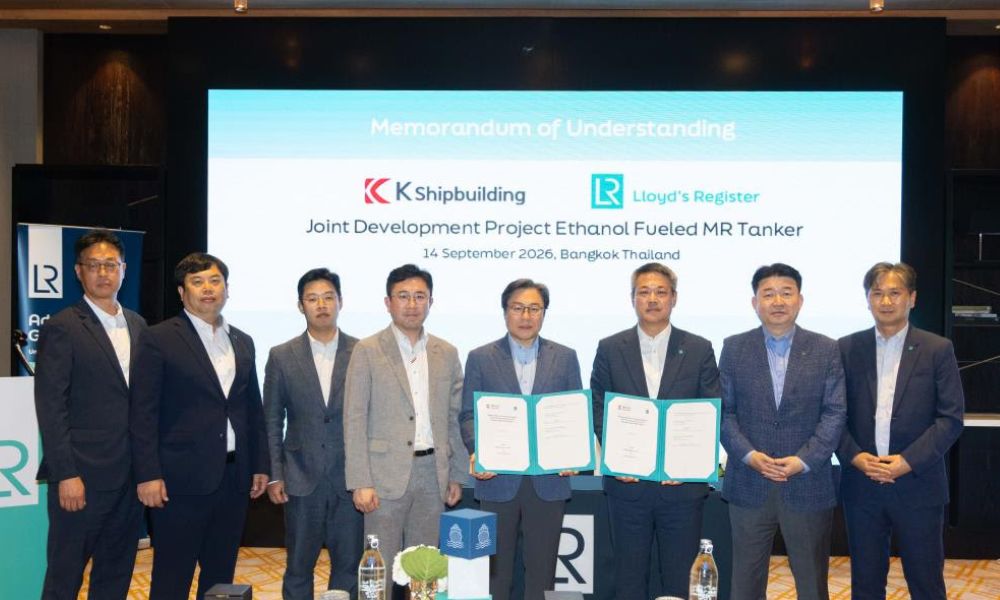
K Shipbuilding and Lloyd’s Register (LR) on Monday (14 September) signed a Memorandum of Understanding (MoU) to jointly develop an ethanol-fuelled 50,000 dwt Medium Range (MR) tanker.

Announced at Gastech 2026 in Bangkok, the joint development project will assess the technical feasibility, safety and regulatory compliance of a new ethanol-fuelled tanker design, with the objective of achieving Approval in Principle (AiP) from LR and creating a commercially competitive vessel concept for the global product tanker market.

LR will undertake technical reviews covering vessel arrangements, stability, structural requirements and fuel tank integration, while K Shipbuilding will lead the vessel design and development programme.

The project will also examine opportunities to optimise vessel design and operational efficiency while ensuring compliance with applicable class rules and international regulations.

Theo Kourmpelis, Global Business Director for tankers, Lloyd’s Register, said: “Ethanol is already a familiar cargo across the product tanker trades, which makes the MR segment a practical place to assess it as a fuel. As ethanol production and seaborne trade continue to develop, owners active in these trades are well placed to connect its role as a cargo with its use onboard.

“This project will give owners a clearer basis for evaluating ethanol within their fleet strategies, and help lay the groundwork for its broader uptake across the tanker sector.”

Andy McKeran, Chief Growth Officer, Lloyd’s Register, said: “Shipping’s energy transition is unlikely to be delivered through a single fuel solution. Shipowners are increasingly looking at a range of fuel options and want confidence that emerging technologies can be implemented safely, efficiently and in compliance with evolving regulations.

“This project will help deepen industry understanding of ethanol’s potential in the tanker sector and provide owners with greater insight into how alternative fuel solutions can be incorporated into commercially viable vessel designs.”

Tae-Hyun Koh, Chief Technology Officer, K Shipbuilding, said: “We see growing interest in fuel flexibility as shipowners make long-term investment decisions in an increasingly complex regulatory environment. Through this collaboration with Lloyd’s Register, we aim to develop a practical and competitive ethanol-fuelled MR tanker design that addresses both operational and market requirements.”


Photo credit: Lloyd’s Register
Published: 16 September, 2026

Continue Reading

Trending