Connect with us

LNG Bunkering

Sohar port joins SEALNG as its first Middle Eastern port member

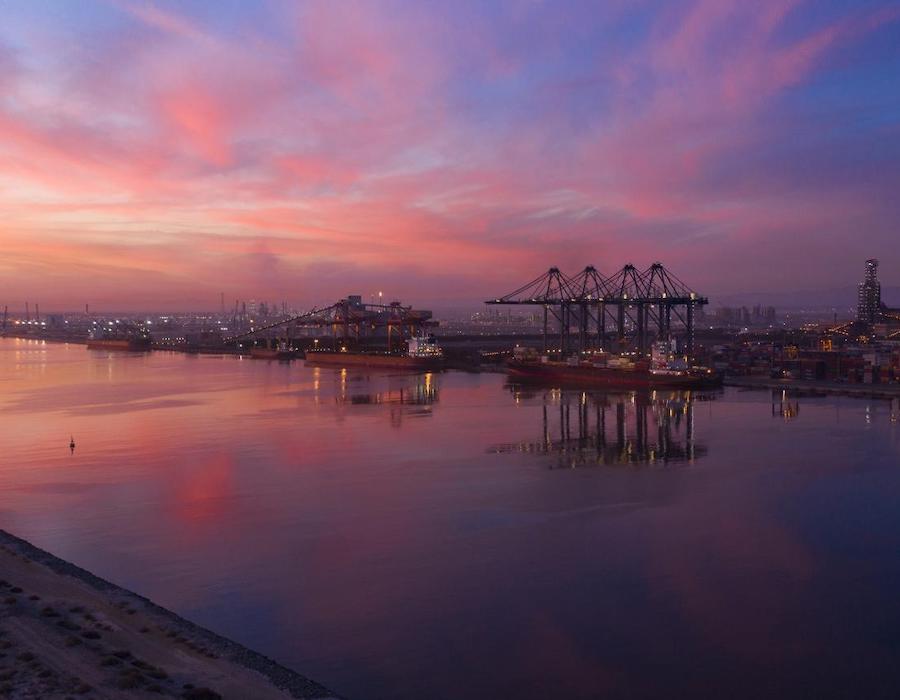
SOHAR joins coalition to promote its investment in LNG bunkering facilities and the use of liquefied natural gas (LNG) as a marine fuel, says SEALNG.

Admin

Published

on

Sohar port

Global multi-sector industry coalition SEALNG on Monday (20 April) announced SOHAR Port and Freezone as its first Middle Eastern port member.  

SOHAR joins SEALNG to promote its investment in LNG bunkering facilities and the use of liquefied natural gas (LNG) as a marine fuel, it said. 

MARSA LNG is a venture comprising TOTAL S.A. and OQ, and is developing a LNG liquefaction plant and bunkering facility in SOHAR Port.

“This major LNG Bunkering project will generate in-country value and job opportunities, and will support industry diversification efforts by promoting shipping activities in Oman,” said Mark Geilenkirchen, CEO of SOHAR Port.

“The establishment of this facility will make SOHAR one of the key LNG bunkering facilities on the main shipping trade routes, alongside other strategic ports, many of whom are already SEALNG Members, such as the Port of Singapore. MARSA LNG will supply LNG sourced locally in the Sultanate.”

“We are excited to welcome SOHAR to the SEALNG coalition.  SOHAR is our first Member from the Sultanate of Oman and will provide an attractive global offering once the marine bunkering project is completed,” adds Peter Keller, Chairman of SEALNG.

“From our perspective, this is an opportune time to develop LNG capabilities in Oman given the expansive growth of marine activity within the region.  We welcome SOHAR to our cause of furthering the use of LNG as an important, environmentally superior maritime fuel.”

Due to its unique location outside the Strait of Hormuz and mid-way between Europe and Asia, SEA/LNG explains that SOHAR is ideally positioned to become a major LNG bunkering hub in the Middle East. 

In addition, SOHAR Port and Freezone feature deep-water drafts capable of handling the largest vessels in the world, it adds. 

The liquefaction plant and bunkering project will be able to offer attractive business conditions, further enhanced by access to a dedicated logistics chain as well as large domestic gas reserves.

“As well as providing a means to comply with recently enforced sulphur limitations, LNG provides a clear pathway for the shipping industry to decarbonise through the introduction of biomethane and synthetic methane,” adds Keller.

“Now is the time to move forward with LNG as an important maritime fuel.  Inaction is not a plan and we cannot afford to wait decades for solutions that may never be realised. 

“Investing in LNG capable vessels now provides the shipping industry with a pathway to a low carbon future as well as significant and immediate environmental and health benefits.”

Related: McDermott begins construction of Oman LNG bunkering station at Sohar
Related: Total to develop LNG bunkering service at Oman


Photo credit: SOHAR Port and Freezone
Published: 21 April, 2020


Continue Reading

LNG Bunkering

PIL’s LNG dual-fuel boxship “Kota Elok” arrives in Singapore on maiden call

As the first of 13 new 13,000 TEU vessels joining its fleet, Kota Elok is equipped to operate on LNG and low-sulphur fuel oil that helps reduce our greenhouse gas emissions.

Admin

Published

on

By

PIL's LNG dual-fuel boxship “Kota Elok” arrives in Singapore on maiden call

Singapore-based Pacific International Lines Pte Ltd on Monday (20 July) said its first 13,000 TEU LNG dual-fuel container vessel, Kota Elok, recently made her maiden call to Singapore on 15 July.

As the first of 13 new 13,000 TEU vessels joining its fleet, Kota Elok is equipped to operate on liquefied natural gas (LNG) and low-sulphur fuel oil that helps reduce our greenhouse gas emissions. 

The vessel also incorporated energy-saving features and digital technologies to reduce fuel consumption and enhance operational performance, as well as a bow windshield to improve aerodynamics, contributing to improved fuel efficiency and lower emissions over the course of long-haul voyages.

“Following Singapore, Kota Elok will continue her voyage on our East Coast Service 1 (ES1) route to South America, calling at ports in Brazil, Uruguay, and Argentina before returning to Asia,” the company said in a social media post. 

Kota Elok also became PIL’s first vessel to receive Lloyd’s Register certification for compliance with the IACS UR E26 and UR E27 cyber security requirements.

Developed by the International Association of Classification Societies (IACS), UR E26 and UR E27 are mandatory cyber resilience requirements for newbuild vessels contracted from 1 July 2024. 


Photo credit: Pacific International Lines
Published: 21 July, 2026

Continue Reading

LNG Bunkering

CIMC SOE secures order for 12,000-cbm LNG bunkering vessel from Sinopec Clean Energy

Once operational, the vessel is expected to strengthen Sinopec’s domestic coastal LNG bunkering network and help address gaps in China’s alternative fuel bunkering infrastructure.

Admin

Published

on

By

CIMC SOE secures order for 12,000-cbm LNG bunkering vessel from Sinopec Clean Energy

China’s Nantong CIMC Sinopacific Offshore & Engineering Co., Ltd. (CIMC SOE) recently signed a contract with Sinopec (Beijing) Clean Energy Co., Ltd. to build a 12,000-cubic metre (m3) LNG bunkering vessel, according to Chinese maritime media.

The vessel is scheduled for delivery in 2028 and will support Sinopec’s efforts to expand its presence in the marine clean energy sector.

Once operational, the vessel is expected to strengthen Sinopec’s domestic coastal LNG bunkering network and help address gaps in China’s LNG bunkering infrastructure.

With this signing , CIMC Pacific Offshore Engineering’s LNG bunkering vessel orderbook is further strengthened, maintaining its leading position in the global market for small and medium-sized LNG bunkering vessels.

The contract also marked another milestone for CIMC SOE, which has seen a sharp increase in orders and business performance this year amid a surge in domestic LNG vessel demand.


Photo credit: Nantong CIMC Sinopacific Offshore & Engineering
Published: 21 July, 2026

Continue Reading

Alternative Fuels

ENGINE on Fuel Switch Snapshot: LSMGO surges to greater premium over biofuel

B100 discount to LSMGO widens to $541/mt in Rotterdam; Singapore’s B100 drops to $106/mt below LSMGO; Rotterdam LBM at $639-833/mt discounts to LSMGO.

Admin

Published

on

By

ENGINE on Fuel Switch Snapshot: LSMGO surges to greater premium over biofuel

Once a week, bunker intelligence platform ENGINE will publish a snapshot of alternative and conventional bunker fuel prices in the world’s two biggest bunkering hubs. The following is the latest snapshot:

20 July 2026

  • B100 discount to LSMGO widens to $541/mt in Rotterdam
  • Singapore’s B100 drops to $106/mt below LSMGO
  • Rotterdam LBM at $639-833/mt discounts to LSMGO

B100’s premium over HSFO in Rotterdam has narrowed by $50/mt over the past week to $64/mt, while its discount to VLSFO has widened by $83/mt to $105/mt.

B100 has become far more competitive against LSMGO in Rotterdam, with its discount widening by $180/mt over the past week to $541/mt, as a surge in conventional fuel prices left B100 broadly unchanged by comparison.

B100’s price has risen by $109/mt in Singapore, but its discount to LSMGO has still widened by $102/mt to $106/mt, as LSMGO surged by an even greater $211/mt.

Rotterdam’s LNG premium over VLSFO has widened by $35/mt to $201/mt for vessels with Otto medium speed (Otto MS) engines. For vessels with diesel slow speed (diesel SS) engines, LNG has flipped to a $15/mt premium over VLSFO, from a $22/mt discount the prior week.

Liquefied biomethane (LBM) discounts to VLSFO in Rotterdam have narrowed by $50-52/mt to $203-396/mt over the past week. Against LSMGO, LBM discounts have widened by $45-47/mt to $639-833/mt, depending on engine type.

In Singapore, LNG is now $42/mt cheaper than LSMGO for vessels with Otto MS engines, and $134/mt cheaper for vessels with diesel SS engines.

ENGINE on Fuel Switch Snapshot: LSMGO surges to greater premium over biofuel

Liquid fuels

HSFO and VLSFO prices in Rotterdam have jumped by $66/mt and $99/mt respectively over the past week, while LSMGO has surged by an even steeper $196/mt. A $9.69/bbl ($71/mt) rise in front-month ICE Brent futures, to $87.94/bbl ($645/mt), drove bunker prices sharply higher across the board.

Bunker fuel availability is tight for prompt delivery dates in the ARA ports, with buyers advised to enquire about stems between 5-7 days ahead to get good coverage, a trader said.

Rotterdam’s B100 price has risen by $16/mt over the past week. Dutch ZRE A ticket prices were unchanged at €107.50/mtCO2e.

Singapore’s HSFO and VLSFO prices have risen by $130/mt and $132/mt respectively, while its LSMGO price has gained an even steeper $211/mt over the past week.

VLSFO availability in Singapore has been tight, with several suppliers reporting low stock levels. Recommended lead times have widened from 13–17 days last week to 14–19 days now.

Liquid gases

Rotterdam’s LNG prices have surged by $134-136/mt over the past week, while its LBM prices have climbed by $149-151/mt.

LBM discounts to LNG in Rotterdam have narrowed by $15/mt to $404-411/mt.

Singapore’s LNG bunker benchmarks have surged by $196-197/mt over the past week.

By Erik Hoffmann


Photo credit and source: ENGINE
Published: 21 July, 2026

Continue Reading

Trending