Connect with us

Business

Argus and Zhoushan city government sign initial agreement for bunker markets

Argus Chairman and Chief Executive: ‘We expect the Zhoushan Bunker Index to serve as a regional benchmark as Zhoushan grows in importance as a regional bunker hub.’

Admin

Published

on

5cc7eb8f4ea01 1556605839

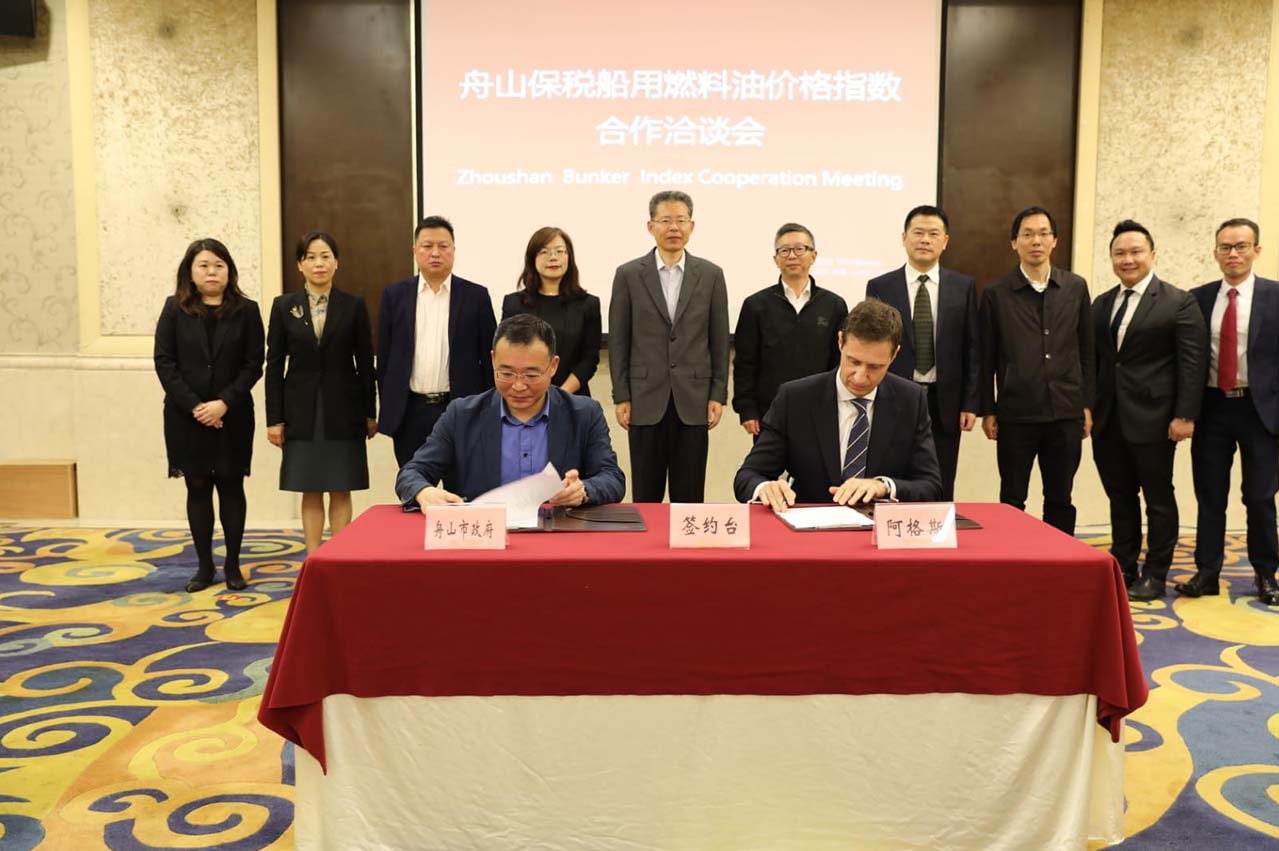
The Zhoushan city government and global energy and commodity price reporting agency Argus on Tuesday (30 April) signed an initial agreement to work together to bring further price transparency to the Zhoushan bunkering hub.

Argus has been assessing delivered-to-ship high-sulphur 380 centistokes (cSt) bunker fuel prices in Zhoushan since December, it notes.

It is seeking to extend its coverage through the development of a new Zhoushan Bunker Index for low-sulphur fuel oil in response to the tighter sulphur specifications for marine fuel that the International Maritime Organisation is introducing at the beginning of next year.

According to Argus, the Zhoushan city government chose to work with the company owing to its international reputation as a commodity price reporting agency and its position as a leading provider of assessments for the port of Singapore, where companies submit daily transaction information to Argus for use in its bunker indexes.

Argus, in turn, chose to work with the Zhoushan city government because of Zhoushan’s strategic location, world-class infrastructure and free trade zone status, which combine to give Zhoushan a bright future in terms of growing bunker trade and as an important regional pricing and trading hub.

“Argus welcomes the opportunity to provide greater transparency to the port of Zhoushan and we hope that by providing independent, high-quality, bunker fuel assessments we can assist suppliers and shipowners to make well-informed business decisions,” said Argus Media Chairman and Chief Executive Adrian Binks.

“We expect the Zhoushan Bunker Index to serve as a regional benchmark as Zhoushan grows in importance as a regional bunker hub. We wish the Zhoushan city government success in further developing the port.”

Zhoushan lies within the Zhejiang free trade zone and has grown rapidly in recent years to become the biggest marine fuels hub in China and one of the top 10 ports globally for bunker sales. Marine fuel sales through Zhoushan were 3.5 million metric tonnes last year.

Photo credit: Argus Media
Published: 30 April, 2019


Continue Reading

Ammonia

HPA and MB Energy develop safety concept for STS ammonia bunkering

HPA says the Port of Hamburg will become “bunker ready” for ammonia, laying the groundwork for safe and reliable ammonia bunkering in the future.

Admin

Published

on

By

HPA and MB Energy develop safety concept for STS ammonia bunkering

The Hamburg Port Authority (HPA) and integrated energy company MB Energy on Tuesday (21 July) said they have completed a comprehensive risk analysis and developed a dedicated safety concept for ship-to-ship ammonia bunkering.

MB Energy said the analysis lays the groundwork for the safe introduction of ammonia as a future marine fuel.

“With our planned ammonia import terminal in Hamburg-Blumensand, MB Energy intends to provide the reliable land side supply infrastructure needed to support this transition across northern German ports,” it said in a social media post. 

Mabanaft Group was renamed to MB Energy last year and merged over 50 existing brands under one identity. 

Separately, HPA said the Port of Hamburg will become “bunker ready” for ammonia, laying the groundwork for safe and reliable ammonia bunkering in the future.

“The focus is in particular on container ships, cruise ships as well as RoRo and ConRo (Container/RoRo) ships,” it said. 

“We expect ammonia to establish itself as an alternative marine marine fuel in the coming years. With our preparatory work, we are already creating the conditions to welcome the first ammonia-powered ships in Hamburg and to bunker them safely.:

HPA added that the import terminal for ammonia planned by MB Energy from 2029 will make a decisive contribution to ensuring the reliable availability of ammonia as a bunker fuel in northern German ports in the long term. 

“The use of an ammonia bunker barge is considered a possible addition to the landside infrastructure to enable ship bunkering in the port and beyond in the future,” it said.

Related: Mabanaft Group renames as MB Energy, merging over 50 brands under one identity


Photo credit: Hamburg Port Authority
Published: 22 July, 2026

Continue Reading

Milestone

GCMD: Project CAPTURED achieves two regulatory milestones for onboard captured CO2

CO2 captured onboard during the project has been formally recognised for compliance under the EU ETS while a proposal submitted to MEPC 84, based on the project, has received IMO’s in-principle support.

Admin

Published

on

By

RESIZED venti views

Global Centre for Maritime Decarbonisation (GCMD) on Wednesday (21 July) said Project CAPTURED has achieved two regulatory milestones that strengthen the commercial case for onboard carbon capture and storage (OCCS).

This comes following its world’s first demonstration of an end-to-end value chain for onboard captured and liquefied CO2 (LCO2).

Completed in June 2025, the pilot showed that CO2 captured onboard a vessel can be offloaded ship-to-ship, transported overland and permanently bound through carbon mineralisation—a process that converts captured CO₂ into stable materials for industrial use.

The CO2 captured onboard during Project CAPTURED has been formally recognised for compliance under the European Union Emissions Trading System (EU ETS). This means the verified tonnage of captured CO2 can be deducted from emissions requiring the surrender of EU Allowances (EUAs).

To qualify for this recognition, the CO2 must be chemically bound permanently in eligible products. Project CAPTURED demonstrated that CO2 captured onboard vessels can meet this requirement through carbon mineralisation.

The data and learnings from the same demonstration formed the basis of a proposal submitted to MEPC 84. This proposal received in-principle support from the International Maritime Organization (IMO) for recognising carbon mineralisation as a form of permanent CO₂ storage.

Complementing geological sequestration, which is already accepted by the IMO, this recognition broadens the downstream options for CO2 captured onboard vessels, and supports the development of maritime carbon value chains. Beyond providing a permanent storage pathway, carbon mineralisation also creates the potential for captured CO2 to serve not only as a waste stream requiring permanent storage, but also as a feedstock for industrial applications through carbon mineralisation, extending emissions reductions beyond the shipping value chain.

Professor Lynn Loo, CEO, GCMD, said, “Project CAPTURED has moved OCCS beyond technical demonstration. The acceptance of the EU ETS deduction gives captured CO₂ a compliance value. At the same time, IMO’s in-principle support for carbon mineralisation will help clarify how captured CO2 can be treated after it leaves the vessel. Together, these milestones turn a pilot into a verified reference case for maritime carbon logistics, one that links regulatory recognition, commercial value and emissions impact.”


Photo credit: Venti Views on Unsplash
Published: 22 July, 2026

Continue Reading

Bunker Fuel

Alkagesta highlights key insights of Malta bunkering market in 2026

Darren Lee Axisa discusses the key trends influencing Malta’s bunkering market and the factors that will determine Malta’s long-term competitiveness as a regional bunkering hub.

Admin

Published

on

By

Alkagesta highlights key insights of Malta bunkering market in 2026

In an article published on Alkagesta Market Insights, Darren Lee Axisa, Malta Country Manager of Alkagesta, on Monday (20 July) discussed the key trends influencing Malta’s bunkering market and the factors that will determine Malta’s long-term competitiveness as a regional bunkering hub: 

Malta’s bunkering and energy market is moving through a period of structural adjustment. The disruptions that defined the first half of 2026 have accelerated shifts in product demand, terminal strategy, and the competitive dynamics of one of the Mediterranean’s most strategically positioned bunkering hubs. For Alkagesta, whose storage footprint on the island approaches 300,000 cubic metres, the period has tested operational flexibility while reinforcing the value of diversified infrastructure access.

A Market Shifting in Two Directions

Malta’s broader economy has remained resilient — GDP growth reached 3.9% in Q1 2026 — but the bunkering market has undergone a significant product mix shift, the roots of which predate the current geopolitical disruption.

The Mediterranean Emission Control Area, which came into force on 1 May 2025, triggered an immediate and measurable realignment in fuel demand across the region. VPS data covering the first six months post-ECA implementation shows that across the top ten Mediterranean bunkering ports, VLSFO volumes fell 23%, MGO more than doubled, ULSFO quadrupled, and biofuels increased fivefold. In Valletta specifically, the shift was even more pronounced: VLSFO dropped 57% from 111,641 mt to 47,732 mt, while MGO volumes more than tripled from 33,299 mt to 103,445 mt, and ULSFO rose from 2,821 mt to 34,535 mt over the same period.

This structural rotation has been further accelerated by the broader regulatory environment. FuelEU Maritime and EU ETS requirements are pushing shipowners toward cleaner, verifiable fuel options at every port call — a direction Alkagesta had already positioned itself ahead of, having been among the first movers in the Mediterranean to support the transition to 0.1% sulphur fuel oil following the ECA’s introduction.

Layered on top of this regulatory shift has been a period of reduced terminal capacity affecting bunkering market availability across the island. Fuel oil volumes dropped roughly 35% year-on-year between January and May 2026, falling from approximately 382,000 mt in 2025 to 247,000 mt. DMA demand moved sharply in the opposite direction, rising from around 150,000 mt in January to April 2025 to 247,000 mt over the same period in 2026 — a trend consistent with both the ECA-driven product mix shift and the disruption to heavier fuel availability during the constrained period.

Note: The full article can be read here


Photo credit: Alkagesta
Published: 22 July, 2026

Continue Reading

Trending