
Bunker Fuel Quality
VPS highlights fuel quality management for vessels idled in Arabian Gulf, Gulf of Oman
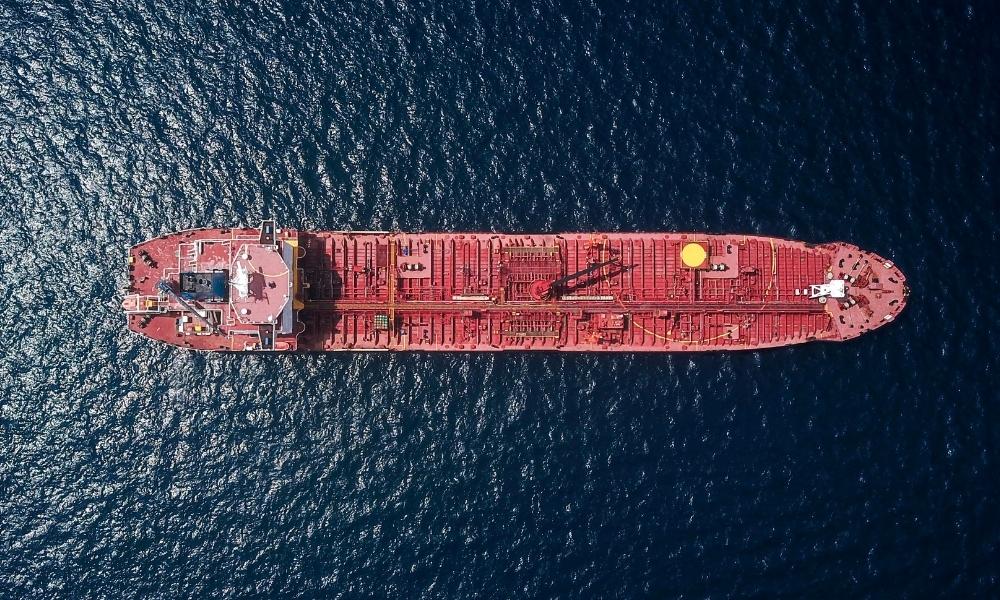
Captain Rahul Choudhuri, President of Strategic Partnerships at marine fuels testing company VPS offers insight and advice on how to manage fuel quality onboard idle vessels in the Gulf region.


Captain Rahul Choudhuri, President of Strategic Partnerships at marine fuels testing company VPS, on Monday (8 June) offered insight and advice on how to manage fuel quality onboard idle vessels in the Gulf region:
The Current Situation
Since the closure of the Strait of Hormuz to most commercial shipping in late February 2026, an estimated 1,550 vessels, carrying approximately 20,000 seafarers, have been unable to transit, or have chosen to remain at anchor in the Arabian Gulf, Gulf of Oman, and approaches. Traffic through the Strait, which normally averages around 138 vessels per day, has fallen to near-zero on most days. The conflict began on 28 February 2026, resulting in vessels being idle for approximately 90 days. Many are expected to remain idle until a navigable resolution to the situation emerges, which cannot be predicted at this time.
For vessel owners and operators responsible for such vessels, there is a need to focus on the technical consequences of extended idle upon fuel quality and what needs to be done in order to protect the vessel, crew and the environment.
Fuel Quality Deterioration During Extended Idle
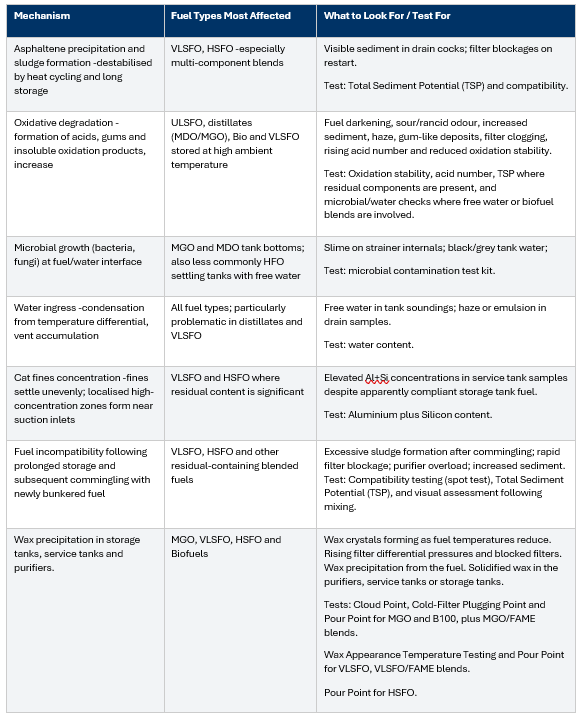
Fuel deterioration in idle vessels is caused by a combination of time, temperature, water ingress, and inactivity. Each mechanism reinforces the others. The Arabian Gulf summer (June–September) is one of the most demanding storage environments in global shipping, with bunker tank temperatures on unshaded anchored vessels regularly reaching 50–55°C.
Biofuel Blends
The UAE, principally Fujairah and Jebel Ali, has begun supplying ISCC-certified marine biofuel blends, primarily FAME (UCOME) blended into VLSFO, at concentrations typically ranging from B10 to B30 (10–30% FAME by volume). Vessels that bunkered Biofuel blends before going idle face additional degradation risks that do not apply to conventional fuel:
FAME (UCOME) blends, may exhibit reduced storage stability. Although storage life varies, a typical shelf life is often considered to be around 3 to 4 months, after which the risk of oxidation, acid formation and microbial contamination may increase, particularly under elevated ambient temperatures.
FAME is hygroscopic and absorbs water from tank atmospheres, promoting microbial growth at rates significantly higher than conventional VLSFO. Here, the free-water monitoring frequency should be doubled for any tank containing a biofuel blend.
FAME can cause filter blockage. Depending on feedstock composition, may be susceptible to crystallisation at lower temperatures. Therefore, Wax Appearance Temperature testing should be performed before re-activation for any vessel sailing to cooler latitudes post-Gulf.
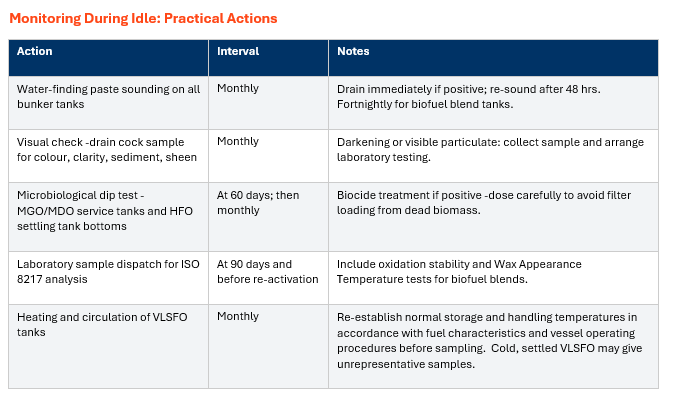
Note: The full article by VPS can be viewed here.
Photo credit: VPS
Published: 9 June, 2026
Winding up
Singapore: Marine fuel testing firm CCIC Singapore faces winding up application
Application for the winding up of CCIC Singapore Pte Ltd was filed by Hong Kong-registered CCIC International Holding Limited on 7 September, according to Government Gazette notice.
Bunker Fuel Quality
VPS: High bunker prices meet declining fuel quality
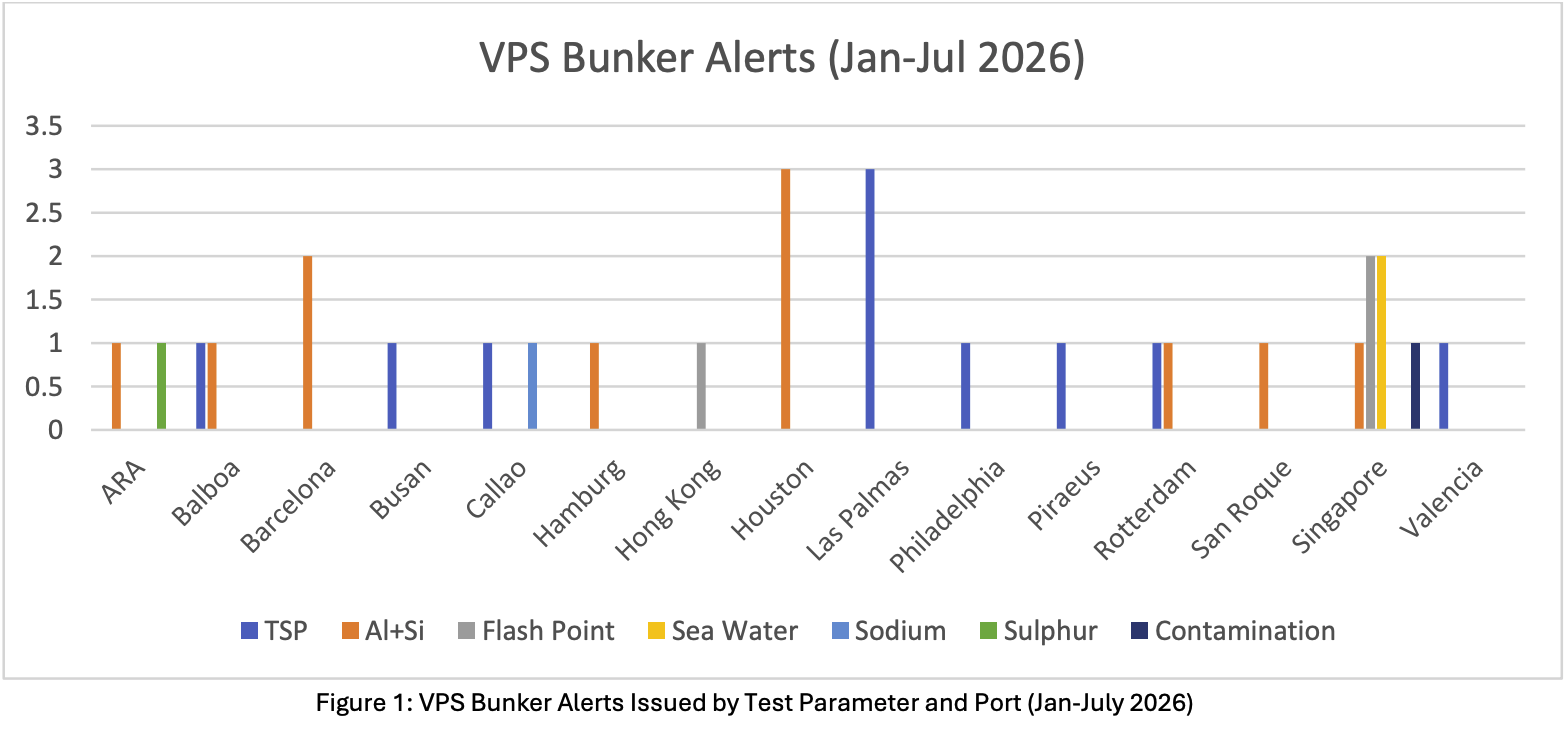
Of the current 29 Bunker Alerts issued by VPS from January to July 2026, the combination of abrasive issues due to elevated cat-fines, plus fuel stability issues, account for 72% of these alerts.
Steve Bee, Group Marketing and Strategic Projects Director of marine fuels testing company VPS, on Monday (24 August) reviewed 2026 marine fossil fuel quality to date and the high number of issues being witnessed:
Marine fuel buyers entered 2026 facing a perfect storm, suffering some of the highest bunker prices ever experienced, paired with a sharp and concerning decline in fuel quality. Across the traditional marine fossil fuel supply chain, VPS has seen a marked rise in fuel quality issues, with the Middle East conflict playing a major role in driving both price volatility and quality deterioration. For ship owners/operators, the message is clear, today’s fuel market is not only more expensive, it is also becoming more complex and unpredictable, with a higher degree of operational risk.
This deterioration is already showing itself in the test data VPS have produced. Between January and July 2026, VPS issued 29 Bunker Alerts, more than the total issued across the whole of 2024 and already closing in on the 37 alerts recorded throughout all of 2025. In just seven months of 2026, the scale and frequency of these alerts underline a clear, accelerating rise in fuel quality problems across the industry. Of the current 29 Bunker Alerts issued so far, Jan-Jul 2026, the combination of abrasive issues due to elevated cat-fines, plus fuel stability issues, account for 72% of these alerts. The ports requiring cat-fines and/or stability-related bunker alerts were, ARA, Balboa, Busan, Callao, Hamburg, Houston, Las Palmas, Philadelphia, Piraeus, Rotterdam, San Roque, Singapore and Valencia.
What is of additional interest is that marine gas oil does not account for a single Bunker Alert so far in 2026. It is HSFO and VLSFO dominating the fuels requiring such warnings.
Looking at the rate of off-specifications across each of the main marine fossil fuel types, HSFO is currently running at 8.87% of samples tested, being off-specification for at least one ISO8217 test parameter, whilst VLSFO has 9.88% off-specification level, MGO has 9.03% and ULSFOs is at 19.58%. ISO 8217 provides specification requirements for marine fuel as delivered to the ship. From a commercial perspective the fuel is only required to meet the specification at the point of custody transfer, ie at the ship’s manifold. However, compliance at this point, is not a guarantee of assurance that the fuel can be used without operational difficulties throughout its onboard lifecycle. This includes, how the fuel is stored, treat and consumed in main engines, generator engines, boilers, or other machinery. The condition of the fuel which ultimately reaches the machinery, is also strongly influenced by onboard fuel management, including storage and settling temperatures, settling time, purification temperature and throughput, purifier configuration and desludging arrangements, filtration, maintenance of the correct injection viscosity and other operational factors.
This is why knowing the characteristics of the bunkered fuel is critical to managing it correctly onboard. Appropriate testing can identify characteristics which, although not necessarily resulting in an ISO 8217 specification failure, may warrant additional operational attention. VPS therefore evaluates bunker fuels not only against the applicable specification requirements, but also provides operational advice where analytical findings indicate that additional precautions may be appropriate during storage, treatment or consumption.
VPS testing and observations, based on over 45 years of marine fuel testing experience and expertise, strongly align with a recent Linkedin post by marine and energy consultants, Brookes Bell. Their post highlighted a growing concern within the industry, stating a P&I Club had reported that bunker-related claims are up 50% this year, with many of the fuels involved having technically passed ISO8217 standard specification testing.
The same post noted that some ISO8217-compliant fuels have still caused operational damage. This has left shipowners to manage complex evidentiary disputes after problems arose. Its key warning was clear: Standard compliance testing alone isn’t catching the problem. If “passing spec” is not necessarily the same as being “safe-to-burn”, then the critical question becomes, “What additional testing is needed to identify the real operational risks?”
VPS have recognised that for some time, the ISO8217 standard is not an all-encompassing set of tests providing the highest level of asset, crew and environmental protection. For this reason, VPS offer a range of additional tests, as well as our Additional Protection Service (APS) test bundles. For example in the case of avoiding damages from cat-fines, the Fuel System Check (FSC) service, can provide valuable information in regard to monitoring purifier efficiency and the removal of cat-fines, protecting the engine to a higher degree. Whereas, Separability Number testing, is a key compliment to the hot filtration stability tests of TSP, TSA and TSE in mitigating stability risks. Should additional cold-flow information be required, the VPS proprietary Wax Appearance Temperature (WAT) testing provides key storage and fuel transfer temperature information. Whilst the VPS chemical screening services can identify potentially harmful chemicals within a fuel before the fuel is burnt. Then more detailed Gas Chromatography Mass Spectrometry (GCMS) forensic analysis provides key information to potentially support the fuel claims process.
VPS account managers and technical specialists can help shipowners and operators determine which laboratory tests are most appropriate for their fleet, based on the fuel characteristics, vessel operations and potential risk exposure. This guidance can support the mitigation of risks linked to engine damage, SOLAS compliance, legislative requirements and wider operational reliability.
The VPS Technical Advisory Team reviews bunker analysis results together with the vessel operational observations to provide practical advice on fuel storage, handling, purification and overall fuel management. Where appropriate, additional laboratory tests, or test bundles, may be recommended to further evaluate the fuel and assist in identifying the cause of an operational issue, supporting more informed decision-making.
VPS continues to monitor regional and global fuel quality trends through its laboratory network and customer feedback. Information received from vessels experiencing similar operational issues is valuable in helping VPS identify emerging trends and provide timely technical guidance to the wider shipping industry.
Photo credit: VPS
Published: 25 August, 2026
Bunker Alerts
Low flashpoint found in Indonesia bunker fuels, alerts Maritec-Naias
Firm tested eight bunker samples representing LSMDO and B40 fuel grade from vessels that took fuel oil /bunkered in Indonesia ports, which indicated flashpoints as low as 39.5°C.

OUR INDUSTRY PARTNERS

Singapore: Liquidator of Da Xin Tankers, Nan Chiau Maritime issues notices of dividend

GCMD, BCG: Engine choices today to shape shipping’s fuel pathways through 2050

Yang Ming names 15,500 TEU LNG dual-fuel container vessel “YM Weight”

Peninsula: Missing “Hercules Star” crew member found dead after Dubai incident

DNV: Existing ammonia shipping and safety expertise key to scaling new supply chains

Baltic Exchange: Bunker Report (17 September 2026)

ENGINE: Americas Bunker Fuel Availability Outlook (17 Sep 2026)
Peninsula confirms one fatality, crew member missing from bunker tanker “Hercules Star”

Singapore: Marine fuel testing firm CCIC Singapore faces winding up application

Auramarine: Marine fuel flexibility will be key to shipping’s energy transition
Singapore: Liquidators of Nan Ho Maritime, Nan Xin Maritime issue notices of dividend

Singapore: MPA working with industry on next phase of digital bunkering, says Deputy CE

Amogy and LOTTE Fine Chemical to explore ammonia bunkering in South Korea

Kongsberg Maritime to buy Finnish marine propulsion designer Steerprop
-
 Incident1 week ago
Peninsula confirms one fatality, crew member missing from bunker tanker “Hercules Star”
-
 Winding up3 days ago
Singapore: Marine fuel testing firm CCIC Singapore faces winding up application
-
 Alternative Fuels2 weeks ago
Auramarine: Marine fuel flexibility will be key to shipping’s energy transition
-
 Winding up2 weeks ago
Singapore: Liquidators of Nan Ho Maritime, Nan Xin Maritime issue notices of dividend
-
 Technology1 week ago
Singapore: MPA working with industry on next phase of digital bunkering, says Deputy CE
-
 Ammonia1 week ago
Amogy and LOTTE Fine Chemical to explore ammonia bunkering in South Korea
-
 Business2 weeks ago
Kongsberg Maritime to buy Finnish marine propulsion designer Steerprop
-
 Winding up4 days ago
High Court of Singapore issues winding up order against Hengli Petrochemical International