Connect with us

Business

Oil glut set to halve in May and shrink to 6 million bpd in June, but storage can’t breathe

‘We still believe in an oil price recovery, possibly as early as June, and see a risk for a tight market in 2022 with prices much higher than pre-crisis levels,’ says Rystad Energy.

Admin

Published

on

Rystad Energy Oil Glut Forecast

Independent energy research and business intelligence company Rystad Energy on Thursday (30 April) published its forecast for the aftermath and recovery of the global oil market post Covid-19 pandemic for the short term and long term: 

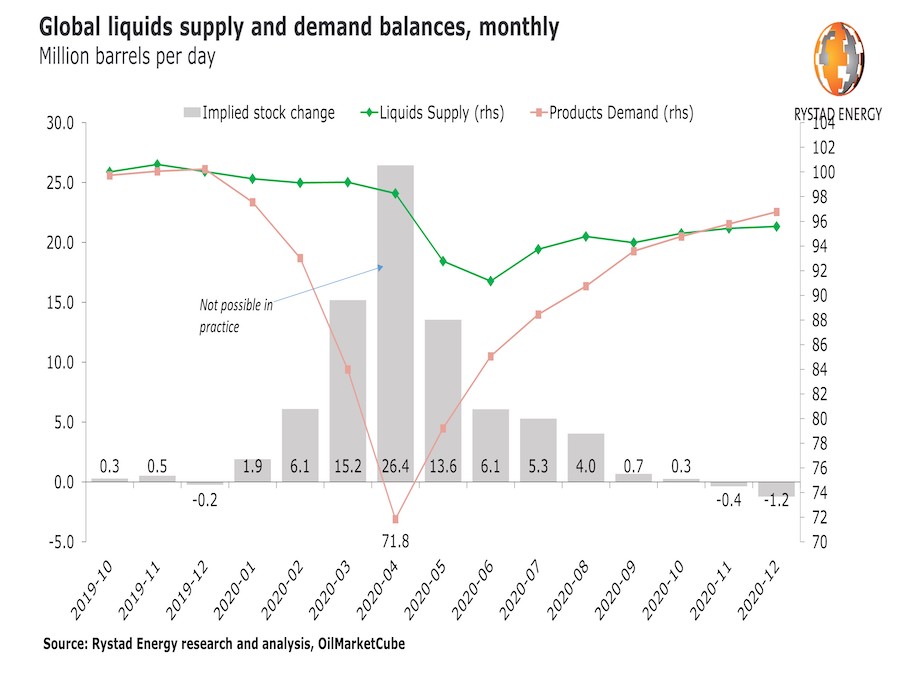
Some good news: The global imbalance between oil supply and demand, which has built to 26.4 million barrels per day (bpd) in April due to the Covid-19 pandemic, is set to halve to 13.6 million bpd in May and fall further to just 6.1 million bpd, according to a Rystad Energy analysis. However, despite the improvement, the stock build will still overwhelm remaining global storage, which will fill in weeks.

Global supply is expected to fall in May to 92.8 million bpd, from 98.3 million bpd in April, and further decline to 91.1 million bpd in June. We expect June to see the lowest supply level this year unless further production cuts are announced, with output rebounding from July.

Demand on the other hand, which Rystad Energy estimates will reach its lowest point at 71.8 million bpd in April, will rise to 79.2 million bpd in May and to 85.1 million bpd in June, as governments ease Covid-19-related restrictions and some industrial activity resumes.

This supply figure already includes the cumulative 6.5 million bpd cuts we expect from OPEC+ countries, as well as more than 2 million bpd of production shut-ins from non-OPEC countries (such as Norway) suffering under the unprecedented market squeeze.

“While this may seem like a drastic improvement from April, the oil market is not magically fixed. The storage issue still looms large and will spill over onto trading floors, as buyers are left with crude they cannot physically cannot place, and into the boardrooms of oil companies which must make very costly but necessary decisions to scale back production and give the market some breathing space,“ says Rystad Energy oil market analyst Louise Dickson.

The demand-supply gap will become narrower in practice as we believe the market will be forced to tighten the stock build gap during May when countries run out of local storage. After local storage is exhausted, tankers will be packed with oil barrels seeking refuge in the country with the most remaining storage capacity – the US.

Until this gap is filled by additional shut-ins (possibly even within OPEC+ countries themselves), we can expect further downward pressure on oil prices, especially those that lack a clear conduit to the export market.

If sufficient production isn’t shuttered by 19 May 2020 (the expiration of the WTI June 2020 contract), then the potential remains for another nightmare WTI price collapse, which we do not rule out spreading to other crude blends. However, given that most oil futures outside of WTI do not require the buyer to physically take oil delivery, and instead have cash settlement options, the destruction to other benchmarks should be tamer.

The negative price crash is most clearly linked to the shortage in global storage. Currently, global storage for crude is about 90% full and for crude oil products, that figure is closer to 80%. Rystad Energy currently estimates that there is 400 million barrels of available global crude storage left, and that crude stocks will build by 13.6 million bpd on average in the month of May.

The math isn’t overly complicated, and at this rate, assuming storage tanks can only be filled to about 95% capacity due to technical reasons, Rystad Energy forecasts storage is already hitting the wall in the markets. And, it could reach capacity at the last storage facility standing, the US, towards the end of May. Cushing, Oklahoma could top up even sooner.

“No matter how this physical rebalancing occurs during May, we still expect that the oil price bottom is right in front of us rather than behind us. The next question for markets now is what the recovery will look like and how many oil companies are able to weather the storm and bring inevitable field shut-ins back onstream,” adds Dickson.

We still believe in an oil price recovery, possibly starting as early as June, and see a risk for a tight market in 2022 with prices much higher than pre-crisis levels. This will be facilitated by a recovery in demand to above pre-Covid-19 levels in 2022, ongoing OPEC+ cuts, and a loss of supply capacity in both US shale and long-cycled global production. Not all production that is currently being shut-in will be able to swiftly return.


Photo credit and source:
Rystad Energy
Published: 4 May, 2020

Continue Reading

Legal

Singapore withdraws remaining 127 charges against Hin Leong founder OK Lim

Lim Oon Kuin, also known as OK Lim, was issued a stern warning and a district court granted him a discharge amounting to an acquittal for these charges on 17 July.

Admin

Published

on

By

RESIZED Sora Shimazaki on Pexels

Founder of collapsed oil trader Hin Leong Trading, Lim Oon Kuin, also known as OK Lim, has had the remaining 127 charges against him withdrawn, according to The Straits Times on Monday (20 July). 

OK Lim was issued a stern warning and a district court granted him a discharge amounting to an acquittal for these charges, including those for cheating, on 17 July. The discharge means Lim cannot be prosecuted again for the same offences.

Lim, 84, is currently serving a 13½-year prison sentence after the High Court reduced his original 17½-year jail term in March 2026. He was convicted in 2024 on two cheating charges and one count of abetting forgery in a case prosecutors described as one of Singapore’s most serious trade finance frauds.

Lim was convicted in May 2024 of two charges of cheating the Hongkong and Shanghai Banking Corporation (HSBC) and one count of abetting forgery that proceeded to trial out of a total of 130 criminal charges.

He was first charged in court on 14 August 2020, and was subsequently handed further charges in court on 25 September 2020, 30 April 2021 and 24 June 2021 for his role in perpetuating fraud on various financial institutions. 

A total of 130 charges were eventually brought against him for cheating and forgery-related offences.

Related: Singapore: Hin Leong Founder OK Lim gets jail term slashed to 13.5 years


Photo credit: Sora Shimazaki
Published: 21 July, 2026

Continue Reading

Winding up

Singapore: Coastal Logistics Pte Ltd to be wound up voluntarily

Coastal Logistics was reportedly affiliated with troubled Singapore bunker player Coastal Oil (Singapore) Pte Ltd.

Admin

Published

on

By

RESIZED Drew Beamer

Several resolutions for Coastal Logistics Pte Ltd were made during an extraordinary general meeting held on 14 July, according to a notice in the Government Gazette on Friday (4 July).

The following resolutions were duly passed during the meeting:

As Special Resolution

  • That it has been proved to the satisfaction of the meeting that the Company cannot by reason of its liabilities continue its business and accordingly the Company be wound up voluntarily pursuant to Section 160(1)(b) of the Insolvency, Restructuring and Dissolution Act 2018 (No. 40 of 2018);

As Ordinary Resolutions

  • that Mr. Wong Pheng Cheong Martin and Ms. Koay May Yee, both care of FTI Consulting (Singapore) Pte Ltd, One Raffles Quay, #27-10 South Tower, Singapore 048583 be appointed as the joint and several Liquidators of the Company for the purpose of such winding up; and
  • that the Liquidators be at liberty to open, maintain and operate any bank account(s) or account(s) for monies received by them as Liquidators with such bank(s) as they deem fit; and
  • that a Committee of Inspection will not be formed.

Manifold Times previously reported Nicholas James Gronow, director of Heng Tong Fuels & Shipping and Coastal Logistics, filed statutory declarations for both companies stating the firms cannot continue their businesses due to liabilities.

Both companies were reportedly affiliated with troubled Singapore bunker player Coastal Oil (Singapore) Pte Ltd. 

In 2019, several vessels owned by both firms entered the sale & purchase (S&P) market in Singapore.

Related: Singapore: Director declares Heng Tong Fuels & Shipping’s inability to continue business
Related: Heng Tong Fuels & Shipping in court over DBS Bank bunker tanker loan
Related: Singapore: Bunker tanker “Coastal Neptune” arrested
Related: Heng Tong Fuels & Shipping, Coastal Logistics tankers enter S&P market


Photo credit: Drew Beamer
Published: 21 July, 2026

Continue Reading

LNG Bunkering

PIL’s LNG dual-fuel boxship “Kota Elok” arrives in Singapore on maiden call

As the first of 13 new 13,000 TEU vessels joining its fleet, Kota Elok is equipped to operate on LNG and low-sulphur fuel oil that helps reduce our greenhouse gas emissions.

Admin

Published

on

By

PIL's LNG dual-fuel boxship “Kota Elok” arrives in Singapore on maiden call

Singapore-based Pacific International Lines Pte Ltd on Monday (20 July) said its first 13,000 TEU LNG dual-fuel container vessel, Kota Elok, recently made her maiden call to Singapore on 15 July.

As the first of 13 new 13,000 TEU vessels joining its fleet, Kota Elok is equipped to operate on liquefied natural gas (LNG) and low-sulphur fuel oil that helps reduce our greenhouse gas emissions. 

The vessel also incorporated energy-saving features and digital technologies to reduce fuel consumption and enhance operational performance, as well as a bow windshield to improve aerodynamics, contributing to improved fuel efficiency and lower emissions over the course of long-haul voyages.

“Following Singapore, Kota Elok will continue her voyage on our East Coast Service 1 (ES1) route to South America, calling at ports in Brazil, Uruguay, and Argentina before returning to Asia,” the company said in a social media post. 

Kota Elok also became PIL’s first vessel to receive Lloyd’s Register certification for compliance with the IACS UR E26 and UR E27 cyber security requirements.

Developed by the International Association of Classification Societies (IACS), UR E26 and UR E27 are mandatory cyber resilience requirements for newbuild vessels contracted from 1 July 2024. 


Photo credit: Pacific International Lines
Published: 21 July, 2026

Continue Reading

Trending