Connect with us

Bunker Fuel Availability

ENGINE: East of Suez Bunker Fuel Availability Outlook (3 Feb 2026)

VLSFO and HSFO availability tight in Singapore; bunker demand low in several South Korean ports; VLSFO and LSMGO availability good in Oceanic ports.

Admin

Published

on

RESIZED ENGINE East of Suez

The following article regarding regional bunker fuel availability outlook for the East of Suez region has been provided by online marine fuels procurement platform ENGINE for publication on Singapore bunkering publication Manifold Times:
  • VLSFO and HSFO availability tight in Singapore
  • Bunker demand low in several South Korean ports
  • VLSFO and LSMGO availability good in Oceanic ports

Singapore and Malaysia

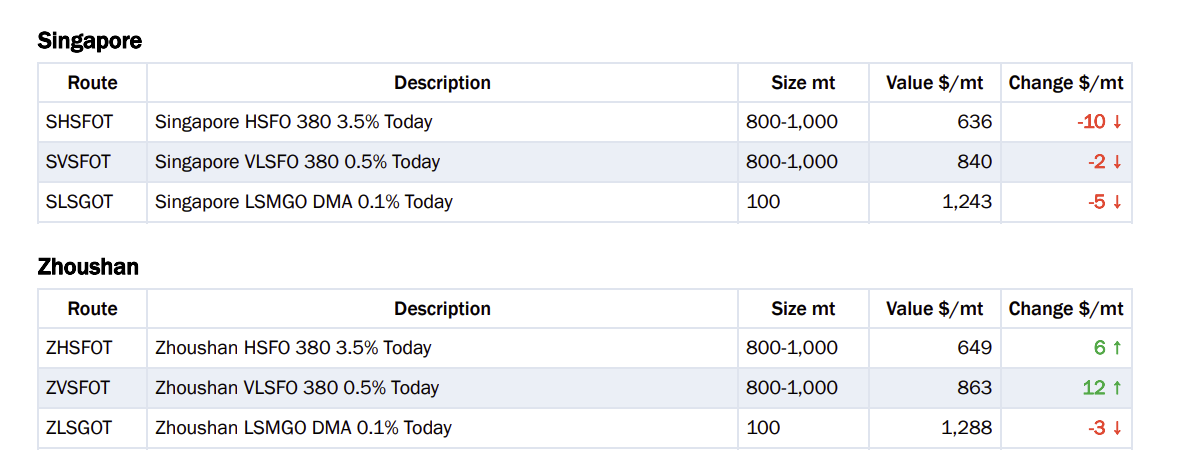
In Singapore, VLSFO supply remains tight as terminal loading delays continue to affect several suppliers, causing some January bookings to roll into February. Recommended lead times for the grade have widened to 10–18 days, compared with 12–14 days last week. A source said the tightness is likely to continue through the first half of February.

HSFO availability has tightened further, with deliveries typically requiring 11–18 days of advance notice, up from 9–12 days last week. In contrast, LSMGO supply has improved, with lead times narrowing to 3–5 days from 7–9 days previously.

At Port Klang, VLSFO and LSMGO grades are generally well supplied, especially for smaller prompt stems, while HSFO remains tight and more difficult to secure.

East Asia

VLSFO availability in Zhoushan has improved, with several suppliers now indicating lead times of about five days, down from more than seven days last week. HSFO remains constrained, with recommended lead times of around seven days, broadly unchanged week on week. LSMGO supply is comfortable, with steady lead times of 3–5 days.

Across northern China, bunker supply remains uneven. Dalian and Qingdao have adequate availability of both VLSFO and LSMGO, although HSFO is still tight in Qingdao. Bunker supply remains tight across all fuel grades in Tianjin. In Shanghai, VLSFO and HSFO supplies remain limited, while LSMGO availability is stable.

Further south, tight supply persists for both VLSFO and LSMGO in Fuzhou. Suppliers in Xiamen have sufficient supply of VLSFO, but LSMGO is limited. In Yangpu and Guangzhou, delivery options for both grades are still limited.

In Hong Kong, bunker lead times are steady at around seven days for all grades, largely unchanged from recent weeks.

Across Taiwan, lead times for both VLSFO and LSMGO remain broadly stable, with deliveries at Keelung, Taichung, Kaohsiung and Hualien still requiring about two days of advance notice, unchanged from last week.

In South Korea, most suppliers are quoting lead times of around 3–8 days for all fuel grades amid subdued demand, compared with 4–6 days last week. Meanwhile, ongoing winter conditions continue to heighten the risk of operational disruptions. Weather-related interruptions may affect Busan and Ulsan between 6–9 February, Yeosu between 7–9 February, and Daesan from 5–9 February.

Bunkering activity is expected to stay subdued during the Lunar New Year (Seollal) holiday period, observed from 16–18 February, as barge operations are likely to be suspended, although this may vary by supplier, according to a trader.

In Japan, prompt VLSFO supply remains tight at major ports including Tokyo, Chiba, Yokohama, Kawasaki, Nagoya, Yokkaichi and Mizushima, with recommended lead times of 7–10 days. Supply is steady at Osaka and Kobe.

LSMGO availability remains broadly stable across the country. B24-VLSFO is available only on request at Tokyo, Chiba and Yokohama. HSFO supply is generally stable at several Japanese ports. At Tokuyama and Oita, suppliers report adequate availability of all three grades, while Kashima has good supplies of VLSFO and HSFO.

Oceania

Bunker availability across Australia remains broadly steady, with VLSFO and LSMGO readily available nationwide and seven-day lead times still the norm.

In Western Australia, suppliers are advising lead times of around seven days at Kwinana and Fremantle. Most deliveries are handled by barge from a single supplier, although LSMGO can also be delivered by truck. Strong afternoon winds continue to cause occasional scheduling disruptions.

In New South Wales, VLSFO deliveries at Port Kembla are possible by both truck and pipeline, with pipeline parcels starting at around 70 mt, while smaller volumes are supplied by truck. Sydney is currently operating with one barge and also offers truck deliveries and pipeline supply at selected berths. Delivery schedules there are frequently adjusted to accommodate naval and cruise vessels. Although VLSFO and LSMGO inventories remain healthy, HSFO availability is tight, with suppliers generally requiring about seven days’ notice. Seasonal cruise traffic in Sydney, Cairns and Darwin between December and February is expected to add further pressure to delivery schedules.

A supplier in Sydney noted that ports are facing heavy vessel traffic as it is the peak cruise season, though availability remains steady, according to a source.

In Brisbane and Gladstone, VLSFO and LSMGO continue to be supplied with similar seven-day lead times. HSFO is available on request in Brisbane, while suppliers in Gladstone may still experience intermittent weather-related delays. Access constraints persist at Brisbane’s AAT terminal. Two barges, operated by different suppliers, are currently active in Brisbane supplying VLSFO and LSMGO, with HSFO offered only on enquiry.

In Victoria, suppliers in Melbourne and Geelong hold strong inventories of VLSFO and LSMGO. HSFO remains tight for prompt delivery, although Melbourne currently has adequate supply. Both ports rely on a single barge, and lead times remain steady at around seven days. LSMGO can also be delivered by truck to smaller ports such as Portland and Port Welshpool within 2–3 days.

Overall, Australia’s bunker market remains stable, with deliveries often achievable within 3–4 days due to healthy inventory levels. Even at ports with pipeline infrastructure, including Darwin and Dampier, suppliers continue to rely heavily on truck deliveries to support distribution.

In New Zealand, bunker supply is stable. VLSFO is widely available at Tauranga and Auckland, with pipeline access available at certain berths in Tauranga. At Marsden Point, both VLSFO and LSMGO can be delivered by pipeline to cargo vessels, while truck availability across South Island ports remains limited.

Meanwhile, the northern Australian cyclone season, which runs from November to April, is expected to cause intermittent disruptions, with 9–11 cyclones forecast this year, a source said.

A tropical cyclone could potentially form off the coast of Western Australia later this week. A low-pressure system is currently over the Northern Territory, bringing heavy rainfall, although no port warnings have been issued so far, the source added.

South Asia

Rough weather is expected to affect bunkering operations at India’s Kandla and Sikka ports on 4 February, potentially causing temporary disruptions.

Similar conditions are forecast at Sri Lanka’s Colombo port on 4 February, while adverse weather in Trincomalee between 3–7 February may also interrupt bunkering activity.

Middle East

Prompt bunker supply in Fujairah remains constrained across all fuel grades, with several suppliers operating on tight delivery schedules. Most continue to quote lead times of 5–7 days, almost unchanged from last week, according to a source. Bunker supply is tight in Khor Fakkan as well.

In Basrah, VLSFO and LSMGO remain readily available, while HSFO supply is still limited. At Jeddah, availability of both VLSFO and LSMGO has improved, but ongoing port congestion continues to slow bunker delivery operations.

Port Suez shows a contrasting situation, with stocks of VLSFO, LSMGO and HSFO close to depletion. Weather-related disruptions to bunkering are expected at Port Said between 5–6 February.

In Ras Laffan, VLSFO and LSMGO supplies remain tight. VLSFO supply is stable in Djibouti, although LSMGO inventories are nearly exhausted.

Across Oman’s ports—Sohar, Salalah, Muscat and Duqm—bunker availability remains stable, with suppliers consistently able to offer LSMGO within prompt delivery windows.

By Tuhin Roy


Photo credit and source: ENGINE
Published: 4 February, 2026

Continue Reading

Alternative Fuels

ENGINE on Fuel Switch Snapshot: LSMGO surges to greater premium over biofuel

B100 discount to LSMGO widens to $541/mt in Rotterdam; Singapore’s B100 drops to $106/mt below LSMGO; Rotterdam LBM at $639-833/mt discounts to LSMGO.

Admin

Published

on

By

ENGINE on Fuel Switch Snapshot: LSMGO surges to greater premium over biofuel

Once a week, bunker intelligence platform ENGINE will publish a snapshot of alternative and conventional bunker fuel prices in the world’s two biggest bunkering hubs. The following is the latest snapshot:

20 July 2026

  • B100 discount to LSMGO widens to $541/mt in Rotterdam
  • Singapore’s B100 drops to $106/mt below LSMGO
  • Rotterdam LBM at $639-833/mt discounts to LSMGO

B100’s premium over HSFO in Rotterdam has narrowed by $50/mt over the past week to $64/mt, while its discount to VLSFO has widened by $83/mt to $105/mt.

B100 has become far more competitive against LSMGO in Rotterdam, with its discount widening by $180/mt over the past week to $541/mt, as a surge in conventional fuel prices left B100 broadly unchanged by comparison.

B100’s price has risen by $109/mt in Singapore, but its discount to LSMGO has still widened by $102/mt to $106/mt, as LSMGO surged by an even greater $211/mt.

Rotterdam’s LNG premium over VLSFO has widened by $35/mt to $201/mt for vessels with Otto medium speed (Otto MS) engines. For vessels with diesel slow speed (diesel SS) engines, LNG has flipped to a $15/mt premium over VLSFO, from a $22/mt discount the prior week.

Liquefied biomethane (LBM) discounts to VLSFO in Rotterdam have narrowed by $50-52/mt to $203-396/mt over the past week. Against LSMGO, LBM discounts have widened by $45-47/mt to $639-833/mt, depending on engine type.

In Singapore, LNG is now $42/mt cheaper than LSMGO for vessels with Otto MS engines, and $134/mt cheaper for vessels with diesel SS engines.

ENGINE on Fuel Switch Snapshot: LSMGO surges to greater premium over biofuel

Liquid fuels

HSFO and VLSFO prices in Rotterdam have jumped by $66/mt and $99/mt respectively over the past week, while LSMGO has surged by an even steeper $196/mt. A $9.69/bbl ($71/mt) rise in front-month ICE Brent futures, to $87.94/bbl ($645/mt), drove bunker prices sharply higher across the board.

Bunker fuel availability is tight for prompt delivery dates in the ARA ports, with buyers advised to enquire about stems between 5-7 days ahead to get good coverage, a trader said.

Rotterdam’s B100 price has risen by $16/mt over the past week. Dutch ZRE A ticket prices were unchanged at €107.50/mtCO2e.

Singapore’s HSFO and VLSFO prices have risen by $130/mt and $132/mt respectively, while its LSMGO price has gained an even steeper $211/mt over the past week.

VLSFO availability in Singapore has been tight, with several suppliers reporting low stock levels. Recommended lead times have widened from 13–17 days last week to 14–19 days now.

Liquid gases

Rotterdam’s LNG prices have surged by $134-136/mt over the past week, while its LBM prices have climbed by $149-151/mt.

LBM discounts to LNG in Rotterdam have narrowed by $15/mt to $404-411/mt.

Singapore’s LNG bunker benchmarks have surged by $196-197/mt over the past week.

By Erik Hoffmann


Photo credit and source: ENGINE
Published: 21 July, 2026

Continue Reading

Bunker Fuel

ENGINE: Americas Fuel Availability Outlook (16 July 2026)

Moderate sea fog to affect parts of US Gulf; Panama bunker supply steady; tight VLSFO and LSMGO supply in Rio Grande.

Admin

Published

on

By

RESIZED ENGINE Americas

The following article regarding bunker fuel availability in the Americas region has been provided by online marine fuel procurement platform ENGINE for post on Singapore bunkering publication Manifold Times:
  • Moderate sea fog to affect parts of US Gulf
  • Panama bunker supply steady
  • Tight VLSFO and LSMGO supply in Rio Grande

North America

In Houston, bunker availability is normal across all three conventional fuel grades. Recommended lead times are about 5-7 days for VLSFO and HSFO, while LSMGO has typically taken 4-5 days over the past week, a trader tells ENGINE.

At the Galveston Offshore Lightering Area (GOLA), deliveries are continuing on a first-come, first-served basis, subject to weather conditions.

Currently, no major operational disruptions have been reported at the anchorage.

Sea fog is not expected to cause widespread bunker disruptions across the US Gulf Coast, with most major ports forecast to maintain good visibility.

Moderate sea fog could affect Pascagoula and Mobile early next week, while Tampa faces the highest risk of reduced visibility between 20-22 July.

Brief visibility restrictions are also forecast at Venice, Louisiana, while conditions are expected to remain favourable at Houston, Galveston, Freeport, Corpus Christi, Port Arthur, Lake Charles, Port Fourchon and New Orleans.

The Atlantic hurricane season is underway, and the US National Hurricane Center (NHC) has issued an advisory for Tropical Storm Elida in the Eastern Pacific. Marine warnings are also in effect across parts of the Caribbean, southwest Atlantic and Eastern Pacific.

Bunker demand on the US East Coast at the port of New York is good, with healthy availability of HSFO and VLSFO.

Most suppliers can deliver both grades within 5 days, and LSMGO requires 2-4 days.

In New York, periods of high wind gusts are forecast through 19 July.

While no backlog congestion has been reported, suppliers may require standby tugs under poor weather conditions, which could slow bunker barge movements, a source said.

On the West Coast, bunker demand has remained normal in Los Angeles and Long Beach, where suppliers recommend lead times between 8-10 days across all conventional grades.

In Vancouver, recommended lead times are 5-7 days for HSFO and 6-8 days for VLSFO and LSMGO, a source said.

Latin America and the Caribbean

Bunker availability is stable in Panama’s Balboa and Cristobal ports. Recommended lead times are 3-5 days for VLSFO and LSMGO, and HSFO requires around 7 days, a source said.

No major congestion or weather-related disruptions have been reported at the ports.

At Balboa, deliveries are being made on a first-come, first-served basis, subject to weather conditions, with priority given to vessels holding confirmed Panama Canal transit schedules.

Weather conditions could temporarily affect operations at several Caribbean bunkering locations.

In Freeport, Bahamas, bunker operations continue normally. Cruise vessels are given priority at the port, and no significant congestion or weather-related disruptions have been reported.

Further east, high wind gusts are forecast through 19 July and could delay bunker operations at St. Eustatius, where deliveries are conducted at anchorage.

Offshore bunkering in Trinidad may also experience delays during the same period because of high winds and rough seas.

Brazil continues to present a mixed supply of bunker fuels.

Santos this week offers normal availability for VLSFO and LSMGO, although port congestion persists, a trader tells ENGINE. Recommended lead times are 5-8 days at the port.

Rio de Janeiro also has normal VLSFO availability and requires lead times between 4 days to one week. LSMGO is available only upon prior consultation at the port.

Availability is tighter at southern Brazilian ports. Paranaguá and Rio Grande have both reported tight VLSFO and LSMGO availability, and operators are advised to plan bunker stems well in advance.

Belém and Vila do Conde continue to offer normal availability of both grades, with lead times between 4-7 days, a source said.

In Argentina’s Zona Común, VLSFO and LSMGO availability is good, with suppliers typically taking between 5-7 days of lead time to deliver via barges, a source said.

Weather conditions could become less favourable between 19-20 July, when high wind gusts are forecast. Deliveries will continue on a first-come, first-served basis, subject to weather conditions.

By Gautamee Hazarika


Photo credit and source: ENGINE
Published: 17 July, 2026

Continue Reading

Bunker Fuel Availability

ENGINE: Europe and Africa Fuel Availability Outlook (15 July 2026)

Notice of 5-7 days required in ARA; congestion remains high in Gibraltar and Algeciras; lead time of around 4-5 days recommended in Luanda.

Admin

Published

on

By

RESIZED ENGINE Europe and Africa

The following article regarding Europe and Africa bunker fuel availability has been provided by online marine fuel procurement platform ENGINE for post on Singapore bunkering publication Manifold Times:

  • Notice of 5-7 days required in ARA
  • Congestion remains high in Gibraltar and Algeciras
  • Lead time of around 4-5 days recommended in Luanda

Northwest Europe

Bunker fuel availability is tight in the ARA for prompt supplies, with buyers advised to book stems around 5-7 days in advance to get good coverage from suppliers, a trader said.

In Antwerp’s Deurganck Dock, hydrofluoric acid spilled from a container on a cargo ship, leading to traffic getting suspended in the affected area. Operations have resumed in all terminals, except the MPET terminal.

The ARA’s independently held fuel oil stocks have averaged 9% higher so far in July, compared to June’s monthly average, according to Insights Global data.

The ARA hub has imported only 175,000 b/d of fuel oil in July so far, down from June’s monthly average of 215,000 b/d, according to Vortexa cargo data.Most import cargoes have come from Colombia (33%), the Caribbean Netherlands (28%) and France (24%).

The region has imported 84,000 b/d of gasoil in July so far, down from 188,000 b/d imported in June, according to Vortexa data. Most of these shipments have come from Canada (24%), the US (20%) and Finland (15%).

Availability of all marine fuel types is stable in Germany’s Hamburg, and all fuel grades can be delivered within five days, a trader told ENGINE.

Off Denmark’s Skaw and in Sweden’s Gothenburg, fuel buyers are advised booking deliveries around 10 days ahead for any fuel grade, according to a trader.

Mediterranean

Ships calling at Gibraltar are seeing heavy congestion due to a lack of space, with around 21 vessels awaiting bunkers as of Wednesday morning, port agent MH Bland said. Some suppliers may be late by anywhere between 24-48 hours on deliveries, the port agent added.

In neighbouring Algeciras, some suppliers are delayed by 12-18 hours on supplies, port agent MH Bland said.

Consequently, fuel buyers looking to bunker in Gibraltar and Algeciras are recommended to book stems around 15 days ahead, a trader said. The congestion in Gibraltar and Algeciras is caused mostly due to overbooking by suppliers, the trader added.

In Spain’s Barcelona, buyers are advised to book with a lead time of a week, a trader said.

Fuel availability is stable in Portugal’s Lisbon, a supplier said.

In Las Palmas, buyers are requested to book with a lead time of around 7-10 days for delivery of HSFO, VLSFO and LSMGO supplies, a trader told ENGINE.

Fuel buyers off Malta should enquire around 5-7 days prior to their expected time of arrival, a trader said.

Although there is a slight shortage of LSMGO, the market is expected to bounce back by next week, a supplier told ENGINE.

Fuel availability is stable in Turkey’s Istanbul, with notice of 1-3 days sufficient to get any fuel grade, a local supplier told ENGINE.

In Romania’s Constanta, Mangalia and Midia, fuel availability is normal, but prices are high, a local supplier said.

Africa

HSFO availability remains limited across almost all ports in Africa, a trader told ENGINE.

Prompt fuel availability remains tight in Togo’s Lome and off Namibia’s Walvis Bay, and buyers are recommended lead times of seven days, a trader told ENGINE.

VLSFO supplies in the Nigeria’s Lagos anchorage come with a lead time of 5-7 days, a local supplier told ENGINE.

In Angola’s Luanda, buyers are advised to book with a notice of 4-5 days for VLSFO and LSMGO, a supplier said.

Bunker availability is tight for prompt deliveries in South Africa’s Durban and off Algoa Bay, with buyers advised at least 5-7-day notice for VLSFO and LSMGO, a trader said.

Fuel availability remains tight in Mozambique’s Nacala and Maputo, as suppliers are recommending lead times of around 5-7 days for VLSFO supplies, a trader said.

Bunker fuel availability is tight in Mauritius’ Port Louis, where buyers are advised to book seven days ahead for VLSFO and LSMGO deliveries, a trader said.

By Nachiket Tekawade


Photo credit and source: ENGINE
Published: 16 July, 2026

Continue Reading

Trending