Connect with us

Bunker Fuel Availability

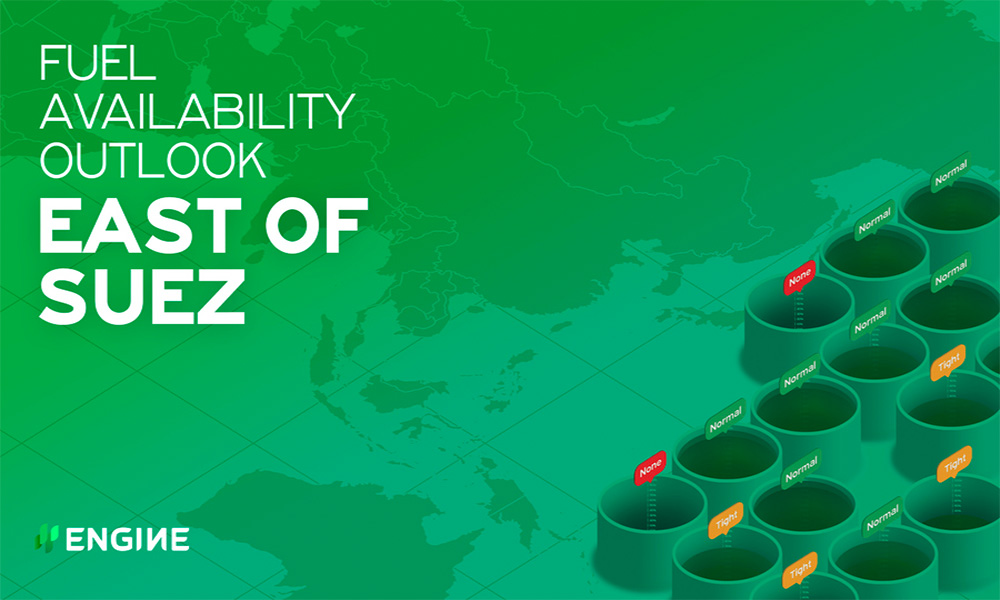
ENGINE: East of Suez Fuel Availability Outlook (28 July 2026)

VLSFO availability tight in Zhoushan; availability tight across all grades in Fujairah; bunker demand picks up in Jeddah.

Admin

Published

on

RESIZED ENGINE East of Suez

The following article regarding regional bunker fuel availability outlook for the East of Suez region has been provided by online marine fuels procurement platform ENGINE for publication on Singapore bunkering publication Manifold Times:
  • VLSFO availability tight in Zhoushan
  • Availability tight across all grades in Fujairah
  • Bunker demand picks up in Jeddah

Singapore and Malaysia

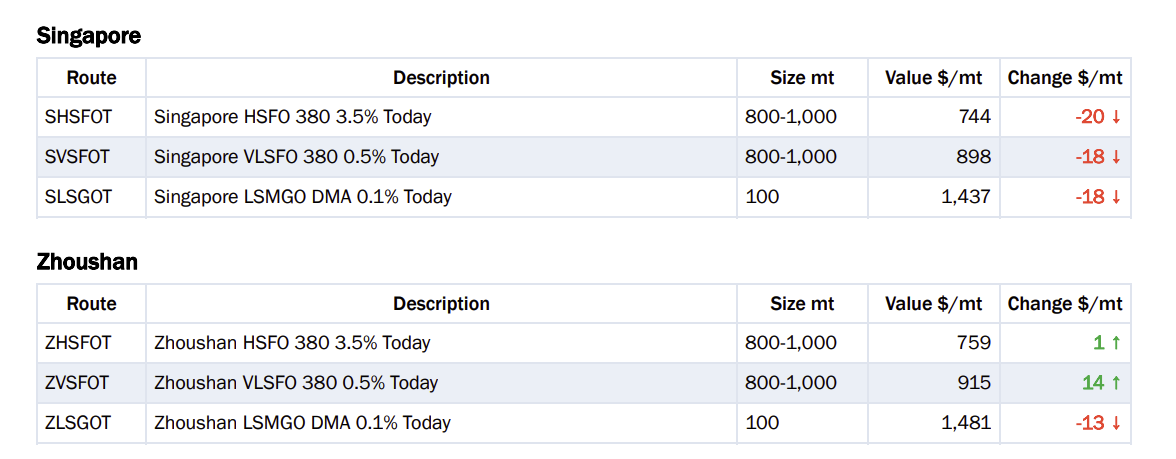
VLSFO availability in Singapore has tightened further, with suppliers now recommending lead times of 16-20 days, compared with 14-19 days last week. Supply remains under pressure as the port’s fuel oil inventories have yet to recover to pre-conflict levels, while cargo inflows continue to be affected by renewed US-Iran hostilities that have disrupted traffic through the Strait of Hormuz.

HSFO supply has also tightened, with recommended lead times extending to 12-15 days from 9-13 days a week earlier. Meanwhile, LSMGO availability has improved, with lead times easing to 5-8 days from 9-11 days last week.

Fuel oil inventories fell below 18 million bbls in June, down from more than 23 million bbls in March. Stocks have also remained below the 20 million-bbl mark so far this month, latest data from Enterprise Singapore shows.

In Malaysia’s Port Klang, bunker fuel supply remains constrained. Prompt VLSFO availability is tight, LSMGO supply is limited, and HSFO continues to face supply pressure.

East Asia

VLSFO availability in Zhoushan remains tight despite muted demand, with suppliers recommending lead times of about nine days, down from roughly 12 days previously. A local source attributed the extended lead times to reduced refinery output.

Recommended lead times for both LSMGO and HSFO have remained largely unchanged at around seven days.

Bunker fuel availability across northern China continues to vary by port. Suppliers in Dalian and Qingdao have sufficient VLSFO and LSMGO stocks, although HSFO remains tight in Qingdao. In Tianjin, availability of all three major bunker grades is constrained, while Shanghai continues to face tight VLSFO and HSFO supply. LSMGO availability in Shanghai remains comparatively stable.

Supply conditions also remain tight across several southern Chinese ports. VLSFO and LSMGO are both under pressure in Fuzhou. Xiamen has adequate VLSFO availability, but prompt LSMGO supply is more limited. In Yangpu and Guangzhou, both grades continue to face supply constraints.

Hong Kong’s bunker market remains stable, with suppliers continuing to recommend lead times of around seven days for all major fuel grades, largely unchanged from recent weeks.

In Taiwan, VLSFO and LSMGO deliveries can be arranged within about two days in Hualien and Taichung, while Kaohsiung requires lead times of around three days. In Keelung, however, lead times for both grades have extended to 4-5 days from about three days previously due to ongoing barge constraints.

Bunker fuel availability has improved across South Korea’s southern ports, including Busan, Ulsan, Masan, Onsan, Yeosu and Kwangyang. Recommended lead times for VLSFO, LSMGO and HSFO have all shortened to 6-8 days, compared with 9-16 days last week, reflecting an easing in supply conditions.

A similar trend is evident across South Korea’s western ports—including Incheon, Daesan, Dangjin, Pyeongtaek and Taean—where lead times for all three fuel grades have also narrowed to 6-8 days, from 9-16 days a week earlier.

Meanwhile, supply remains tight at Japan’s major ports, including Tokyo, Chiba, Kawasaki, Kashima, Nagoya, Yokkaichi, Osaka, Kobe, Mizushima and Oita. VLSFO and LSMGO continue to be available through only a limited number of suppliers, while HSFO is comparatively easier to source, with recommended lead times of around 7-10 days.

In contrast, Indonesia continues to enjoy healthy bunker fuel availability. Suppliers in Jakarta, Surabaya, Balikpapan and Cigading are generally recommending lead times of just 2-3 days for VLSFO, indicating ample supply.

Oceania

VLSFO availability remains steady across Western Australia, with suppliers in Kwinana and Fremantle continuing to recommend lead times of about seven days. Both ports rely on a single supplier, with all bunker deliveries conducted by barge.

Supply conditions are more varied along Australia’s east coast. In Port Kembla, VLSFO can be delivered by truck or pipeline, while suppliers in Sydney have sufficient stocks of both VLSFO and LSMGO. HSFO availability is comparatively tighter in Sydney, where suppliers generally advise booking around seven days in advance.

In Queensland, VLSFO and LSMGO remain readily available in Brisbane and Gladstone, with lead times holding at approximately seven days.

Further south, Melbourne and Geelong continue to have healthy VLSFO inventories. However, both ports depend on a single bunker barge for deliveries, keeping recommended lead times at around one week. HSFO availability has tightened further in both Melbourne and Brisbane.

Separately, one supplier is offering all major bunker grades in Brisbane, Sydney and Melbourne with lead times of roughly five days. In Western Australia, pipeline-based bunker deliveries to Dampier Cargo Wharf (DCW) have been suspended until around the end of September due to repair works. Limited truck deliveries remain available, depending on vessel size. During the outage, a supplier has designated the Toll Supply Base (TSB) in Dampier as the preferred alternative for bunker operations, a source said.

Across the Tasman, bunker fuel availability in New Zealand remains largely unchanged. VLSFO supply is readily available in Tauranga and Auckland, where suppliers continue to recommend lead times of around four days. At Marsden Point, both VLSFO and LSMGO can be supplied directly to vessels via pipeline.

Weather remains the primary operational challenge in New Zealand. Bunker deliveries are especially vulnerable to disruption in Wellington and ports across the South Island, where adverse weather conditions can periodically delay supply operations.

South Asia

Some suppliers in Mumbai continue to recommend lead times of 4–5 days for both VLSFO and LSMGO, although deliveries remain subject to weather conditions. In contrast, VLSFO availability is extremely tight at Haldia, Visakhapatnam, Kakinada, Gangavaram and Krishnapatnam, a source said.

Monsoon conditions are expected to disrupt bunker operations at several Indian ports over the coming days, with weather-related delays likely to affect bunker deliveries. Operations at Kandla and Sikka are forecast to face disruptions between 28 July and 1 August, while rough seas could hinder bunkering in Mumbai, Cochin and Visakhapatnam over the same period.

In Sri Lanka, adverse weather is also expected to intermittently disrupt bunker operations in Colombo and Trincomalee between 28 July and 1 August, with potential delays to bunker deliveries.

Middle East

Renewed hostilities between the US and Iran in the Strait of Hormuz have tightened bunker fuel availability in Fujairah. Supplies of VLSFO and LSMGO have become more constrained compared to last week, when prompt deliveries were still possible. Only a handful of suppliers are currently able to offer LSMGO, while HSFO remains scarce and is largely available only on a firm enquiry basis.

Conditions are more favourable at the neighbouring UAE bunker hub of Khor Fakkan, where VLSFO and HSFO availability remains good. However, bunker demand has eased in both Fujairah and Khor Fakkan amid the renewed regional conflict, according to a Middle East-based source.

In Saudi Arabia’s Jeddah, VLSFO and LSMGO availability continues to hold steady, despite an uptick in demand.

Supply constraints persist in Qatar’s Ras Laffan, where both VLSFO and LSMGO remain in limited supply.

At Egypt’s Port Suez, inventories of all three conventional bunker grades remain critically tight.

Further south, availability of all major bunker fuel grades also continues to be limited in Djibouti.

By Tuhin Roy


Photo credit and source: ENGINE
Published: 29 July, 2026

Continue Reading

Bunker Fuel

BGN enters US retail bunkering market with Gulf Coast launch

To launch its bunkering operations, BGN has partnered with Houston-based Centerline Logistics Corporation, chartering two new barges, the “Jackson Eades” and “MGI 2100”.

Admin

Published

on

By

BGN enters US retail bunkering market with Gulf Coast launch

Energy and commodities trading company BGN on Wednesday (29 July) launched its first US-based retail marine bunkering business, marking another important milestone in the continued expansion of its global shipping platform.

To launch its bunkering operations, BGN has partnered with Houston-based Centerline Logistics Corporation, a marine petroleum transportation company, chartering two new barges, the Jackson Eades and MGI 2100. The company’s double-hulled fleet of bunker and terminal barges are designed to maximise safety and minimise environmental impact.

The new business will supply high sulphur fuel oil (HSFO), very low sulphur fuel oil (VLSFO) and marine gas oil (MGO) to vessels calling at ports across the US Gulf Coast.

Initially, the operation will support BGN’s owned and chartered LPG fleet of around 40 vessels, helping to strengthen the integration between our trading, shipping and marine fuels businesses. The new service will also provide reliable, competitive bunkering solutions to third-party shipowners operating throughout the region.

Harry Thwaites, Head of Fuel Oil, Feedstocks and Marine Fuels, said: “We are delighted to launch BGN’s first retail bunkering business, representing an important milestone in the continued growth of our marine fuels platform. The US Gulf Coast is one of the world’s most important shipping and energy hubs, making it the ideal location to establish our first retail bunkering operation.

“Initially, the business will support our own global LPG fleet while also providing reliable, competitive marine fuel solutions to third-party shipowners operating across the region.

“We are also pleased to be working with world-class partners such as Centerline Logistics, whose advanced fleet of liquid oil barges will support our ambition to grow BGN’s bunkering operations across the Americas. Going forward, we will look to expand into other major international ports as we continue to strengthen our marine fuels trading platform globally.”


Photo credit: BGN
Published: 30 July, 2026

Continue Reading

Bunker Fuel Availability

ENGINE: Europe and Africa Fuel Availability Outlook (29 July 2026)

Prompt fuel availability is tight in ARA; slight port congestion seen in Gibraltar; VLSFO requires needs notice of 5-7 days off Algoa Bay.

Admin

Published

on

By

RESIZED ENGINE Europe and Africa

The following article regarding Europe and Africa bunker fuel availability has been provided by online marine fuel procurement platform ENGINE for post on Singapore bunkering publication Manifold Times:
  • Prompt fuel availability is tight in ARA
  • Slight port congestion seen in Gibraltar
  • VLSFO requires needs notice of 5-7 days off Algoa Bay

Northwest Europe

Fuel availability is tight for prompt delivery dates in the ARA, and buyers are recommended lead times between 5-7 days to secure supplies, a trader said.

The ARA’s independently held fuel oil stocks have averaged 3% higher so far in July, compared to June’s monthly average, according to Insights Global data.

The ARA hub has imported only 134,000 b/d of fuel oil in July so far, a sharp drop from June’s monthly average of 215,000 b/d, according to Vortexa cargo data. Shipments originated from Syria, France (21%) and Colombia (17%) among other countries.

The region’s independent gasoil inventories – which include diesel and heating oil – have dropped by 6% in July, compared to June, according to the Insights Global data. 

The region has imported 126,000 b/d of gasoil in July so far, down significantly from 188,000 b/d imported in June, according to Vortexa data. Most of these shipments have come from Sweden (17%), the UK (16%) and Canada (13%).

Bunker availability is normal in Germany’s Hamburg, and all fuel grades can be delivered within five days, a trader told ENGINE.

Off Denmark’s Skaw and in Sweden’s Gothenburg, bunker fuel availability is tight, and fuel buyers are advised booking deliveries around 10 days ahead for any fuel grade, according to a trader.

Mediterranean

Those looking to bunker in the Gibraltar Strait ports are recommended to book stems around 5-7 days ahead, a trader said.

There are 13 vessels awaiting bunkers at Gibraltar, and some suppliers are running around 6-10 hours behind schedule on deliveries, port agent MH Bland said.

Buyers can secure deliveries in Barcelona with a lead time of seven days, a trader said.

In Las Palmas, buyers are advised lead times of 10–12 days for HSFO, VLSFO and LSMGO deliveries, a trader told ENGINE.

VLSFO fuel availability is tight off Malta, with lead times of around seven days recommended, a trader said. ULSFO availability is also tight, while it is possible to get prompt deliveries of LSMGO, the trader added.

VLSFO availability is tight in Istanbul, and suppliers are recommended booking with lead times of between 5-7 days, a trader said. LSMGO is available more promptly in the port, the trader added.

Africa

HSFO availability remains limited across most African ports, a trader told ENGINE.

VLSFO and LSMGO availability remains tight in Lome and off Walvis Bay for prompt supplies, with buyers advised to book seven days ahead, a trader told ENGINE.

VLSFO deliveries at the Lagos anchorage requires 5–7 days of notice, a local supplier told ENGINE.

Prompt VLSFO availability is tight off Algoa Bay, with buyers advised at least 5–7 days of notice, a trader said.

VLSFO availability remains tight in Nacala and Maputo, where suppliers recommend lead times of around 5–7 days, a trader said.

Bunker availability is tight in Port Louis, with buyers advised booking VLSFO and LSMGO deliveries seven days ahead, a trader said.

By Nachiket Tekawade


Photo credit and source: ENGINE
Published: 30 July, 2026

Continue Reading

Bunker Fuel

Port of Rotterdam publishes bunker fuel sales data for Q2 2026

Ethanol as a bunker fuel was reported in Rotterdam for the first time with 1,025 mt delivered in Q2 2026, following an ethanol-methanol blend bunkering operation of container vessel Eco Levant in May.

Admin

Published

on

By

RESIZED port of rotterdam

The Port of Rotterdam Authority recently published bunker fuel sales data for the second quarter (Q2) of 2026.

Deliveries of ultra low sulphur fuel oil, very low sulphur fuel oil, high sulphur fuel oil, marine gas oil and marine diesel oil in Q2 2026 (against on year) recorded respectively 123,190 metric tonnes (mt) (+33%  from 162,142 mt), 354,448 mt (-9.1% from 439,804 mt), 704,637 mt (+10.9% from 619,010 mt), 266,570(+18% from 273,696 mt), 64,777 mt (-8.2% from 86,821 mt). 

Bio-blended variants of ultra low sulphur fuel oil, very low sulphur fuel oil, high sulphur fuel oil, marine gas oil and marine diesel oil in Q2 2026 (against on year) recorded respectively 22,032 mt (-28.3% from  24,573 mt), 144,665 mt (-57% from 68,271 mt), 30,191 mt (+15.3% from 38,490 mt), 34,574 mt (+627.7% from 31,663 mt) and 8,413 mt (-30.2% from 2,223 mt).

Port data showed 273,021 m3 of liquefied natural gas (LNG) being delivered as a marine fuel in Q2 2026, down by 17.4% from 207,658 m3 in Q2 2025. Bio-methanol and bio-blended LNG recorded 2,845 mt and 7,506 m3 respectively in Q2 2026.

Ethanol as a bunker fuel was reported in Rotterdam for the first time with 1,025 mt delivered in Q2 2026,  following an ethanol-methanol blend bunkering operation of container vessel Eco Levant in May.

Manifold Times previously reported Evos Rotterdam holding a ground-breaking ceremony for its methanol and ethanol expansion project at the Port of Rotterdam, formally starting the construction phase of a major investment in additional terminal capacity.

Once operational in early 2028, the expansion will give Evos Rotterdam greater capacity to handle methanol and ethanol for industrial customers, as well as for the developing market in cleaner, low-carbon marine fuels and bunkering.

Shipping giant A.P. Moller – Maersk (Maersk) recently announced a new milestone in its marine fuel trials, with its dual-fuel feeder vessel Laura Maersk successfully operating on 100% ethanol for a second time.

The latest trial marked a significant step forward from earlier tests, as the vessel was supplied through a larger-scale bunkering operation conducted by barge in Rotterdam.

Related: X-Press Feeders, METHANAVE complete first ethanol-methanol bunkering op in Rotterdam
Related: Maersk advances ethanol fuel trials with larger-scale Rotterdam bunkering


Photo credit: Port of Rotterdam
Published: 29 July, 2026

Continue Reading

Trending