Connect with us

Bunker Fuel Availability

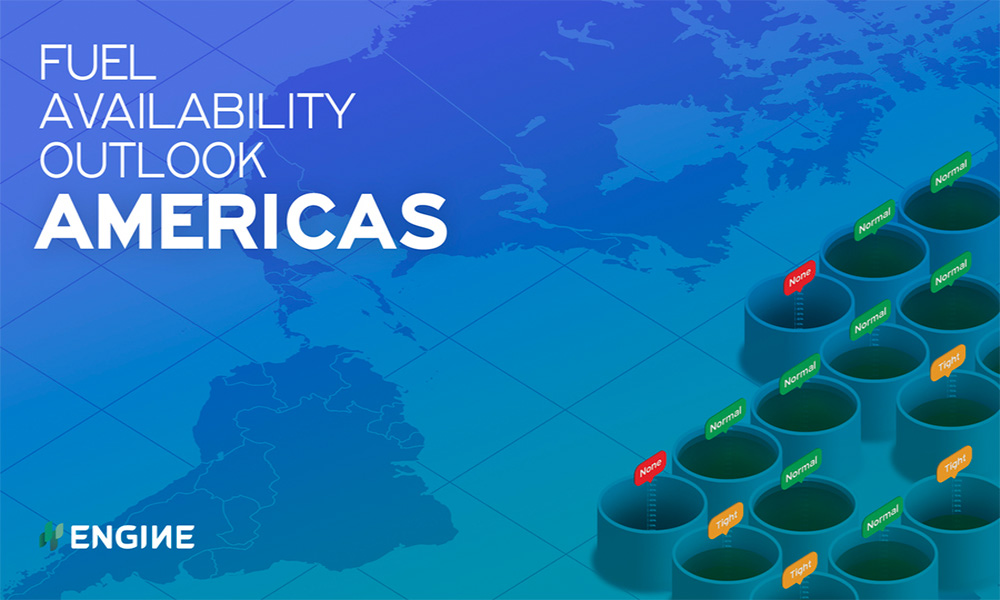
ENGINE: Americas Bunker Fuel Availability Outlook (12 June 2025)

Bunker demand in Houston remains weak; Argentina authorised voluntary use of biofuels; VLSFO availability in Zona Comun improves.

Admin

Published

on

RESIZED ENGINE Americas

The following article regarding bunker fuel availability in the Americas region has been provided by online marine fuel procurement platform ENGINE for post on Singapore bunkering publication Manifold Times:

  • Bunker demand in Houston remains weak
  • Argentina authorised voluntary use of biofuels
  • VLSFO availability in Zona Comun improves

North America

Bunker demand in Houston remains weak across all fuel grades. Both VLSFO and LSMGO are readily available, with recommended lead times of 3–5 days. HSFO is also stocked, though prompt deliveries may face delays due to barge congestion, requiring lead times of at least 7 days and above.

In the last 24 hours, 77 vessels have arrived at the port, and 122 more are expected over the next 30 days.

The US Gulf region has entered its hurricane season, which will last through 30 November.

“This is likely to bring bouts of bad weather that could disrupt bunkering operations, particularly around the Bolivar Roads anchorage,” a source noted.

In Galveston Offshore Lightering Area (GOLA), deliveries are suspended due to high seas and are likely to remain so until the afternoon of 13 June.

Bunker operations are being carried out on a first-come, first-served basis, where weather conditions allow.

In New York, bunker demand remains good. All fuel grades are available at the port for prompt delivery, with suppliers recommending lead times of around 5 days.

High wind gusts are forecast between 12–13 June at the port, which could lead to disruptions. No backlog congestion or barge readiness issues are currently reported.

Both bunker fuel availability and demand at the Port of Los Angeles remain steady. Suppliers say they can deliver all the fuel grades in less than 7 days.

While importers have been frontloading cargo in anticipation of the upcoming end to the tariff pause, according to the Port of Los Angeles’ Port Optimizer, import volumes declined during the week between 8–14 June, reaching 94,692 TEUs from 17 scheduled vessel calls.

This represents a 5.82% drop from the previous week and an 18.98% decrease year-on-year.

However, volumes are expected to rebound in Week 25, i.e, 15-21 June, with 121,916 TEUs expected from 22 scheduled vessels. This reflects a 28.75% week-on-week increase and a significant 41.27% rise year-on-year (YoY).

Rising tariffs and ongoing uncertainty in US-China relations have significantly slowed the movement of goods, impacting jobs, businesses, and local economies in tangible ways.

Data from the Chinese government revealed that exports to the US plummeted by 35% YoY in May — the sharpest decline since the early 2020 trade freeze during Covid lockdowns. This followed a 21% drop in April.

In Canada’s Montreal, bunker operations may face disruptions on 12 June due to high wind gusts. Barge services operate only during daylight hours, and delays at anchorage are possible.

Latin America and the Caribbean

The market is still very quiet in Panama. All fuel grades in Balboa and Cristobal can be supplied within 5-7 days.

In Balboa, from 12-16 June, high winds and thunderstorms may disrupt bunkering. Deliveries operate on a first-come first serve basis, with priority given to vessels with confirmed Panama Canal transit slots.

Ongoing drought conditions are still affecting transit through the Panama Canal, causing delays in vessel movements, especially for ships with deeper drafts.

In the Bahamas’ Freeport and St. Eustatius, no weather disruptions are expected. Deliveries are being made at the anchorage, with cruise ships receiving priority. No barge congestion is reported.

In Trinidad Offshore, from 12-16 June, high wind gusts and high seas could impact bunker deliveries. No barge readiness congestion has been reported at the moment.

Argentina has authorised the voluntary use of biofuels or biofuel blends for river and sea vessels, as long as their engines are compatible.

To support this, the government has introduced a new “Bunker Operator” category in its official registry. Companies supplying marine biofuels must now register and follow certain rules, helping ensure proper handling, safety, and fuel quality.

The anticipated increase in Argentina’s maize production and export volumes is also expected to drive higher vessel traffic at key ports, which could in turn boost bunker fuel demand and impact delivery schedules, another source informed.

VLSFO availability in Zona Comun has significantly increased, with lead times now at 5-6 days, down from the typical 10-12 days.

High wind gusts are expected from 12-16 June, and if wind speeds exceed 20 knots, bunker deliveries will be suspended, the port authorities said.

Bunker fuel supply continues to be stable across key Brazilian ports, including Santos, Rio de Janeiro, and Rio Grande, with VLSFO and LSMGO available for prompt delivery. HSFO is not supplied at these ports. Recommended lead times are around 5–7 days.

Operations at the Port of Santos remain affected by congestion, though conditions are expected to ease in the next few days.

Meanwhile, bunker availability in Colombia’s Barranquilla, Cartagena, and Santa Marta ports also remains good, with recommended lead times of 2–3 days, according to a source.

By Gautamee Hazarika


Photo credit and source: ENGINE
Published: 13 June 2025

Continue Reading

Bunker Fuel

Baltic Exchange: Bunker Report (3 September 2026)

Bunker report panellists include Island Oil Limited, Cockett Marine Oil Pte, Monjasa A/S, KPI OceanConnect, NSI Marine and Transparensea Fuels.

Admin

Published

on

By

Baltic Exchange logo

The following bunker report has been provided by freight market information provider Baltic Exchange for post on Singapore bunkering publication Manifold Times:
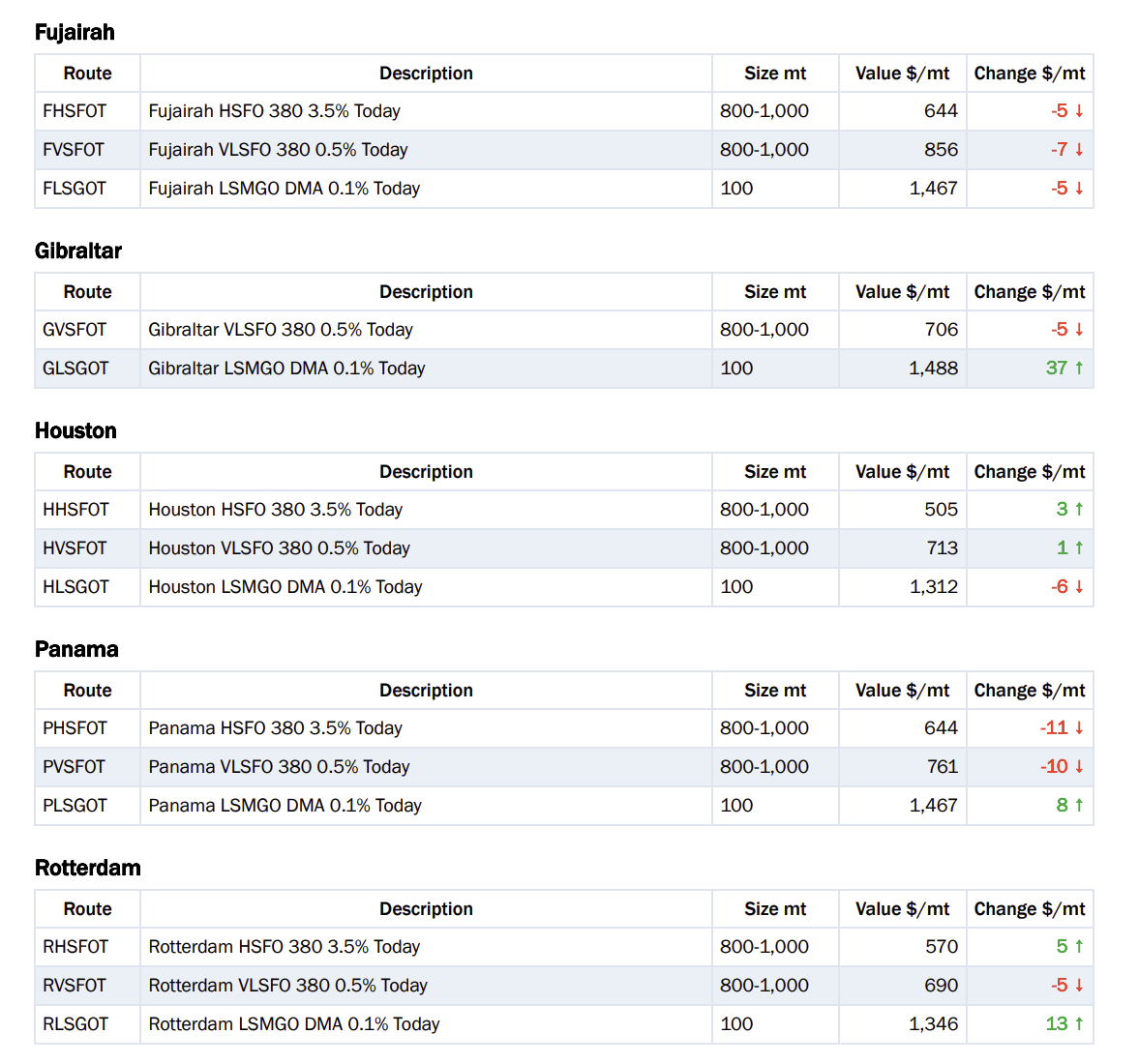
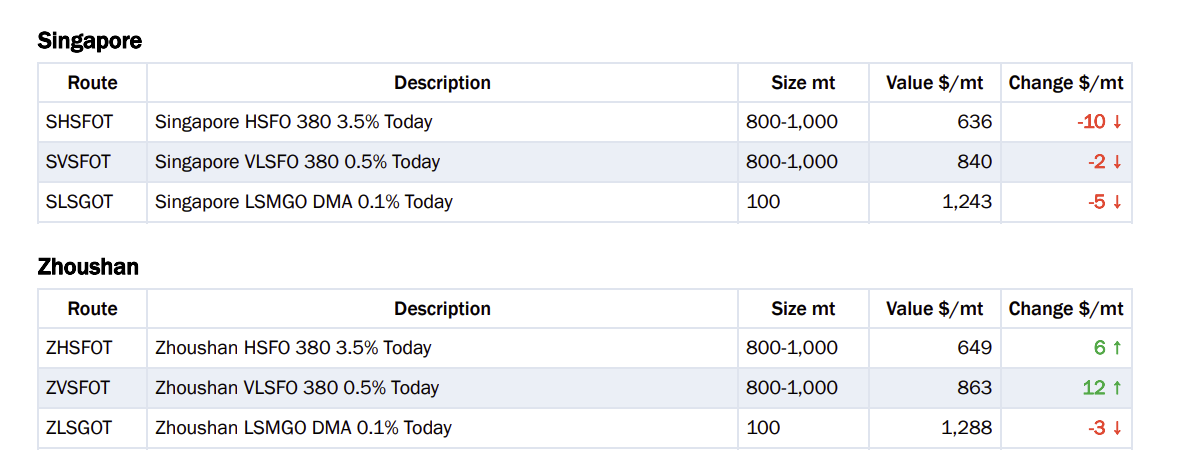
Baltic Exchange: Bunker Report (3 September 2026)

All values are in US$/metric ton, all-in (invoice price), delivered on board
Delivery in 7-10 days
ISO 8217:2010
IFO 380 3.5% Sulphur
IFO 380 0.5% Sulphur
DMA 0.1% Sulphur

Fujairah – Offshore Anchorage Area
Gibraltar – Anchorage area
Houston – Houston Harbor
Panama – (Pacific) dangerous cargo area, Balboa
Rotterdam – Waalhaven Maasvlakte range
Singapore – Anchorage, under SBA Scheme
Zhoushan – Southern anchorage area

Submitted weekly at Close of Business UK time Daily

Panellists:
Cockett Marine Oil Pte, Island Oil Limited, KPI OceanConnect, Monjasa A/S, NSI Marine and Transparensea Fuels


Photo credit and source: Baltic Exchange
Published: 4 September, 2026

Continue Reading

Bunker Fuel

ENGINE: Americas Fuel Availability Outlook (3 September 2026)

New York sees healthy bunker demand; availability improves in Los Angeles; VLSFO and LSMGO tight in Rio de Janeiro.

Admin

Published

on

By

RESIZED ENGINE Americas

The following article regarding bunker fuel availability in the Americas region has been provided by online marine fuel procurement platform ENGINE for post on Singapore bunkering publication Manifold Times:

  • New York sees healthy bunker demand
  • Availability improves in Los Angeles
  • VLSFO and LSMGO tight in Rio de Janeiro

North America

In Houston, bunker demand has been strong over the past week, and prompt availability is bit tight across all three conventional grades.

HSFO and VLSFO require lead times of 5–7 days, and LSMGO can be delivered by most suppliers within 4–5 days, a trader said.

At the Galveston Offshore Lightering Area (GOLA), operations are being conducted on a first-come, first-served basis and remain subject to weather conditions.

Recommended lead times for all three grades stand at 5–8 days at the anchorage this week.

Mobile Bay stands out this week, with visibility dropping as low as 1 nautical mile during high-risk periods recurring almost daily through 9 September. Elsewhere, sea fog risk along the US Gulf Coast is mostly low.

Moderate risk builds through midweek at Port Arthur, Lake Charles, Marsh Island, Port Fourchon, New Orleans and Venice, while Texas ports, Pascagoula and Tampa stay largely clear, bar a few brief moderate spells.

In New York, bunker demand has been good. HSFO and VLSFO are tight for prompt supply, with lead times of 6–8 days, and LSMGO is available within 3–5 days.

No backlog or bunker barge readiness issues have been reported. Weather conditions are forecast to remain calm and conducive for bunkering at the port, a source said.

The Atlantic hurricane season is currently ongoing, with three active hurricanes — Karina and Marie in the Eastern Pacific, and Lowell in the Central Pacific.

The National Hurricane Center has issued advisories on all three. Additional marine warnings are also in effect in the Eastern Pacific region.

On the US West Coast, fuel availability across all three conventional grades has improved since the past week, a trader said. At the port of Los Angeles and Long Beach, some suppliers can now deliver VLSFO and LSMGO in a week’s time, compared to last week’s 10 days, while HSFO lead times remain unchanged at 7 days.

Recently, the Port of Los Angeles approved a 30-year lease extension with Yusen Terminals, keeping the operator at the port through 2056, and adding a further $200 million investment in zero-emission equipment.

At Canada’s Vancouver, VLSFO has been a bit tight over the past week, with recommended lead times currently over 5 days, a source said. HSFO and LSMGO have good availability, with lead times of 5–7 days.

Latin America and the Caribbean

Bunker availability is good for HSFO, VLSFO and LSMGO at Panama’s Balboa and Cristobal, and demand has picked up this week, a trader told ENGINE.

Suppliers are recommending lead times of 3–5 days for all three fuel grades.

In Brazil, HSFO is no longer available, and lead times for VLSFO and LSMGO vary across the country’s ports.

Santos is congested, but availability is normal for VLSFO and LSMGO, with recommended lead times of 5–8 days.

Availability is tight for both grades in Rio de Janeiro this week, and supply is only available under prior consultation, a source said.

Rio Grande is reporting no availability for LSMGO, and VLSFO is available and can be supplied by most suppliers within a week.

At Paranaguá, Belém and Vila do Conde, VLSFO and LSMGO have decent availability, with lead times ranging between 4–7 days.

Punta Colorada in Argentina is set for a step up in activity, with two floating LNG (FLNG) units due onstream there by the end of 2027.

The Hilli Episeyo, currently repositioning from Cameroon via Singapore, and the Esperanza, a converted LNG carrier, will together add just over 6 million tonnes of annual LNG production capacity once both are running, Antares Shipping Agency said.

Bunkering operations in Argentina’s Zona Comun are continuing, despite choppy conditions at the anchorage.

Strong winds are expected to persist through the week, with the potential to interrupt bunkering, if winds exceed above 20 knots. Supplies of VLSFO and LSMGO are normal, and delivery lead times are currently running at 5-7 days, a source said.

By Gautamee Hazarika


Photo credit and source: ENGINE
Published: 4 September, 2026

Continue Reading

Bunker Fuel Availability

ENGINE: Europe & Africa Fuel Availability Outlook (2 Sep 2026)

Prompt fuel supplies are tight in the ARA; high cruise demand tightens availability in Piraeus; lead times of 5-7 days required in Durban.
Admin

Published

on

By

RESIZED ENGINE Europe and Africa

The following article regarding Europe and Africa bunker fuel availability has been provided by online marine fuel procurement platform ENGINE for post on Singapore bunkering publication Manifold Times:

  • Prompt fuel supplies are tight in the ARA
  • High cruise demand tightens availability in Piraeus
  • Lead times of 5-7 days required in Durban

Northwest Europe

Fuel availability is tight in the ARA for prompt delivery dates, with buyers advised lead times between 5-7 days for deliveries of HSFO, VLSFO, ULSFO and LSMGO fuel grades, a trader said.

The ARA’s independently held fuel oil stocks have averaged 15% higher in August thus far, compared to July’s monthly average, according to Insights Global data.

The ARA hub has imported around 344,000 b/d of fuel oil in August thus far, more than double July’s monthly average of around 159,000 b/d, according to Vortexa cargo flows data. The largest volumes arrived from Benin (20%), Venezuela (15%) and Mexico (8%).

The region’s independent gasoil inventories – which include diesel and heating oil – have dropped by 1% in August so far, compared to July, according to the Insights Global data.

The region has imported around 156,000 b/d of gasoil in August thus far, up from an average of around 119,000 b/d imported in July, according to Vortexa data. A majority of shipments arrived from the US (36%), Sweden (12%) and the UK (10%).

Bunker fuel availability is stable in Germany’s Hamburg port, a trader told ENGINE. Buyers are recommended a notice of five days to get delivery of any fuel grade.

Fuel availability is tight off Denmark Skaw and in Sweden’s Gothenburg, with buyers advised lead times of 10-14 days for deliveries of any fuel grade, a trader said.

Mediterranean

Bunker availability is tight for prompt dates at ports in the Strait of Gibraltar, with buyers advised earliest delivery dates of around 10-12 days out to get good coverage, a trader told ENGINE.

Suppliers in Gibraltar are running 4-12 hours behind schedule on deliveries, according to port agent MH Bland. In Algeciras, suppliers are running between 6-24 hours delayed, the port agent added. In Spain’s Ceuta, some deliveries at barge could be delayed by 6-8 hours, MH Bland said.

In Barcelona, buyers should book supplies at least a week before deliveries, a trader told ENGINE.

Prompt fuel availability is tight in Las Palmas, with buyers recommended lead times of around 10-12 days, a trader told ENGINE.

VLSFO and LSMGO deliveries off Malta require between 3-4 days of notice while ULSFO deliveries require six days of lead time, according to a trader. Some suppliers are offering prompt deliveries as well, the trader added.

Fuel availability is tight in Greece’s Piraeus for prompt supplies due to increased demand from cruise vessels, with buyers recommended lead times of seven days for HSFO, VLSFO and LSMGO, while ULSFO supplies need a 5-day notice, a trader said.

Prompt fuel availability is okay in Turkey’s Istanbul for most marine fuels, a local supplier told ENGINE. LSMGO and ULSFO deliveries need 1-3 days of notice, while VLSFO needs 2-4 days’ time, a trader said. HSFO availability is slightly tight for prompt supplies in Istanbul, with buyers advised 4-7 days of lead time, the trader added.

Africa

In Togo’s Lome and off Namibia’s Walvis Bay, fuel availability is tight for prompt supplies of VLSFO and LSMGO, with buyers recommended a week of notice for both fuel grades.

VLSFO is not available in Angola’s Luanda, a supplier told ENGINE. LSMGO availability is comparatively stable, and a notice of 3-4 days is sufficient for deliveries of the fuel grade, the supplier added.

In Nigeria’s Lagos anchorage, prompt fuel supplies are tight, and buyers are advised lead times of 5-10 days, a local supplier said.

In South Africa’s Durban, prompt fuel supplies of all three grades are tight, a trader said. Buyers are advised a week’s notice for any fuel grade.

Bunker availability is tight in Port Louis, with suppliers requiring notice of around 10-14 days, a trader said.

In the Mozambican ports of Nacala and Maputo, VLSFO supplies are tight and need lead times of a week, a trader told ENGINE.

By Nachiket Tekawade


Photo credit and source: ENGINE
Published: 3 September, 2026

Continue Reading
Advertisement

OUR INDUSTRY PARTNERS


Trending