Connect with us

Bunker Fuel Availability

ENGINE: East of Suez Bunker Fuel Availability Outlook (5 March 2024)

Very prompt VLSFO availability remains tight in Singapore; bunker demand low in weather-exposed Zhoushan; VLSFO and LSMGO supply tight in several Indian ports.

Admin

Published

on

RESIZED ENGINE East of Suez

The following article regarding regional bunker fuel availability outlook for the East of Suez region has been provided by online marine fuels procurement platform ENGINE for publication on Singapore bunkering publication Manifold Times:
  • Very prompt VLSFO availability remains tight in Singapore
  • Bunker demand low in weather-exposed Zhoushan
  • VLSFO and LSMGO supply tight in several Indian ports

Singapore and Southeast Asia

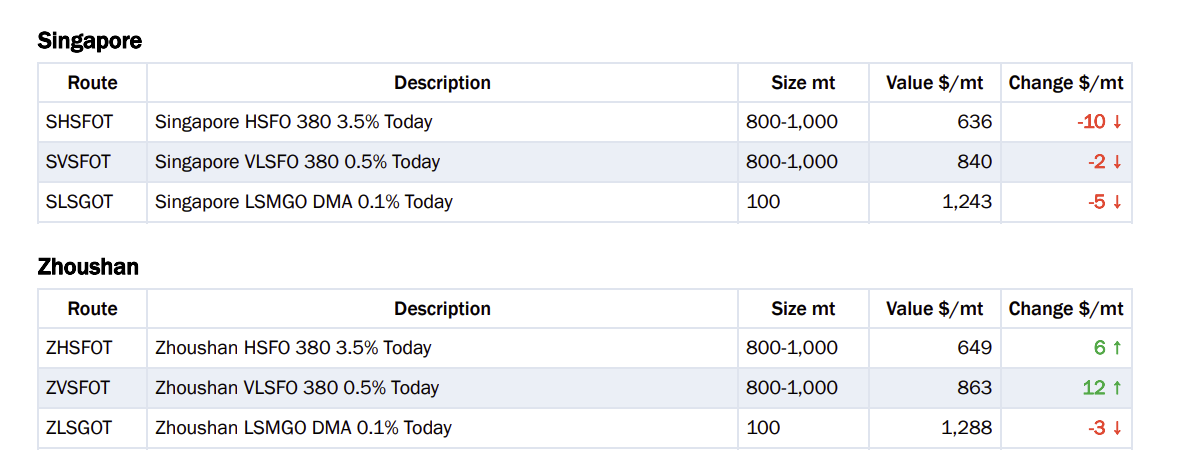
Despite relatively low bunker demand in Singapore, the availability of VLSFO for very prompt dates (0-2 days) remains limited, with certain suppliers recommending lead times of 6-8 days. Some suppliers can accommodate stems for very prompt dates, but these are typically priced about $20-25/mt higher than for dates further out, according to a trader. Similarly, prompt supply of HSFO is under pressure, with lead times ranging from 6-12 days, slightly up from the previous week. Lead times for LSMGO vary between 2-9 days, maintaining consistency with the previous week’s figures.

Enterprise Singapore’s latest data indicates that residual fuel oil stocks in Singapore averaged 5% lower in February compared to January. Despite a 16% decline in net fuel oil imports, the port’s fuel oil stocks remained above 21 million bbls for the second consecutive month. Fuel oil exports surged by 571,000 bbls, offsetting the 244,000 bbls decline in imports and contributing to the stock draw. Conversely, middle distillate stocks in Singapore rose and averaged 27% higher in February.

In Port Klang, Malaysia, the availability of VLSFO and LSMGO remains steady, but HSFO supply is limited. On the contrary, VLSFO availability is tight in the Indonesian ports of Jakarta and Surabaya, while Balikpapan boasts a good supply of the grade.

China, East Asia and Oceania

In China’s Zhoushan, availability of all bunker fuel grades remains good, with suppliers recommending lead times of 3-5 days, similar to the previous week. However, bunkering was suspended in Zhoushan on Tuesday due to rough weather conditions. Bunker deliveries are likely to resume fully on Thursday, when calmer weather is forecast.

Conversely, Dalian is experiencing constrained availability of VLSFO and LSMGO, while Tianjin is facing tightness across all fuel grades. Qingdao is encountering limited availability for prompt delivery of VLSFO and LSMGO, with HSFO supply being subject to inquiry. In southern ports like Shanghai and Guangzhou, VLSFO and LSMGO availability is tight, with HSFO also encountering constraints in Shanghai. However, Fuzhou, Yangpu, and Xiamen are reporting ample availability of both low-sulfur fuel grades.

In Hong Kong, bunker fuel supply remains good amid average demand. Most suppliers recommend lead times of approximately seven days, consistent with the previous week. However, high winds and waves are forecast in the port over the weekend, which might impact bunker operations at the port.

LSMGO demand has climbed in several South Korean ports, partly because the grade’s prices in South Korea have been lower compared to nearby Chinese ports. Busan’s LSMGO price was at a discount of $28/mt to Zhoushan’s on Tuesday. Increased LSMGO demand has caused availability constraints and pushed lead times to nearly nine days in South Korean ports. Some suppliers can still offer stems for prompt delivery, but these are typically priced higher, a source says.

On the other hand, VLSFO and HSFO availability have improved in South Korean ports. Lead times for VLSFO and HSFO have decreased to 4-8 days and around two days, respectively, from 8-14 days last week. However, rough weather is forecast throughout this week and may impact bunkering in the South Korean ports of Ulsan, Onsan, Busan, Daesan, Taean and Yeosu.

In Japan, sluggish bunker demand persists due to high prices and limited cargo availability, which has been further exacerbated by adverse weather conditions. Tokyo’s VLSFO was priced about $68/mt higher than Zhoushan’s on Tuesday and $66/mt higher than Singapore’s. Lead times vary across key Japanese ports, ranging from 5-8 days in Tokyo, Chiba, Osaka, and Kobe, to longer periods of 11-15 days in Nagoya, Yokkaichi, Mizushima, and Oita.

Furthermore, adverse weather forecasts for Subic Bay in the Philippines, Ho Chi Minh in Vietnam, and Tauranga in New Zealand towards the end of the week have raised concerns about potential disruptions to bunkering operations in these ports.

South Asia

Several ports across India, including Kandla, Chennai, Visakhapatnam and Haldia, are facing challenges due to shortages of VLSFO and LSMGO.

Mumbai, Cochin, and Paradip are particularly affected, with some suppliers on the verge of depleting their stocks of VLSFO and LSMGO. A supplier in Tuticorin, situated on the southeast coast of India, is also running low on VLSFO.

In contrast, the supply situation in the Sri Lankan port of Trincomalee appears stable, with normal availability of all grades of fuel and lead times of seven days recommended.

Middle East

Numerous shipping companies persist in avoiding transits through the Red Sea due to escalating attacks by Houthi rebels on commercial vessels in the area. Instead, many of these ships have been opting for the longer route around Africa, bypassing the shorter Suez Canal route. This alteration in shipping routes is gradually affecting the demand for bunker fuel in Fujairah.

Despite a slight decrease in demand, prompt availability remains tight in Fujairah due to ongoing weather-related disruptions, which have caused bunker backlogs. Suppliers suggest lead times of 7-10 days, though some can still provide quick deliveries. Similar supply constraints are noticed in the UAE port of Khor Fakkan, with most suppliers recommending lead times of 7-10 days.

However, in the Saudi Arabian port of Jeddah, both VLSFO and LSMGO are readily available. Conversely, some suppliers in Djibouti are running out of VLSFO supply, while can still supply LSMGO.

Meanwhile, Omani ports of Sohar, Salalah, Muscat, and Duqm have sufficient supply of LSMGO, with prompt delivery dates available.

By Tuhin Roy


Photo credit and source: ENGINE
Published: 6 March 2024

Continue Reading

Bunker Fuel

ENGINE: East of Suez Fuel Availability Outlook (22 July 2026)

Availability tight across all grades in Singapore; bad weather keeps bunkering halted in Zhoushan’s outer anchorages; availability good across several Sri Lankan ports.

Admin

Published

on

By

RESIZED ENGINE East of Suez

The following article regarding regional bunker fuel availability outlook for the East of Suez region has been provided by online marine fuels procurement platform ENGINE for publication on Singapore bunkering publication Manifold Times:
  • Availability tight across all grades in Singapore
  • Bad weather keeps bunkering halted in Zhoushan’s outer anchorages
  • Availability good across several Sri Lankan ports

Singapore and Malaysia

VLSFO availability in Singapore remains tight, with recommended lead times at 14-19 days, largely unchanged from last week. Tightness persists because Singapore’s fuel oil inventories have yet to recover to pre-conflict levels, while cargo arrivals remain constrained due to renewed US-Iran hostilities disrupting traffic through the Strait of Hormuz.

According to the latest Enterprise Singapore data, fuel oil stocks dropped below 18 million bbls in June from more than 23 million bbls in March. Inventories have also remained below 20 million bbls so far this month.

The lower inventory levels have tightened VLSFO supply, lending support to the benchmark price.

HSFO availability also remains tight, with recommended lead times of 9-13 days, compared with 10-12 days a week ago. LSMGO supply has tightened further, with lead times widening to 9-11 days from 6-9 days last week.

In Malaysia’s Port Klang, bunker fuel availability remains tight. VLSFO supply is constrained for prompt stems, while LSMGO availability also remains limited. HSFO continues to face supply pressure.

East Asia

Despite softer demand, VLSFO availability in Zhoushan has tightened, with recommended lead times extending to around 12 days, up from about eight days previously. A source attributed the longer waiting times to limited refinery supply.

Lead times for both LSMGO and HSFO have also lengthened to around seven days, compared with about five days last week.

Meanwhile, bunkering operations at Zhoushan’s outer Tiaozhoumen and Xiazhimen anchorages have remained suspended since 7 July due to adverse weather. Most suppliers are still uncertain about when normal bunker operations across the port will fully resume, the source added.

Bunker fuel availability across northern China remains mixed. Suppliers in Dalian and Qingdao have ample stocks of VLSFO and LSMGO, although HSFO availability in Qingdao remains limited. In Tianjin, all major bunker grades continue to face supply constraints, while VLSFO and HSFO remain tight in Shanghai. LSMGO availability in Shanghai, however, is relatively stable.

Supply constraints also persist across several southern Chinese ports. Both VLSFO and LSMGO remain tight in Fuzhou. Xiamen has sufficient VLSFO availability but tighter LSMGO supply, while both grades remain constrained in Yangpu and Guangzhou.

Hong Kong’s bunker market remains steady, with recommended lead times for all major bunker grades holding at around seven days, broadly unchanged from recent weeks.

In Taiwan, state-owned bunker supplier CPC Corporation (CPC) has temporarily stopped accepting new LSMGO nominations for deliveries at Kaohsiung due to a tight barge schedule.

According to a source, LSMGO deliveries have been suspended since last Friday and will remain on hold until CPC clears its backlog of pending orders.

The disruption has also affected VLSFO supply in Kaohsiung, with recommended lead times increasing to 4-5 days from around three days last week.

Elsewhere in Taiwan, bunker availability remains stable. Recommended lead times for both VLSFO and LSMGO are around two days in Hualien, while Keelung and Taichung continue to record lead times of about three days, broadly unchanged from the previous week.

Bunker fuel availability has tightened across South Korea’s southern ports, including Busan, Ulsan, Masan, Onsan, Yeosu and Kwangyang. Recommended lead times for both VLSFO and LSMGO have increased to 9-16 days, from 4-12 days last week. HSFO has also tightened, with lead times extending to 9-16 days from 4-12 days a week earlier.

In South Korea’s western ports—including Incheon, Daesan, Dangjin, Pyeongtaek and Taean—recommended lead times for VLSFO and LSMGO remain at 9-16 days, largely unchanged from last week. HSFO availability has tightened, with lead times rising to 9-16 days from 4-12 days previously.

Weather-related disruptions are expected to affect bunker operations in Daesan on 21 and 23 July.

Supply remains constrained at major Japanese ports, including Tokyo, Chiba, Kawasaki, Kashima, Nagoya, Yokkaichi, Osaka, Kobe, Mizushima and Oita. VLSFO and LSMGO continue to be offered by only a limited number of suppliers, while HSFO is relatively more accessible, with recommended lead times of around 7-10 days.

In contrast, Indonesia’s bunker market remains comfortably supplied. VLSFO availability is stable across Jakarta, Surabaya, Balikpapan and Cigading, where suppliers are generally recommending lead times of around 2-3 days.

Oceania

VLSFO availability remains stable in Western Australia, with suppliers in Kwinana and Fremantle generally recommending lead times of around seven days. Bunkering at both ports is handled by a single supplier, with all deliveries carried out by barge.

Supply conditions are more mixed along Australia’s east coast. In Port Kembla, VLSFO can be supplied via truck or pipeline, while suppliers in Sydney maintain adequate stocks of both VLSFO and LSMGO. HSFO remains comparatively tighter in Sydney, where suppliers typically require around seven days of advance notice.

In Queensland, VLSFO and LSMGO availability remains good in Brisbane and Gladstone, with recommended lead times also holding at around seven days.

Further south, suppliers continue to maintain healthy VLSFO inventories in Melbourne and Geelong. However, bunker deliveries at both ports depend on a single barge, keeping lead times at about one week. HSFO supply has tightened further in both Melbourne and Brisbane.

Meanwhile, one supplier is offering all major bunker grades in Brisbane, Sydney and Melbourne with lead times of around five days. In Dampier, bunker deliveries continue to be conducted through truck-assisted pipeline operations, making advance planning and berth confirmation particularly important, according to a market source.

Across the Tasman Sea, bunker fuel availability remains broadly unchanged in New Zealand. VLSFO is readily available in Tauranga and Auckland, where suppliers recommend lead times of around four days. At Marsden Point, both VLSFO and LSMGO can be supplied directly to vessels through pipeline infrastructure.

Weather continues to present operational risks across New Zealand. Bunker deliveries remain particularly susceptible to disruption in Wellington and ports across the South Island, where adverse weather can periodically interrupt supply operations.

South Asia

Recommended lead times for VLSFO and LSMGO at India’s west coast ports of Kandla, Sikka, Pipavav, Dahej and Hazira remain at 3–4 days, according to a source.

The monsoon is expected to disrupt bunker operations at several Indian ports over the coming days, with weather-related delays likely to affect delivery schedules. Bunkering is forecast to face disruptions at Kandla and Sikka between 20–24 July, while rough sea conditions could hamper operations in Mumbai, Cochin and Visakhapatnam during the same period.

In Sri Lanka, bunker market conditions remain stable, with adequate stocks of all major bunker fuel grades in Colombo and Hambantota. One supplier is recommending lead times of around seven days, almost unchanged from last week.

Adverse weather could also intermittently disrupt bunker operations in Colombo between 20–24 July and in Trincomalee between 20–23 July, potentially delaying bunker deliveries.

Middle East

Despite escalating US-Iran hostilities in the Strait of Hormuz, bunker fuel availability has improved in Fujairah. VLSFO and LSMGO supply has eased, with several suppliers now able to accommodate prompt delivery requests. HSFO availability, however, has tightened and is largely being offered only on a firm enquiry basis.

Similar supply conditions are being reported at the neighbouring UAE bunker hub of Khor Fakkan.

In Jeddah, VLSFO and LSMGO availability remains relatively stable.

In Qatar’s Ras Laffan, VLSFO and LSMGO supply continues to be constrained.

At Port Suez in Egypt, HSFO inventories remain tight, while VLSFO stocks are close to depletion.

Further south, the availability of all major bunker fuel grades remains limited in Djibouti.

By Tuhin Roy


Photo credit and source: ENGINE
Published: 22 July, 2026

Continue Reading

Alternative Fuels

ENGINE on Fuel Switch Snapshot: LSMGO surges to greater premium over biofuel

B100 discount to LSMGO widens to $541/mt in Rotterdam; Singapore’s B100 drops to $106/mt below LSMGO; Rotterdam LBM at $639-833/mt discounts to LSMGO.

Admin

Published

on

By

ENGINE on Fuel Switch Snapshot: LSMGO surges to greater premium over biofuel

Once a week, bunker intelligence platform ENGINE will publish a snapshot of alternative and conventional bunker fuel prices in the world’s two biggest bunkering hubs. The following is the latest snapshot:

20 July 2026

  • B100 discount to LSMGO widens to $541/mt in Rotterdam
  • Singapore’s B100 drops to $106/mt below LSMGO
  • Rotterdam LBM at $639-833/mt discounts to LSMGO

B100’s premium over HSFO in Rotterdam has narrowed by $50/mt over the past week to $64/mt, while its discount to VLSFO has widened by $83/mt to $105/mt.

B100 has become far more competitive against LSMGO in Rotterdam, with its discount widening by $180/mt over the past week to $541/mt, as a surge in conventional fuel prices left B100 broadly unchanged by comparison.

B100’s price has risen by $109/mt in Singapore, but its discount to LSMGO has still widened by $102/mt to $106/mt, as LSMGO surged by an even greater $211/mt.

Rotterdam’s LNG premium over VLSFO has widened by $35/mt to $201/mt for vessels with Otto medium speed (Otto MS) engines. For vessels with diesel slow speed (diesel SS) engines, LNG has flipped to a $15/mt premium over VLSFO, from a $22/mt discount the prior week.

Liquefied biomethane (LBM) discounts to VLSFO in Rotterdam have narrowed by $50-52/mt to $203-396/mt over the past week. Against LSMGO, LBM discounts have widened by $45-47/mt to $639-833/mt, depending on engine type.

In Singapore, LNG is now $42/mt cheaper than LSMGO for vessels with Otto MS engines, and $134/mt cheaper for vessels with diesel SS engines.

ENGINE on Fuel Switch Snapshot: LSMGO surges to greater premium over biofuel

Liquid fuels

HSFO and VLSFO prices in Rotterdam have jumped by $66/mt and $99/mt respectively over the past week, while LSMGO has surged by an even steeper $196/mt. A $9.69/bbl ($71/mt) rise in front-month ICE Brent futures, to $87.94/bbl ($645/mt), drove bunker prices sharply higher across the board.

Bunker fuel availability is tight for prompt delivery dates in the ARA ports, with buyers advised to enquire about stems between 5-7 days ahead to get good coverage, a trader said.

Rotterdam’s B100 price has risen by $16/mt over the past week. Dutch ZRE A ticket prices were unchanged at €107.50/mtCO2e.

Singapore’s HSFO and VLSFO prices have risen by $130/mt and $132/mt respectively, while its LSMGO price has gained an even steeper $211/mt over the past week.

VLSFO availability in Singapore has been tight, with several suppliers reporting low stock levels. Recommended lead times have widened from 13–17 days last week to 14–19 days now.

Liquid gases

Rotterdam’s LNG prices have surged by $134-136/mt over the past week, while its LBM prices have climbed by $149-151/mt.

LBM discounts to LNG in Rotterdam have narrowed by $15/mt to $404-411/mt.

Singapore’s LNG bunker benchmarks have surged by $196-197/mt over the past week.

By Erik Hoffmann


Photo credit and source: ENGINE
Published: 21 July, 2026

Continue Reading

Bunker Fuel

ENGINE: Americas Fuel Availability Outlook (16 July 2026)

Moderate sea fog to affect parts of US Gulf; Panama bunker supply steady; tight VLSFO and LSMGO supply in Rio Grande.

Admin

Published

on

By

RESIZED ENGINE Americas

The following article regarding bunker fuel availability in the Americas region has been provided by online marine fuel procurement platform ENGINE for post on Singapore bunkering publication Manifold Times:

  • Moderate sea fog to affect parts of US Gulf
  • Panama bunker supply steady
  • Tight VLSFO and LSMGO supply in Rio Grande

North America

In Houston, bunker availability is normal across all three conventional fuel grades. Recommended lead times are about 5-7 days for VLSFO and HSFO, while LSMGO has typically taken 4-5 days over the past week, a trader tells ENGINE.

At the Galveston Offshore Lightering Area (GOLA), deliveries are continuing on a first-come, first-served basis, subject to weather conditions.

Currently, no major operational disruptions have been reported at the anchorage.

Sea fog is not expected to cause widespread bunker disruptions across the US Gulf Coast, with most major ports forecast to maintain good visibility.

Moderate sea fog could affect Pascagoula and Mobile early next week, while Tampa faces the highest risk of reduced visibility between 20-22 July.

Brief visibility restrictions are also forecast at Venice, Louisiana, while conditions are expected to remain favourable at Houston, Galveston, Freeport, Corpus Christi, Port Arthur, Lake Charles, Port Fourchon and New Orleans.

The Atlantic hurricane season is underway, and the US National Hurricane Center (NHC) has issued an advisory for Tropical Storm Elida in the Eastern Pacific. Marine warnings are also in effect across parts of the Caribbean, southwest Atlantic and Eastern Pacific.

Bunker demand on the US East Coast at the port of New York is good, with healthy availability of HSFO and VLSFO.

Most suppliers can deliver both grades within 5 days, and LSMGO requires 2-4 days.

In New York, periods of high wind gusts are forecast through 19 July.

While no backlog congestion has been reported, suppliers may require standby tugs under poor weather conditions, which could slow bunker barge movements, a source said.

On the West Coast, bunker demand has remained normal in Los Angeles and Long Beach, where suppliers recommend lead times between 8-10 days across all conventional grades.

In Vancouver, recommended lead times are 5-7 days for HSFO and 6-8 days for VLSFO and LSMGO, a source said.

Latin America and the Caribbean

Bunker availability is stable in Panama’s Balboa and Cristobal ports. Recommended lead times are 3-5 days for VLSFO and LSMGO, and HSFO requires around 7 days, a source said.

No major congestion or weather-related disruptions have been reported at the ports.

At Balboa, deliveries are being made on a first-come, first-served basis, subject to weather conditions, with priority given to vessels holding confirmed Panama Canal transit schedules.

Weather conditions could temporarily affect operations at several Caribbean bunkering locations.

In Freeport, Bahamas, bunker operations continue normally. Cruise vessels are given priority at the port, and no significant congestion or weather-related disruptions have been reported.

Further east, high wind gusts are forecast through 19 July and could delay bunker operations at St. Eustatius, where deliveries are conducted at anchorage.

Offshore bunkering in Trinidad may also experience delays during the same period because of high winds and rough seas.

Brazil continues to present a mixed supply of bunker fuels.

Santos this week offers normal availability for VLSFO and LSMGO, although port congestion persists, a trader tells ENGINE. Recommended lead times are 5-8 days at the port.

Rio de Janeiro also has normal VLSFO availability and requires lead times between 4 days to one week. LSMGO is available only upon prior consultation at the port.

Availability is tighter at southern Brazilian ports. Paranaguá and Rio Grande have both reported tight VLSFO and LSMGO availability, and operators are advised to plan bunker stems well in advance.

Belém and Vila do Conde continue to offer normal availability of both grades, with lead times between 4-7 days, a source said.

In Argentina’s Zona Común, VLSFO and LSMGO availability is good, with suppliers typically taking between 5-7 days of lead time to deliver via barges, a source said.

Weather conditions could become less favourable between 19-20 July, when high wind gusts are forecast. Deliveries will continue on a first-come, first-served basis, subject to weather conditions.

By Gautamee Hazarika


Photo credit and source: ENGINE
Published: 17 July, 2026

Continue Reading

Trending