Connect with us

Environment

World Fuel Services to join new zero emissions shipping coalition

Getting to Zero Coalition launched by World Economic Forum, Global Maritime Forum, Friends of Ocean Action.


Admin

Published

on

5d89826a25ac7 1569292906

New York-listed oil and bunker trading firm World Fuel Services (WFS) on Monday (23 September) said it has joined a new environmental shipping alliance called “Getting to Zero Coalition”.

The group consists of private and public stakeholders within the maritime, energy, infrastructure and finance sectors focused on developing the fuels, energy solutions and technology necessary to develop commercially viable zero emission vessels by 2030.

“We are pleased to be participating in the Getting to Zero Coalition as we join forces with other maritime industry leaders to make a positive impact on our global community,” said Michael J. Kasbar, chairman and chief executive officer of WFS.

“We are committed to leveraging our technical expertise and global logistics capabilities to serve the maritime industry in furthering decarbonization efforts and working together towards zero emissions for a sustainable future.”

The Getting to Zero Coalition was launched on Monday by the World Economic Forum, Global Maritime Forum, Friends of Ocean Action at the United Nations Climate Action Summit.

The Getting to Zero Coalition is part of the Mission Possible platform, an alliance of experts, businesses and policy partners focused on helping seven key sectors – shipping, aviation, heavy-duty road transport, aluminium, chemicals, cement and concrete, and iron and steel – achieve climate neutrality by 2050.

“The Forum is committed to helping those industries that face the greatest challenges in meeting the Paris Climate Goals achieve net zero emissions. This goal will only be achieved if we can adopt a system-wide approach, and through the commitment of both the public and private sectors to prioritize long-term vision of short-term expedience,” said Dominic Waughray, Managing Director, Head of the Centre for Global Public Goods, World Economic Forum.

The ambition of the Getting to Zero Coalition is closely aligned with the UN International Maritime Organization’s strategy on the reduction of greenhouse gases. The strategy prescribes that international shipping must reduce its total annual greenhouse gas emissions by at least 50% of 2008 levels by 2050, while pursuing efforts to phasing them out as soon as possible this century. This will align greenhouse gas emissions from international shipping with the Paris Agreement targets.

“A healthy ocean is key to achieving the UN 2030 Sustainable Development Agenda, and the Getting to Zero Coalition is an important move in the right direction. Business as usual will not get us where we need to be to achieve sustainability – so it is very encouraging to see hard-to-abate sectors like global seaborne trade boldly stepping up to chart this new course. Let us all support the continued development of cleaner technologies and new fuel solutions,” said Peter Thomson, the UN Secretary-General’s Special Envoy for the Ocean and Co-Chair, Friends of Ocean Action.

Industry partners of the Getting to Zero Coalition range from Mærsk and Shell to Citigroup and Cargill, while knowledge partners include Environmental Defense Fund, University College London and the Energy Transitions Commission.

“Energy efficiency has been an important tool which has helped us reduce CO? emissions per container by 41% over the last decade and position ourselves as a leader 10% ahead of the industry average. However, efficiency measures can only keep shipping emissions stable, not eliminate them. To take the next big step change towards decarbonization of shipping, a shift in propulsion technologies or a shift to clean fuels is required which implies close collaboration from all parties. The coalition launched today is a crucial vehicle to make this collaboration happen,” said Søren Skou, Chief Executive Officer, A.P. Møller-Mærsk.

Getting to Zero Coalition members
Cargill, Lloyd’s Register, Trafigura, American Bureau of Shipping (ABS), Anglo-Eastern, Berge Bulk, Caravel Group, Danske Bank, Gard, Forward Ships, KC Maritime, Kuehne + Nagel, MAN Energy Solutions, Marine Capital, MISC, Port of Aarhus, RightShip, Siemens Gamesa, Skuld, Snam, The China Navigation Company, Torvald Klaveness, Tufton Oceanic, Unilever, Vestas, World Fuel Services, Wärtsilä Corporation, ZIM Integrated Shipping Services

Knowledge partners
Environmental Defense Fund
Energy Transitions Commission
University College London (UCL) and University Maritime Advisory Services (UMAS)
Sustainable Shipping Initiative (SSI)

Supported by
International Renewable Energy Agency (IRENA)
Global Infrastructure Facility (GIF)
United Nations Conference on Trade and Development (UNCTAD)
North American Marine Environment Protection Association (NAMEPA)

Getting to Zero Coalition partners
Global Maritime Forum
Friends of Ocean Action
World Economic Forum

Photo credit: World Economic Forum
Published: 24 September, 2019


Continue Reading

Methanol

GENA Solutions: Total renewable and low-carbon methanol project pipeline increases from 61.8 to 62.2 Mt by 2032

Information shared by MI – the Global Methanol Alliance meant to assist the maritime industry in the adoption of methanol as a mainstream marine fuel heading into IMO 2030/2050.
Admin

Published

on

By

28 1

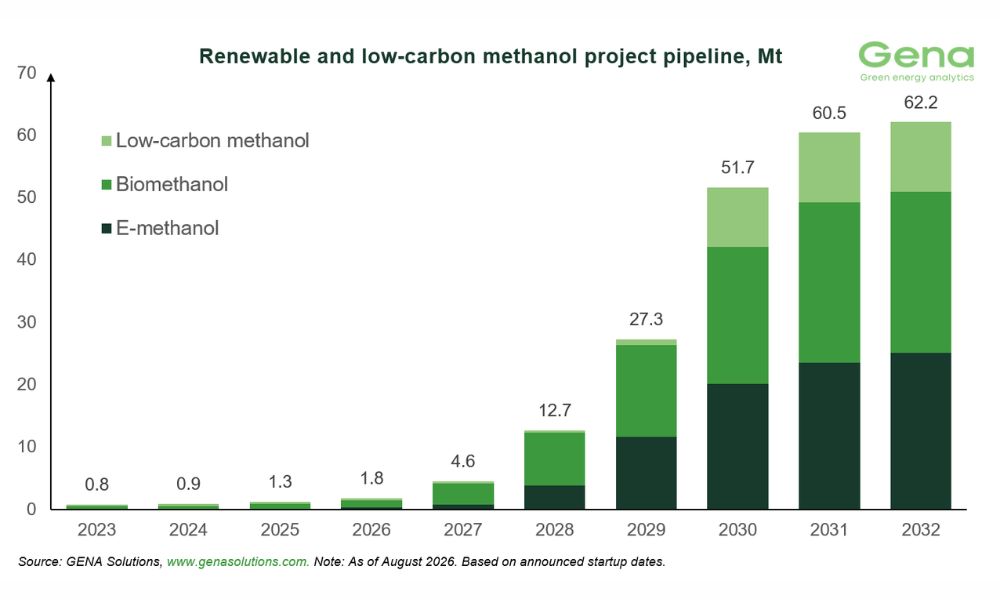
MI – the Global Methanol Alliance recently shared with Manifold Times the renewable and low-carbon methanol project pipeline August 2026 release produced by GENA Solutions Oy.

Information from the release is meant to provide the bunkering publication’s readers with insight on renewable methanol availability, and to assist the maritime industry in the adoption of methanol as a mainstream marine fuel heading into IMO 2030/2050.

Key takeaways from GENA’s August 2026 Methanol release are as follows:

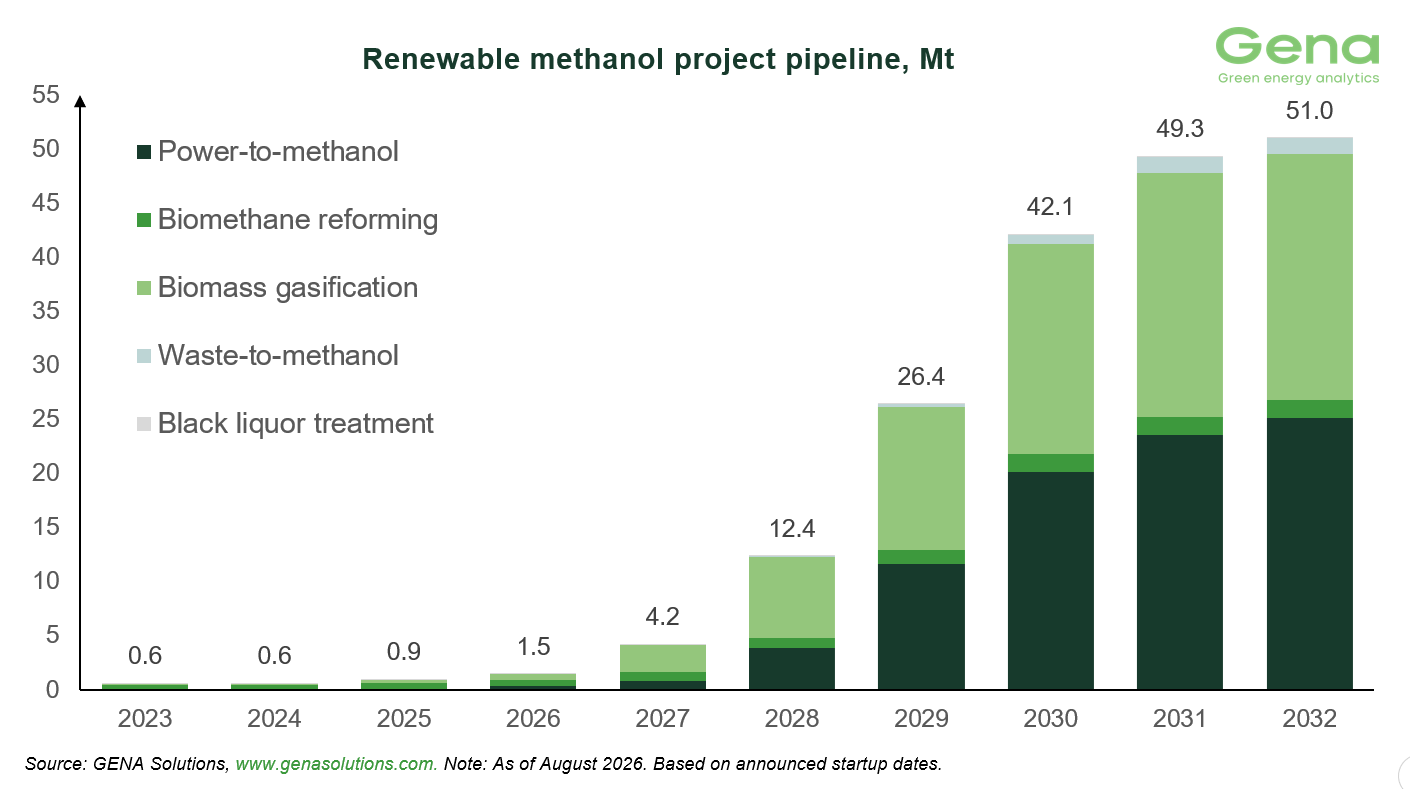
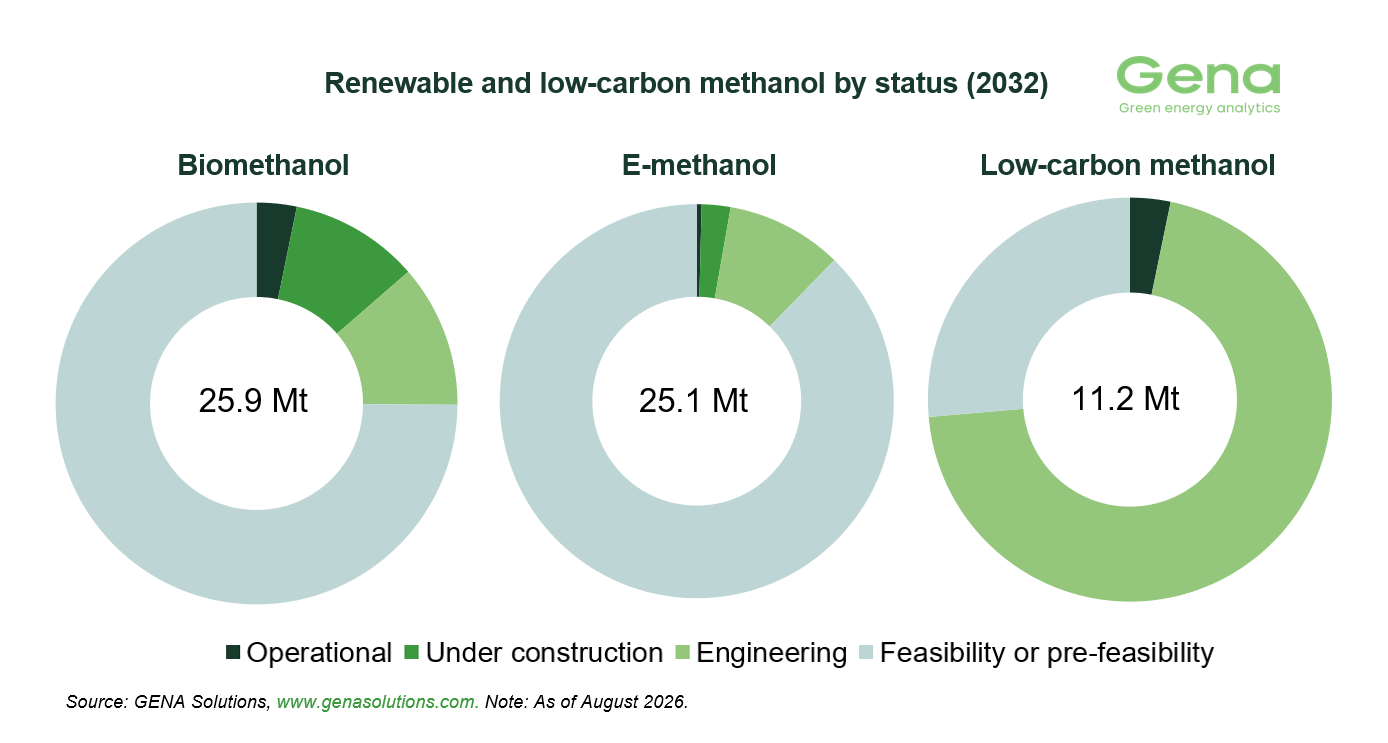
  • As of the end of August 2026, GENA tracks 286 renewable and low carbon methanol projects, representing 62.2 Mt of capacity by 2032. This includes 25.1 Mt of e-methanol, 25.9 Mt of biomethanol, and 11.2 Mt of low carbon methanol capacity.
  • Two new projects were added to Project Navigator last month, while one frozen project was excluded. The project pipeline increased by 0.4 Mt month on month.
  • Four new offtake agreements were registered during August, including two biomethanol and two e-methanol agreements.
  • About 8% of the cumulative renewable methanol project pipeline capacity has reached FID so far, with another 11% at the FEED stage.
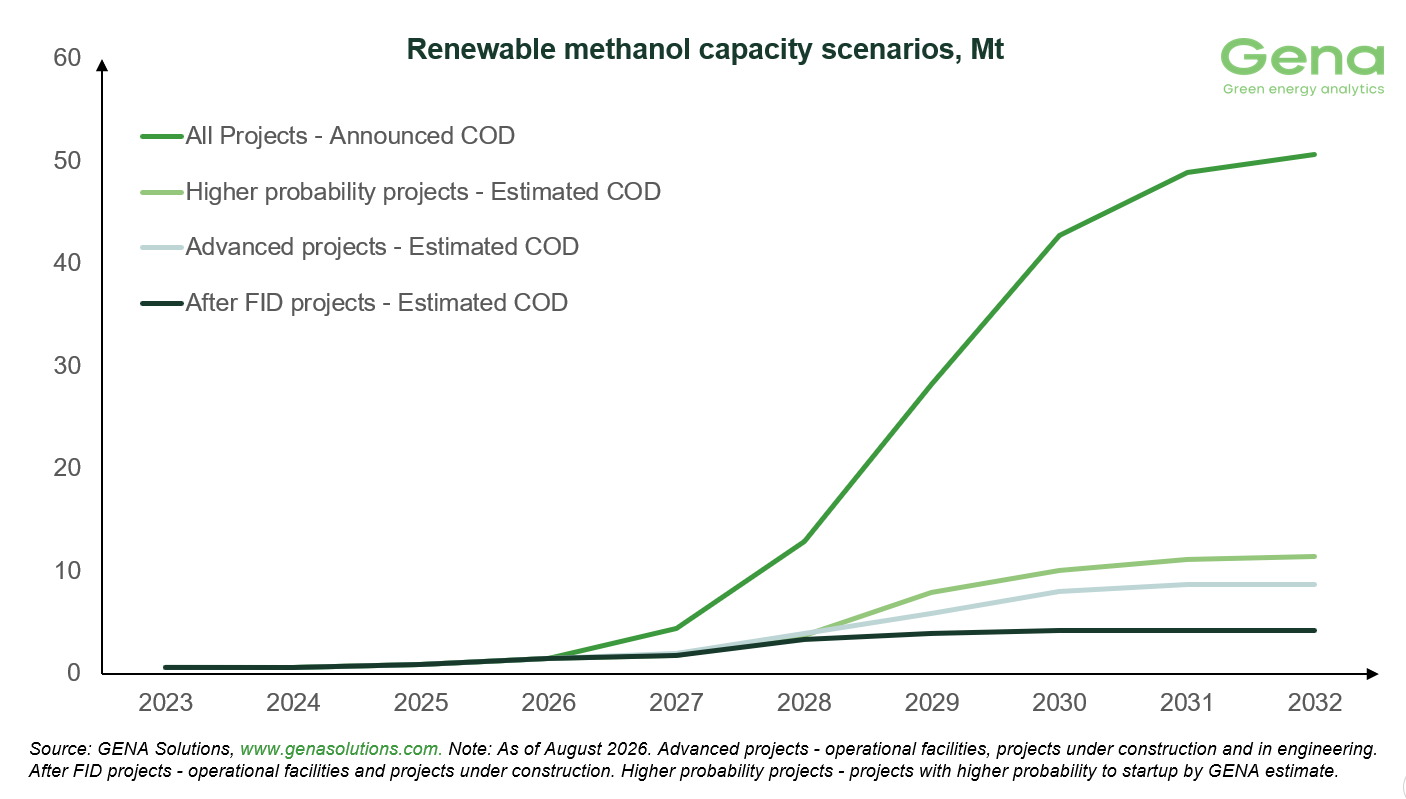
  • Considering the current uncertainty around regulatory developments and demand growth, GENA projects that renewable methanol capacity could reach 6 Mt to 12 Mt by 2031.

Note: The full article can be viewed here.
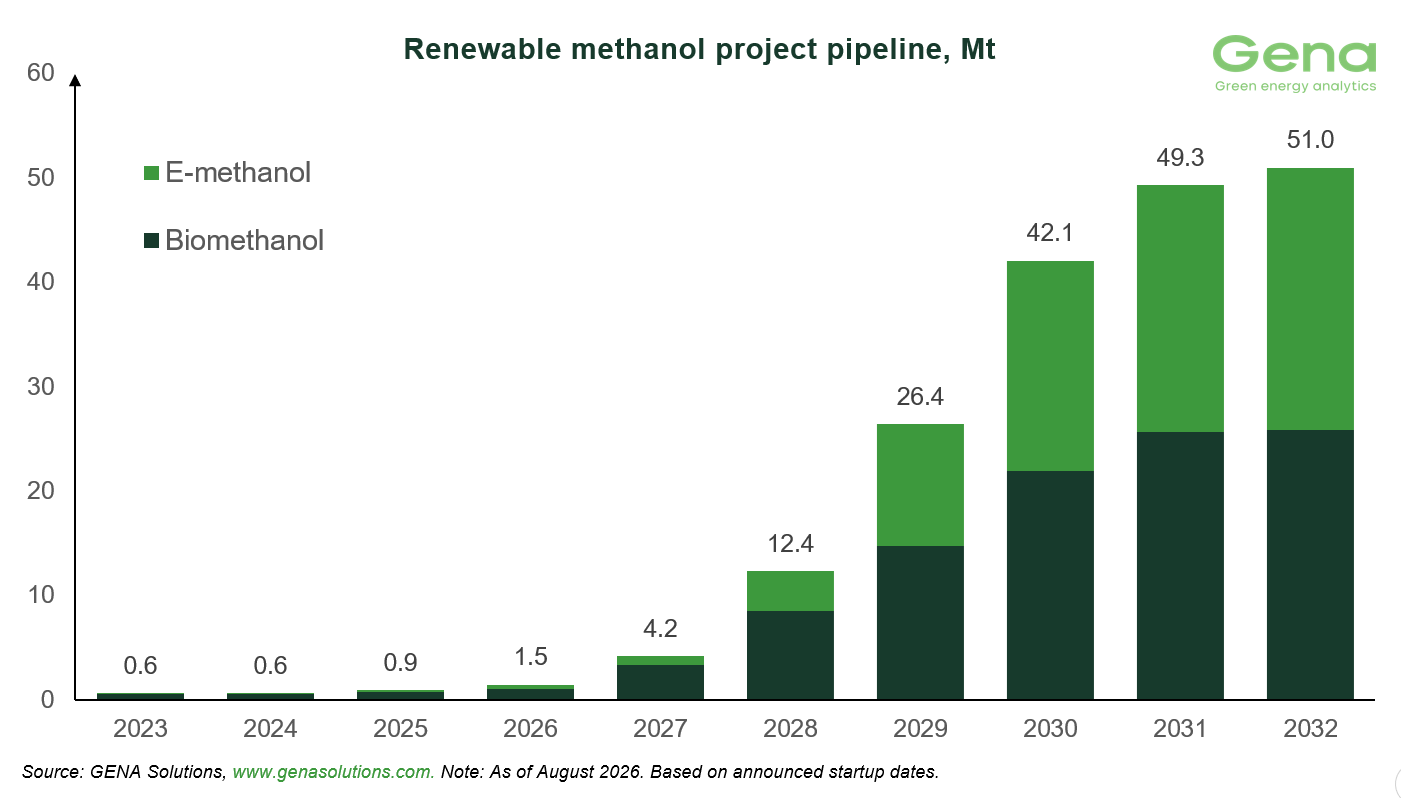
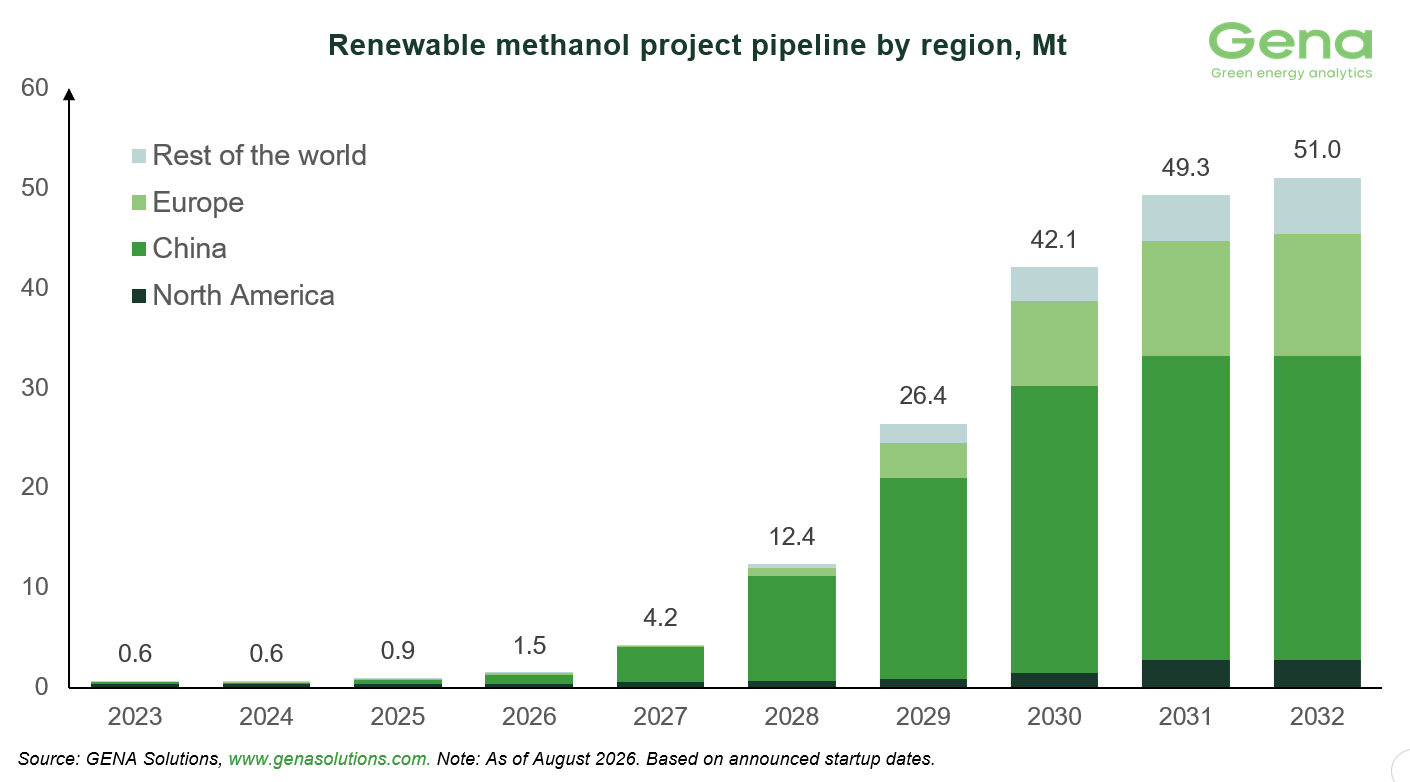
Renewable methanol project pipeline 4 Renewable methanol by feedstock 8 Renewable methanol by region 7 Project pipeline by status Methanol capacity scenarios


Photo credit: GENA Solutions
Published: 4 September, 2026

Continue Reading

Business

Singapore: MPA urges maritime firms to prepare for potential haze with plan

MPA encourages all maritime companies, especially those with workers performing outdoor work to maintain a business continuity plan for haze.
Admin

Published

on

By

RESIZED SG bunker tanker

The Maritime and Port Authority of Singapore (MPA) on Monday (31 August) issued Port Marine Circular No. 9 of 2026 on steps for maritime companies to take for potential haze affecting Singapore:

BUSINESS CONTINUITY PLAN FOR HAZE

This circular supersedes Port Marine Circular No. 09 of 2023.

With reference to the National Environment Agency’s (NEA) joint media release issued on 9 August 2026, hotspots were observed in parts of Sumatra and Kalimantan, with prevailing winds potentially bringing smoke haze towards Singapore. The dry conditions may further increase the likelihood of haze affecting Singapore. The Maritime and Port Authority of Singapore (MPA) encourages all maritime companies, especially those with workers performing outdoor work to maintain a business continuity plan for haze.

MPA advises all maritime companies to monitor the PSI level through the media and the NEA’s website (www.haze.gov.sg), keep at least a one-week supply of N95 masks for workers especially those who work outdoors, and observe the Ministry of Manpower’s (MOM) Haze guidelines and advisory for work which can be found on their website (www.mom.gov.sg/haze). The latter include guidelines to ensure that stocks of N95 masks are periodically inspected, remain serviceable, and not expired.

The visibility in the Singapore Strait and port waters could be significantly reduced in the event of haze. During periods of restricted visibility, shipmasters are advised to keep a proper lookout and navigate with caution. They are also advised to comply with the International Regulations for Preventing Collisions at Sea and in particular Rule No. 19, Rule No. 20 and Rule 35 concerning conduct of vessels in restricted visibility, exhibition of navigation lights and sound signals in restricted visibility, respectively.

In the interest of safety of navigation and life at sea, the Port Master may restrict the movement of harbour craft and pleasure craft in the port waters during reduced visibility conditions.


Photo credit: Manifold Times
Published: 31 August, 2026

Continue Reading

Alternative Fuels

DNV report: Regulatory uncertainty demands fleet strategies built for multiple futures

Report examines four regulatory scenarios, ranging from adoption of IMO NZF in its current form to its outright rejection, energy efficiency uptake, and long-term bunker fuel and technology strategies.
Admin

Published

on

By

DNV report: Regulatory uncertainty demands fleet strategies built for multiple futures

Regulatory uncertainty is increasing pressure on shipowners to make investment decisions that remain viable across multiple future scenarios, said classification society DNV on Thursday (27 August). 

According to DNV’s 10th Maritime Forecast to 2050, stronger global regulatory signals could accelerate the uptake of energy-efficiency measures, enabling the global fleet to consume up to 25% less energy by 2050 compared to a scenario where regulation is driven by regions.

The report examines four regulatory scenarios, ranging from adoption of the IMO Net-Zero Framework (NZF) in its current form to its outright rejection, which could lead to a period of prolonged regulatory gridlock, and explores the implications of these outcomes for fuel demand, energy efficiency uptake, and long-term fleet fuel and technology strategies.

Cristina Saenz de Santa Maria, CEO Maritime, DNV, said: “Ships ordered today will operate well beyond 2050, but many of the factors shaping their future performance remain uncertain. Regulatory requirements are advancing faster than the fuel, infrastructure, and technological systems needed to support them, making long-term investment decisions increasingly complex. The industry therefore needs greater clarity and alignment among all stakeholders to provide the confidence required for long-term investment. In the meantime, shipowners need strategies that deliver benefits today while remaining resilient across a range of regulatory and market outcomes.”

Energy efficiency is one of the most immediate and practical levers available to shipowners, delivering value across regulatory outcomes whether implemented at the newbuild stage or as a retrofit. A case study of a hydrodynamic measures retrofit on a 5,000 TEU container vessel showed potential annual fuel savings of 16%, with a payback time of around one to four years depending on future fuel prices. Retrofits can add similar value across many ship types and with sufficient planning can typically be completed during a standard class-renewal dry docking.

The development of the marine low-GHG fuel market remains a key challenge. While significant progress has been made in expanding alternative-fuel capabilities of vessels, scaling fuel production depends on confidence that demand will materialize. DNV projects shipping demand for low-GHG fuels to range from 4 to 22 Mtoe by 2030 and 33 to 185 Mtoe by 2050, depending on regulatory outcomes, with uptake also shaped by future uptake of shore power, plug-in hybridization, nuclear power, and onboard carbon capture systems.

Current project pipelines indicate a maximum global supply of 270 Mtoe by 2030, although actual volumes are likely to be lower due to project delays and other uncertainties, and shipping will need to compete with other industries for its share. However, the cost of reducing emissions varies significantly between fuel pathways, with abatement costs ranging from about 180 to 1,290 USD per tonne of CO₂ avoided, highlighting the importance of regulation and market incentives in enabling low-GHG fuel markets to develop.

Øyvind Sekkesæter, lead author of Maritime Forecast to 2050, said: “Scenarios explored in this year’s report show how different regulatory futures can lead to very different outcomes in energy efficiency uptake, fuel demand, and consequently, GHG emissions. By testing fuel and technology choices across multiple scenarios, shipowners can identify strategies that create value today while preserving flexibility as regulation, fuel availability, prices, and technologies evolve. Strategies that each owner chooses will also be dependent on their fleet type and operating context.”

Key findings from the report: 

  • Several regulatory futures remain possible as the IMO continues negotiations on the Net-Zero Framework, with these outcomes shaping investment decisions, low-GHG fuel uptake, and energy-efficiency deployment across the global fleet.
  • With global regulatory incentives in place, the world-fleet could consume 25% less energy by 2050 than under a scenario limited to regional regulations.
  • Energy efficiency can pay off regardless of regulatory outcome – 5,000 TEU container ship case study shows 16% annual fuel savings from hydrodynamic measures retrofit.
  • Shipping demand for low-GHG fuels could range from 4 to 22 Mtoe by 2030, and 33 to 185 Mtoe by 2050, depending on regulatory outcomes and the availability of these fuels in a competitive global market.
  • Current project pipelines indicate that a maximum of 270 Mtoe of supply could be available by 2030, though actual volumes are likely to be lower due to project delays and other uncertainties, and shipping will need to compete with other industries for its share.
  • Testing fuel and technology strategies across different scenarios can help shipowners identify robust choices for an uncertain transition. Testing, piloting, and verifying technologies can provide the trusted performance data needed to make investment decisions with greater confidence.

Note: DNV’s 10th Maritime Forecast to 2050 can be found here. 


Photo credit: DNV
Published: 28 August, 2026

Continue Reading
Advertisement

OUR INDUSTRY PARTNERS


Trending